
Golf Beyond America: The Global Market Map
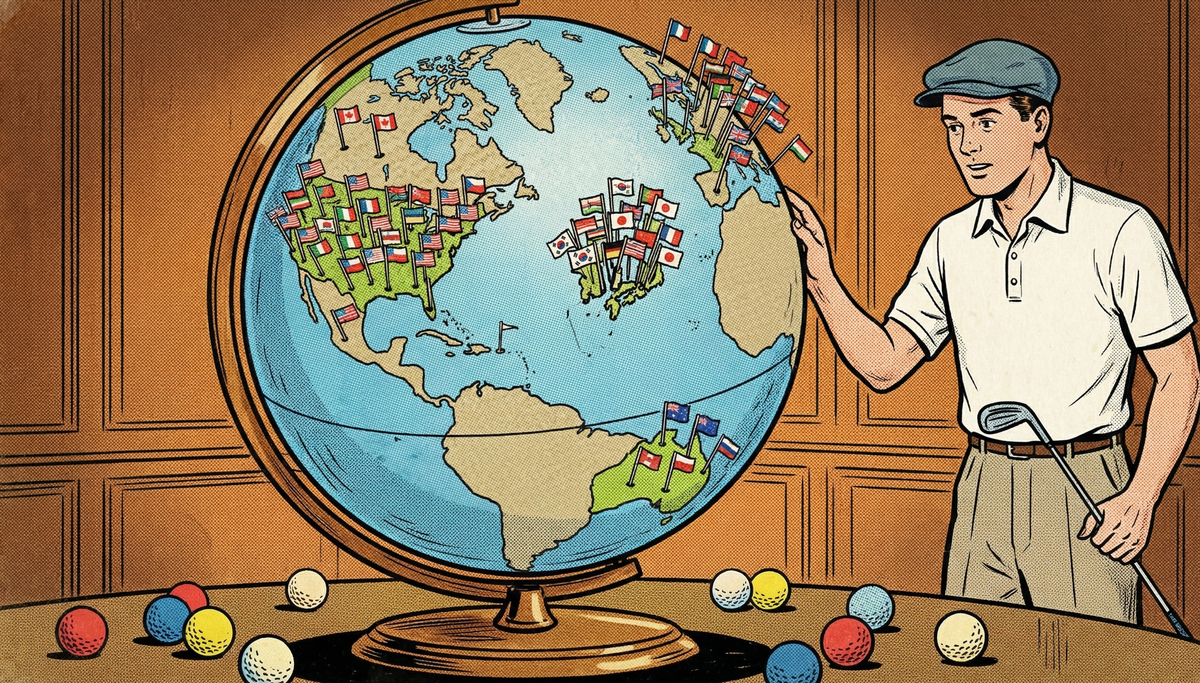
Over 100 million people play golf worldwide. The U.S. has the most golfers, but not the highest participation rate — Canada and Ireland are nearly double. South Korea has fewer courses than Florida but generates $300 million in annual equipment revenue for a single OEM. The global golf economy is not a U.S. story with international footnotes. Here is the full market map.
Golf is a $140B+ industry. Every week, Perfect Putt breaks down what's actually driving it. Welcome to the new members who've joined since our last send — you're now part of a growing community of 11,000+ golfers who follow the business of the game
Read Time: 6 minutes
Golf Beyond America: The Global Market Map
Over 100 million people participate in some form of golf worldwide. For every 100 people on the planet, 1.2 play the game. The United States has the most golfers — an estimated 26.6 million on-course participants — but it does not have the highest participation rate. Several countries are more golf-saturated than America, and the commercial implications of that fact are underappreciated.
The global golf economy is not a U.S. story with international footnotes. It is a multi-market story where the most interesting dynamics — supply constraints, equipment spend, apparel demand, and format innovation — are playing out in countries that receive a fraction of the industry's attention.
The Top Ten Markets
Outside the United States, the largest on-course golf markets by participation tell a clear story about where the global game's commercial weight sits.
Japan leads at an estimated 8.1 million on-course golfers. Canada follows at 5.6 million. South Korea at 5.4 million. England at 3.4 million. Germany at 2.1 million. Australia at 1.9 million. France at 1.5 million. Sweden at 1.1 million. Ireland at 1 million. China at 1 million.
The top three international markets — Japan, Canada, and South Korea — combine for 19.1 million on-course golfers. That is roughly 72% of the U.S. on-course base concentrated in three countries.
Participation Rate: The More Revealing Metric
Raw golfer counts favor large populations. Participation rate — the percentage of the population that plays — tells you how deeply golf is embedded in a country's recreational culture.
Canada and Ireland lead at approximately 14% — meaning for every 100 people living in each country, 14 play golf. Both are nearly double the U.S. on-course participation rate. Australia sits at just under 10%, with total adult golf engagement — on-course and off-course combined — reaching an estimated 3.5 million, or 17.6% of the population.
The countries with the highest participation rates are not the largest markets by total golfers. They are the markets where golf is most culturally embedded per capita — and where the addressable market for equipment, apparel, and services is most concentrated relative to population size.
South Korea: The Most Interesting Market in Golf
South Korea may be the single most compelling case study in the global golf economy.
The country has an estimated 5.4 million on-course golfers and 844 golf courses. That produces a ratio of approximately 6,339 golfers per course. The United States, by comparison, has roughly 15,963 courses and approximately 1,666 golfers per course. South Korea's supply constraint is nearly four times more acute than the American market.
That density explains the country's structural innovations. Night golf and screen golf did not emerge as novelty formats in South Korea — they emerged as necessary responses to a supply problem that made traditional daytime tee times inaccessible to the majority of golfers. Golfzon alone powers over 51,000 simulators in the country, with an estimated 102 million rounds played annually. More rounds of golf are played indoors than outdoors in South Korea.
The commercial output is proportional to the intensity of engagement. Acushnet recognized over $300 million in revenue from South Korea in 2023 — approximately 13% of total company revenue from a single country. According to the Wall Street Journal, South Korea is the world's largest market for golf apparel. Equipment companies are actively establishing distribution partnerships to serve the market, and golf brands from around the world are competing for shelf space in a consumer base that spends at extraordinary levels relative to its size.
The caution: the conditions that produced South Korea's indoor golf economy and its equipment spending intensity are specific to its supply-demand imbalance. Replicating screen golf or night golf formats in markets with fundamentally different supply dynamics — where tee times are available and courses are not at capacity — requires a different commercial thesis.
The Course Supply Map
Golf course counts by country reveal the infrastructure disparities that shape each market's economics.
Japan has approximately 3,090 courses. Canada: 2,530. England: 2,357. Australia: 1,568. Germany: 1,053. South Korea: 844. France: 815. Sweden: 661. China: 605. Ireland: 358.
Florida alone has 1,262 golf courses — more than South Korea, France, Sweden, China, or Ireland. Michigan has more courses than South Korea with a fifth of its population. The infrastructure gap between the U.S. and the rest of the world is substantial, and it directly influences how golfers in each market experience and spend on the game.
Markets with high golfer-to-course ratios — South Korea, Japan, China — produce different commercial behaviors than markets with abundant supply. Constrained supply drives premium pricing, off-course format adoption, and higher per-capita equipment and apparel spend as golfers invest more in the limited playing time they can access.
Australia: Following the Growth Playbook
Australia is tracking the same growth patterns that have defined the U.S. market since 2019. Over two million Australians played on a golf course last year. Junior golf memberships grew an estimated 9%. Female memberships grew an estimated 13%.
The demographic parallels to the American growth story — junior and female participation as the fastest-growing segments — suggest that the structural expansion happening in the U.S. is not a uniquely American phenomenon. The same forces — broader accessibility, off-course entry points, cultural relevance — are producing similar results in comparable developed markets.
The Professional Golf Disconnect
The PGA Tour visited Japan once and Canada once in 2023. The DP World Tour visited Japan once and South Korea once. The three largest international golf markets — representing 19.1 million on-course golfers — received a combined four professional tour events across the two major global circuits.
The correlation between professional tour presence and recreational golf participation is weak. South Korea's 5.4 million golfers and its position as the world's largest golf apparel market were not built on PGA Tour exposure. They were built on domestic infrastructure, cultural adoption, and a supply-demand dynamic that pushed golf into the mainstream of Korean recreational life.
Professional golf adds visibility and aspirational value to the sport. But the commercial health of golf in any given market is driven by participation rates, course supply, equipment distribution, and consumer spending patterns — not by how many tour events are scheduled there.
The Takeaway
The global golf market is structurally healthy and growing across most regions. Over 100 million participants worldwide. South Korea generating $300-plus million in equipment revenue for a single OEM from a country with fewer courses than Florida. Canada and Ireland with participation rates nearly double the U.S. level. Australia replicating the junior and female growth patterns that are reshaping American golf demographics.
The commercial opportunity outside the United States is not a secondary consideration. It is a primary market with distinct supply dynamics, spending patterns, and growth trajectories that are in many cases more intense than the American market on a per-capita basis. The equipment companies that understand these differences — and the investors who recognize where capital is underdeployed relative to participation intensity — are positioned to capture value that the U.S.-centric narrative consistently underestimates.
If you enjoyed this week’s newsletter, please share it with your friends!
The best way to support Perfect Putt is to subscribe and share with a friend.