
Where Margin Sits in Golf’s Supply Chain

Making a golf product and capturing its economics have become separate businesses. Margin data from the factory floor to the shop counter show who keeps the money, and the 2025–26 tariff cycle showed who absorbs the shocks.
A single driver can carry an American brand, a head made by a Taiwanese-owned manufacturer in Vietnam, a Japanese shaft, and final assembly in Mexico. Each of those steps earns something. They do not earn the same thing.
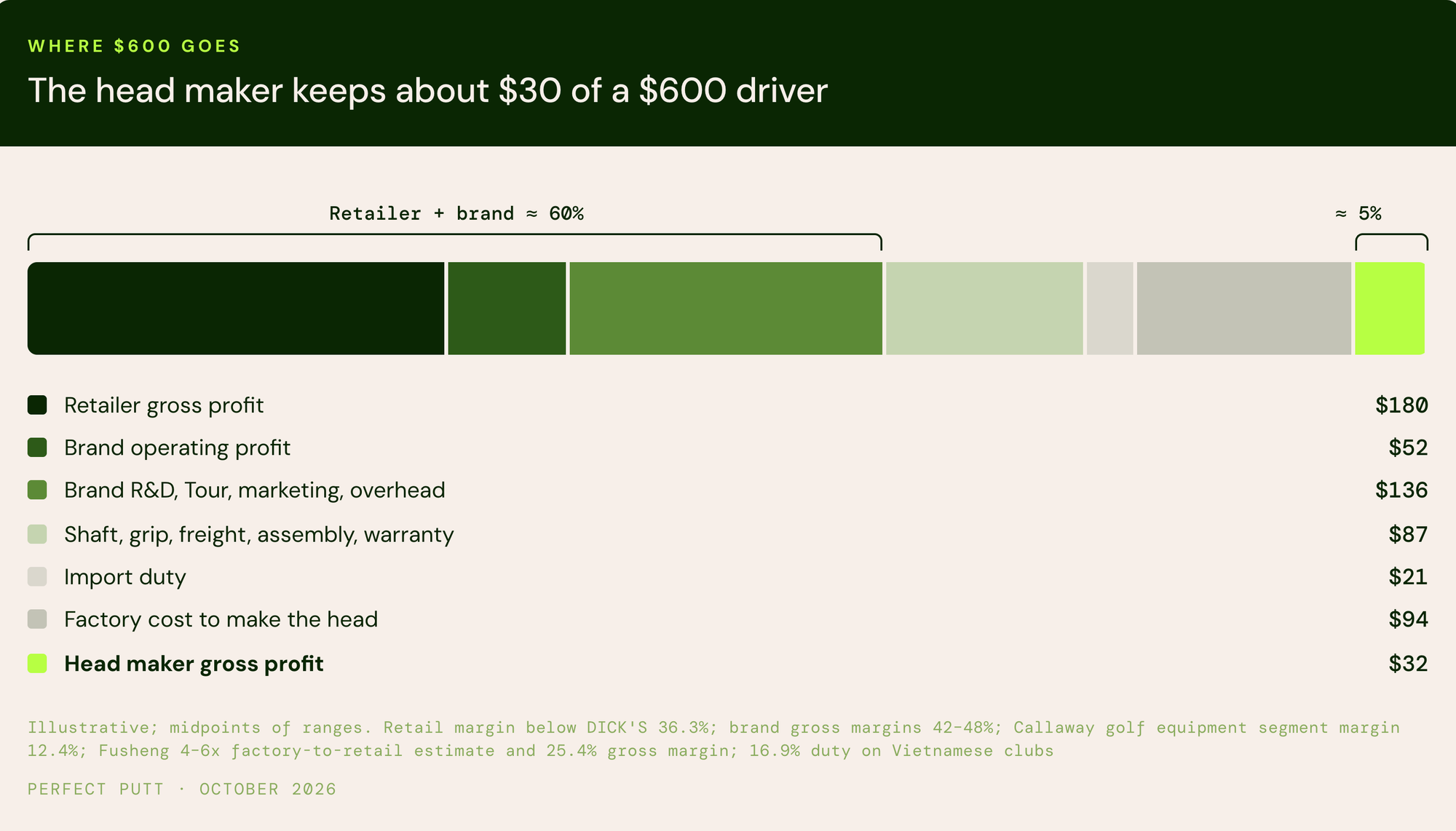
The factory that makes the head keeps roughly 5 percent of the retail price as gross profit. The brand and the retailer together keep roughly 60 percent. That gap between who makes a golf product and who keeps its economics explains more about the industry’s supply chain than any map of where production sits.
Welcome to Perfect Putt, a newsletter covering the business and economics of the golf industry. If this was forwarded to you, subscribe to join 12,000+ readers who follow how capital flows through golf.
Read Time: 7 Minutes
Who Makes It and Who Keeps It
Margins across the chain sort cleanly when compared within type. Gross, segment operating and net margin measure different things, so each comparison below stays on one line of the income statement.
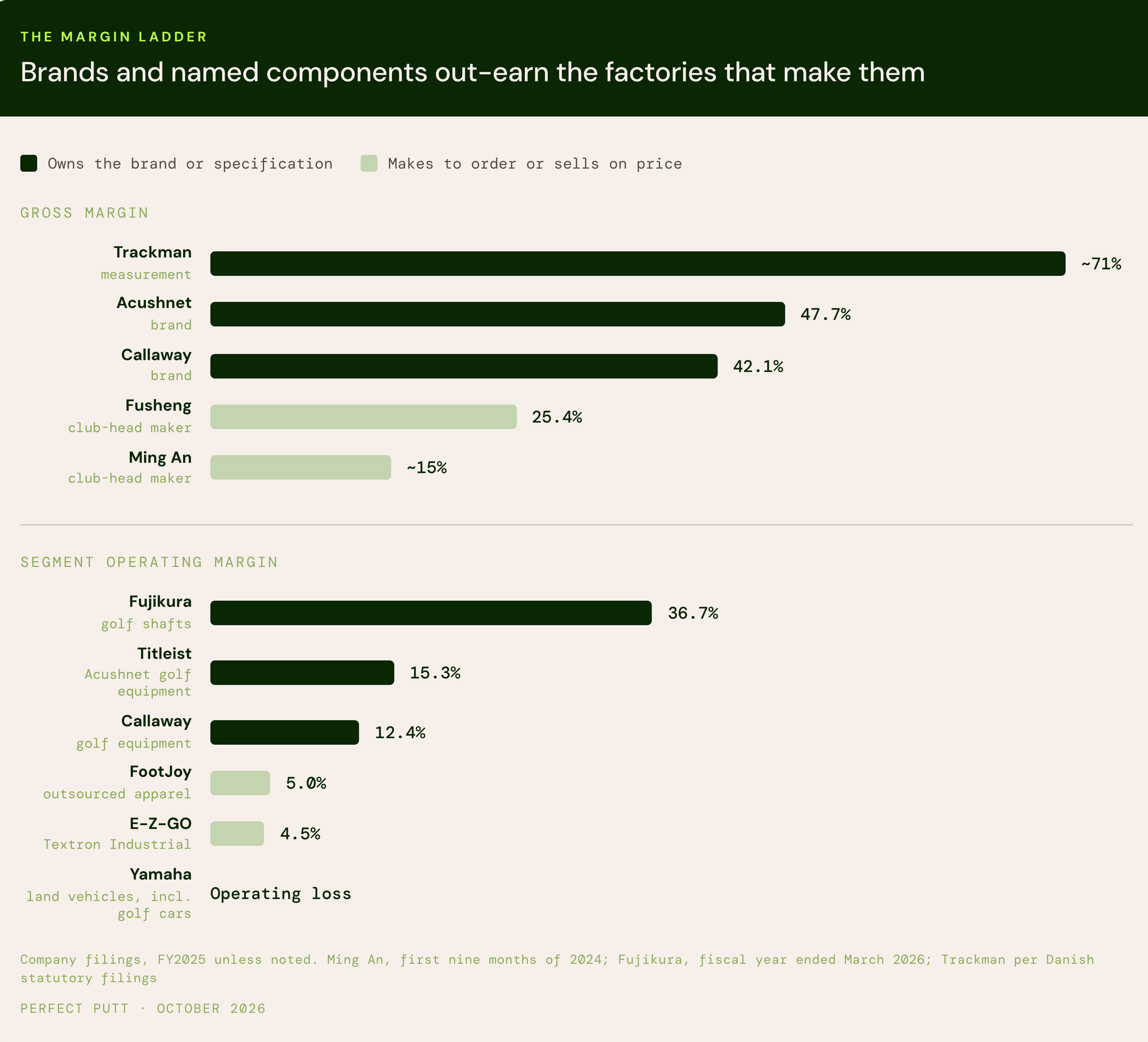
Start with gross margin, where the distance between maker and brand is widest. Fusheng Precision, the largest club-head manufacturer, reported a 25.4 percent gross margin in 2025. A peer, Ming An, ran about 15 percent in the first nine months of 2024. The brands that specify those heads reported 47.7 percent at Acushnet and 42.1 percent at Callaway. Fusheng’s management estimates golf retail prices at four to six times factory prices.
Segment operating margins tell the same story further down the income statement. Fujikura, whose sporting goods segment is mainly golf shafts, reported a 36.7 percent segment operating margin for its fiscal year ended March 2026. Callaway’s golf equipment segment earned 12.4 percent in 2025. Textron’s Industrial segment, home to E-Z-GO, earned 4.5 percent, and Yamaha’s land vehicles segment, which includes golf cars, posted an operating loss.
The split holds inside a single company. Acushnet’s FY2025 filings show its Titleist golf equipment segment earned a 15.3 percent segment operating margin, while FootJoy, built on outsourced apparel and a joint-venture footwear plant, earned 5.0 percent. Golfers ask for a Pro V1 by name; a polo competes on a crowded rack.
Measurement businesses sit at the top of the range. Figures compiled from Trackman’s Danish statutory filings show 2025 revenue of DKK 1,483 million at about a 71 percent gross margin and a 33 percent net margin.
The roles explain the ordering. Fusheng makes the head. The brand decides what that head should be, puts its name on the finished club, validates it on Tour and owns the relationship with the golfer. A component maker such as Fujikura goes a step further: its shaft becomes something golfers and fitters request by model name, so the component carries its own brand pull. A fleet cart, even one built behind trade protection, is bought largely on price and terms.
Following a $600 Driver
A hypothetical $600 driver makes the margin map concrete. Assume the retailer keeps about 30 percent, below the 36.3 percent gross margin DICK’S reports for its core business: roughly $180 at the register and $420 for the brand. At the brands’ reported gross margins of 42 to 48 percent, the brand keeps $175 to $200 in gross profit. About $52 of that is operating profit, using Callaway’s 12.4 percent golf equipment segment margin. The remaining $125 to $150 pays for research, Tour validation, marketing and overhead.
That leaves the brand with $220 to $245 of cost of goods. The head maker’s share is smaller. Fusheng’s four-to-six-times estimate implies roughly $100 to $150 of factory content, assuming that range covers the purchased head and its assembly. At Fusheng’s 25.4 percent gross margin, the head maker earns about $25 to $38 of that in gross profit. If the dutiable value equals that factory content, import duty on a Vietnamese club at the 16.9 percent combined rate now in force adds about $17 to $25. The rest of the brand’s cost, roughly $45 to $130, covers the shaft, grip and headcover, freight, final assembly in Mexico or the U.S., and warranty.
The figures vary by model and channel, but the shape holds: retailer and brand keep roughly 60 percent of the retail price, and the factory that makes the head keeps about 5 percent.
Where the Chain Narrows
Concentration decides where risk sits in the chain.
A handful of Taiwanese-owned contract manufacturers make most of the world’s club heads. Fusheng told investors that more than 75 percent of its unit capacity now sits in Vietnam. Ball supply is concentrated as well: when a 2023 fire shut a single Taiwanese ball factory, the plant had shipped roughly one-fifth of global supply the year before, according to AP reporting. At the premium end, the brands keep production close. Acushnet makes its balls in three company-owned plants, two in Massachusetts and one in Thailand, and is adding cast-urethane lines in both places.
Soft goods concentrate at single sites. Acushnet’s filings show that substantially all FootJoy footwear comes from one joint-venture facility in Long An, Vietnam, and its gloves from one plant in Chonburi, Thailand. On the course, the constraint is geography: according to Oregon State University, the Willamette Valley produces almost two-thirds of U.S. cool-season grass seed, and a single poor season there in 2021 roughly doubled seed prices. In carts, antidumping and countervailing duty orders issued in August 2025 closed a Chinese import channel that had reached 114,170 units in 2023, by Commerce Department data, leaving fleet supply with Club Car, E-Z-GO and Yamaha in Georgia.
Golf has diversified where it sources without diversifying its chokepoints. Risk follows the narrowest point in each chain, and several of those points sit in the layers that keep the least margin.
The Tariff Stress Test
Perfect Putt’s April 9 piece, “The Tariff Impact on Golf,” covered how tariffs moved production and pressured OEM margins. Six months on, the full cycle works as a test of the margin map above.
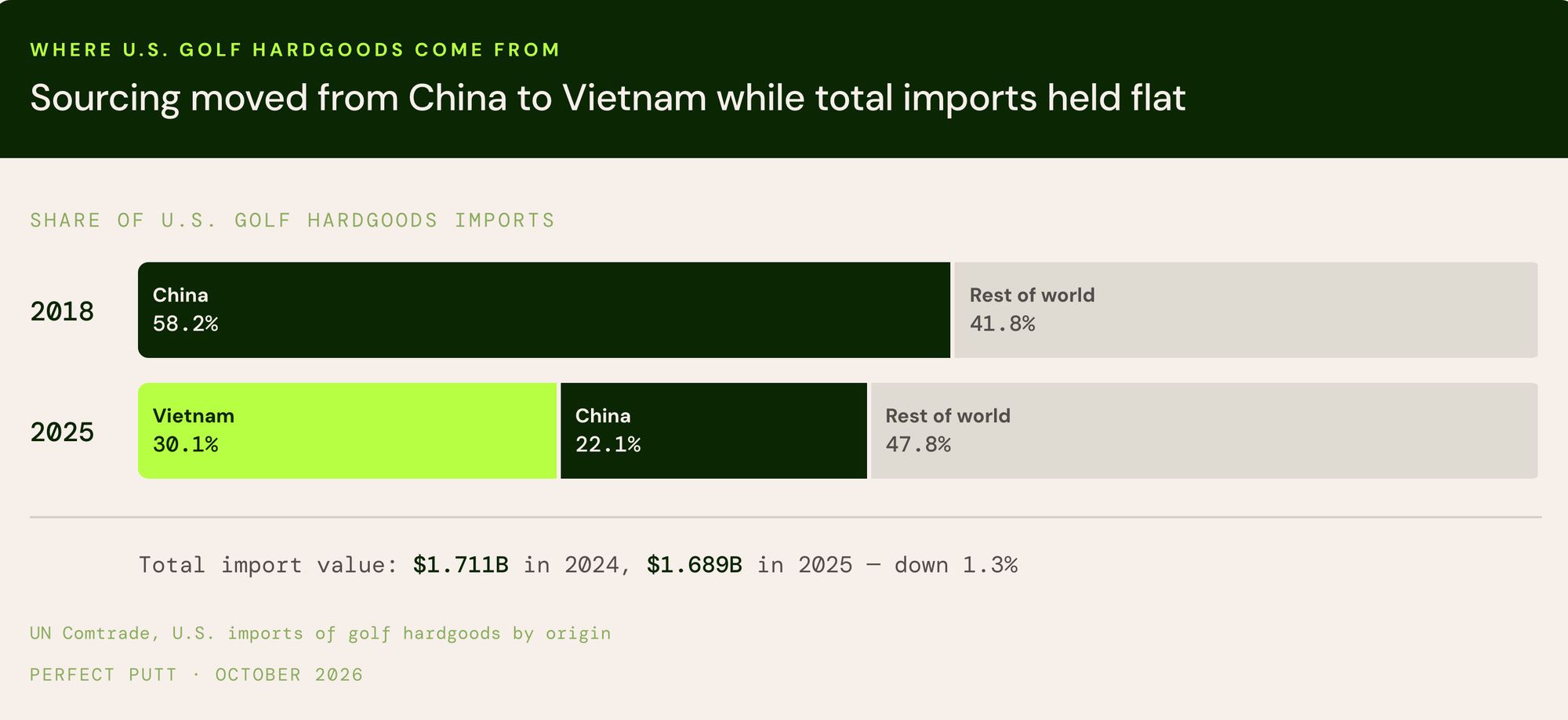
UN Comtrade data show China’s share of U.S. golf hardgoods imports fell from 58.2 percent in 2018 to 22.1 percent in 2025, while Vietnam rose to 30.1 percent and became the largest source. Import value went from $1.711 billion in 2024 to $1.689 billion in 2025, a 1.3 percent decline. From August to early November 2025, by Perfect Putt’s calculation, a complete club from China carried about 42 percent in combined duties and one from Vietnam about 24 percent. Driver prices moved by low single digits.
The cost landed where the margin map predicts. Acushnet absorbed about $30 million of incremental tariff cost in 2025, management told investors, and its gross margin slipped from 48.4 percent to 47.7 percent. Callaway recorded $34 million of tariff expense, a 166 basis-point drag, and finished at 42.1 percent. Each equaled a contained share of gross profit: about 2.5 percent at Acushnet and 3.9 percent at Callaway.
The 2026 numbers need adjusting. After the Supreme Court invalidated the IEEPA tariffs in February, U.S. Customs began refunding those duties. Acushnet’s 54.4 percent second-quarter gross margin included about $38 million of net refunds; on its second-quarter earnings call, management put the first-half margin excluding refunds at 48.1 percent, about 50 basis points below the prior year. Callaway reported a 50.1 percent second-quarter gross margin, or 48.5 percent excluding $10.8 million of refunds, and expects up to just under $50 million in total. Stripped of refunds, Acushnet is running close to its pre-tariff margin.
The manufacturing layer carried a different burden. Fusheng’s revenue history shows where volume risk collects: NT$23.2 billion in 2021, NT$33.7 billion in 2022 as brands restocked, then a 28 percent drop to NT$24.4 billion in 2023 when orders reversed. The brands absorbed a contained cost. The factory absorbed the swing.
The Economics of Reshoring
Tariffs moved production around Asia far more than they moved it home.
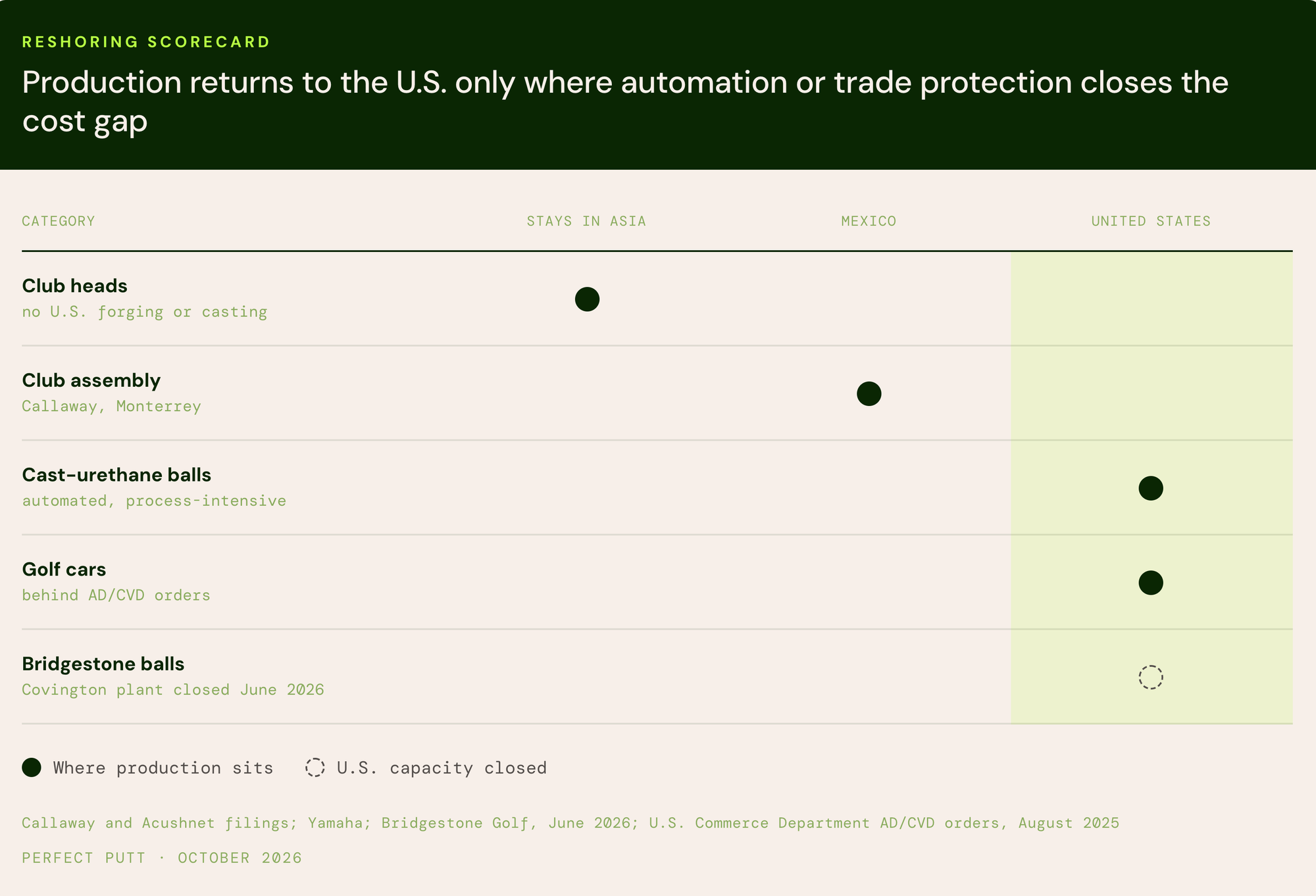
Club-head manufacturing has not returned; Perfect Putt’s research identified no U.S. forging or casting capacity. Assembly has become regional. Callaway’s filings show its primary club assembly operation is in Monterrey, Mexico, and that more than half of its 2025 club assembly took place outside the U.S. The schedule now in force, a Section 301 action that replaced the temporary Section 122 surcharge on July 24 with no set end date, could shuffle Asian capacity again, since Taiwan’s 10 percent combined rate sits below Vietnam’s 12.5 percent.
Domestic capacity is growing only where something offsets U.S. labor costs. Acushnet guided 2026 capital spending to about $95 million, prioritizing ball capacity, including automated, process-intensive cast-urethane lines. In carts, trade remedies changed the cost comparison outright, and Yamaha is shifting its Newnan, Georgia plant toward golf cars. Tariffs alone are not enough: Bridgestone Golf said in June 2026 that it would close its Covington, Georgia ball plant at the end of that month, citing supply-chain and cost pressures.
Production comes home when automation, process know-how, capital intensity or trade protection close the cost gap. Where they do not, it relocates within Asia or to Mexico.
Capital Implications Across the Chain
The margin map, the stress test and the reshoring record point the same way: the attractive layers of golf’s supply chain control a specification, a bottleneck, a distribution channel, an installed base or a recurring customer relationship. Moving the most units is not the same as keeping the most margin.
Specified components are the clearest case. A premium shaft or a named ball model earns its margin from demand the maker created. Specialized capacity is a related case: cast-urethane ball production is concentrated, process-intensive and one of the few categories drawing domestic investment. Measurement businesses such as Trackman anchor an installed base around a data standard.
The same logic reaches turf, where golf has no pricing power over the underlying commodity. SiteOne earned a 34.8 percent gross margin in 2025 on a basket heavy with fertilizer, chemicals and irrigation, and its filings show proprietary brands, mostly LESCO, at about 15 percent of sales. It has added golf-focused distributors, including Regal Chemical in 2023 and Reinders in March 2026. Envu, formerly Bayer’s Environmental Science Professional business, which serves turf alongside pest management and vegetation management, took a minority investment from GIC in March 2026.
In carts, the durable economics sit with the fleet relationship. Municipal fleet contracts reviewed by Perfect Putt show 48- to 60-month terms at roughly $5,000 to $7,300 per cart, with lithium fleets increasingly timed to battery warranties. That recurring cycle is worth more than the 4.5 percent margin in Textron’s Industrial segment suggests assembly is.
Contract manufacturing is the contrast. Fusheng’s revenue swing and peer gross margins of 15 to 25 percent describe a layer that carries utilization risk, sourcing shocks, tariff exposure and demand swings without owning the end customer. Returns there depend on managing volatility, not on pricing power.
Three things will test this map over the next year. The first is normalized margins in 2027, when the IEEPA refunds roll off and Acushnet and Callaway report results without them. The second is whether the Section 301 regime that replaced the Section 122 surcharge holds, and whether the gap between Taiwan and Vietnam rates moves capacity again. The third is whether club-head makers move up the chain; Fusheng already earns part of its revenue from carbon shafts. If the factory starts owning more of the specification, its 5 percent will grow.
The factories have moved, and may move again. The economics have stayed with the parts of the chain that golfers and operators ask for by name.
The best way to support Perfect Putt is to share it with a friend.