
The Instruction Economy

Content changed how golfers discover instruction without changing where they buy it. Owning the customer relationship lets an instructor monetize that attention; the ability to scale beyond a single instructor determines what the relationship is worth.
Welcome to Perfect Putt, a newsletter covering the business and economics of the golf industry. If this was forwarded to you, subscribe to join 12,000+ readers who follow how capital flows through golf.
Read Time: 8 Minutes
Content Took the Free Layer
Content first captured golfers who were not buying lessons. A 2024 survey of 1,000 US and UK golfers by Gather, conducted with YouGov Sport, asked those who had never taken a lesson why not. In the US, about 29 percent said they would rather teach themselves and about 21 percent said they could get enough information online. Stated preferences are not lifetime behavior, and some will eventually book a coach. For now, they are audience rather than revenue.
Content also took over the stretch between lessons, which is where creators build familiarity at scale. Gather flags the possibility that golfers form one-sided personal attachments to on-screen instructors, citing Me and My Golf as an example. That attachment is the asset a creator business monetizes.
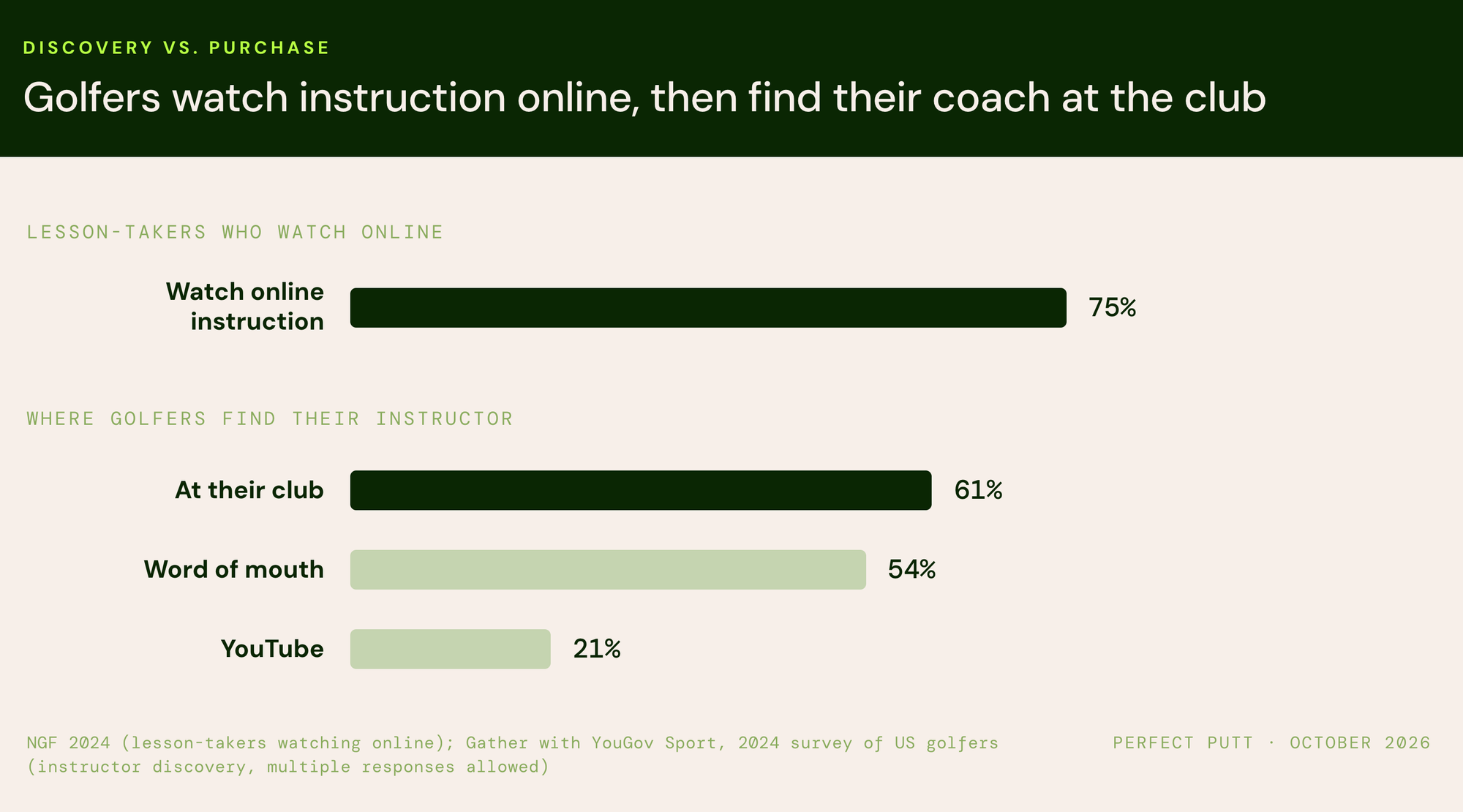
What content did not take is the purchase decision itself. In the same survey, 61 percent of US golfers said they find instructors at their golf club and 54 percent through word of mouth, against 21 percent through YouTube. Proximity was the top selection criterion and price was second. Asked what format they prefer, about 56 percent of US respondents chose an in-person individual lesson; virtual formats drew single digits. About half preferred paying one lesson at a time, while only 16 percent wanted a monthly coaching program and 9 percent an annual one. Coaches are told to stop selling time by the hour. Customers still prefer to buy it that way.
The Channel Is a Cost Center
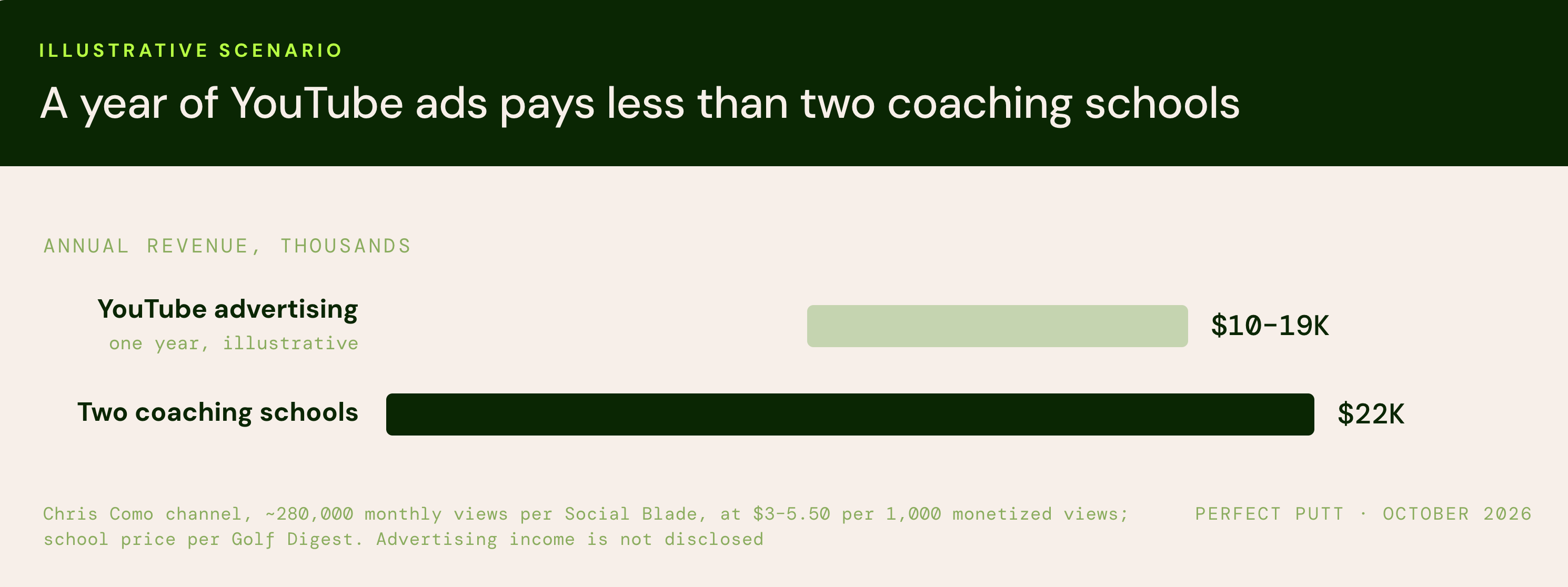
Attention mostly does not pay directly. Creators do not disclose advertising income, so what follows is an illustrative scenario, not a finding. Published industry benchmarks put YouTube payouts for sports and golf content at roughly $3 to $5.50 per thousand monetized views. Apply that range to Mike Malaska's channel, which has about 43 million lifetime views, and the result is roughly $130,000 to $240,000 in advertising across 16 years. Chris Como's channel, launched in 2024, has recently drawn about 280,000 views a month, per Social Blade. At the same rates, that implies about $10,000 to $19,000 a year if every view were long-form, and less if short clips make up much of the total, since they pay a fraction of the rate. Even the high case is less than two of Como's $11,000 coaching schools, as listed by Golf Digest.
A channel is better read as a customer acquisition budget. Malaska runs a member question series on his public channel, which turns the free product into an advertisement for the paid one. The relevant metric is how efficiently the channel converts viewers into buyers.
Three Models, One Deciding Variable
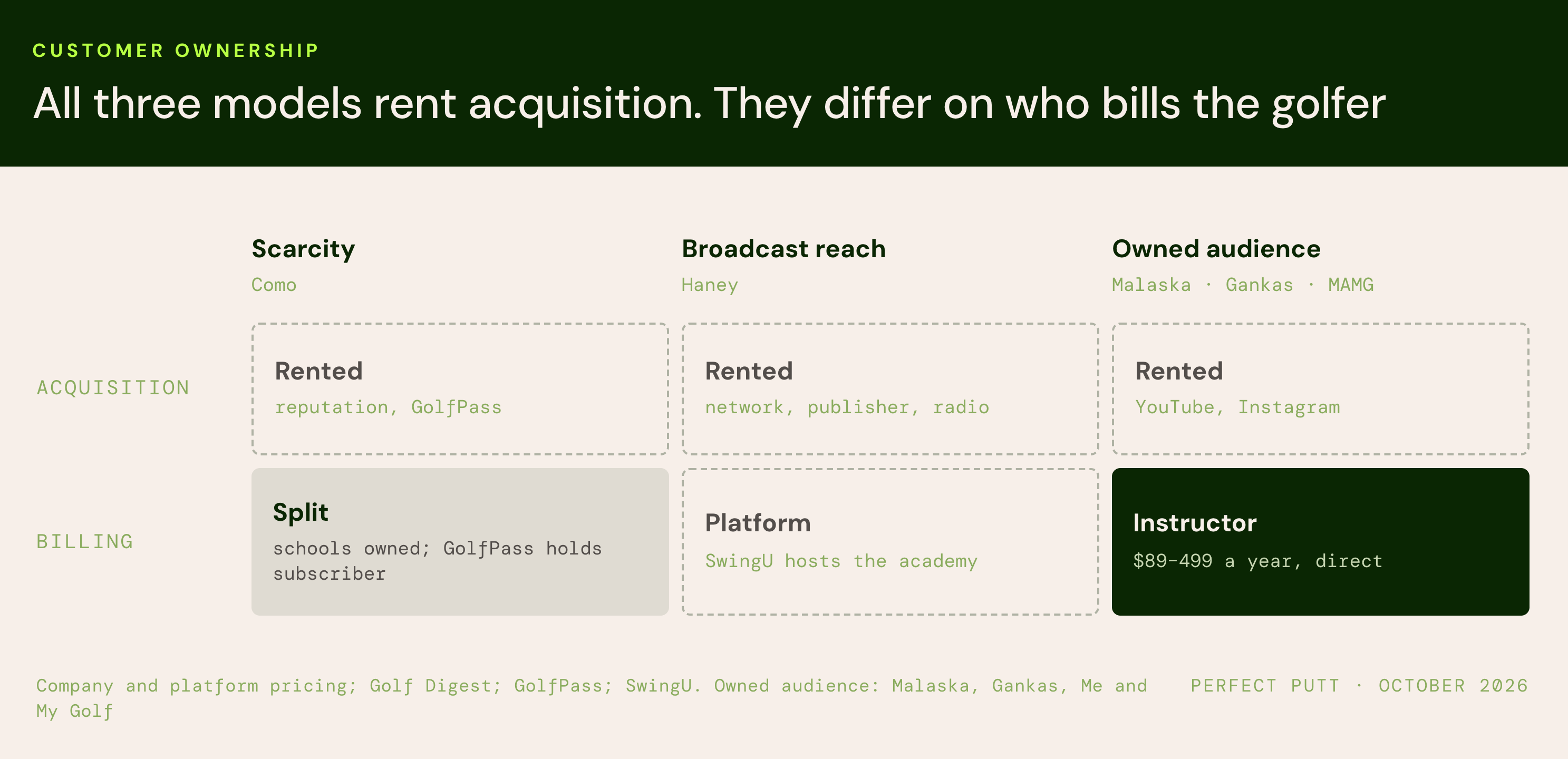
The instructors most associated with this shift run three different businesses. What separates them is who owns the customer.
Como sells scarcity. His headline price is a multi-day school, his core clients are tour players including Bryson DeChambeau and Xander Schauffele, and his other income comes from engineering consulting for PING and from series produced for GolfPass. His content builds reputation, and GolfPass owns the subscriber on that platform. His value rests on limited access rather than audience size, which is what supports premium pricing, and he extends it through a staffed academy near Dallas.
Hank Haney built on broadcast reach. After coaching Tiger Woods, he reached a national audience through a Golf Channel series, a No. 1 New York Times bestselling book and, from 2014, a SiriusXM show that expanded to seven days a week in 2016. The trade-off in this model is structural: the network, the publisher and the radio platform own the distribution. That radio chapter closed in 2019, and Haney has since moved toward a podcast and a subscription academy hosted on SwingU at $99.99 a year.
Malaska, George Gankas and Me and My Golf run the third model: owned audience. Malaska sells his instruction system for $89 a year on the web and $199.99 a year in an app he controls, sells launch monitors and training aids through his own shop, and certifies coaches who teach his method. Gankas, whose large social following grew out of the student swings he shared from his lesson tee in Westlake Village, sells a $499 annual academy and a line of training aids. Me and My Golf charges $379 to $499 a year and bundles Arccos sensors into membership. Each owns the billing relationship, which creates the right to sell a second and third product. Ownership has limits: all three still rely on YouTube and Instagram to find new customers, so acquisition remains rented even when billing is owned.
Scale Beyond the Instructor
Owning the customer lets an instructor monetize attention. Scale determines what that is worth. A creator-owned subscription has high gross margins but a ceiling set by one person's audience and time. The largest disclosed numbers belong to businesses that break that ceiling through products or by aggregating instructors.
Products show the first route. Martin Chuck, a Golf Digest top-50 teacher who charges $350 an hour, invented the Tour Striker training aid in 2006 and has said that product income is what let him leave club employment and open his own academy. After Rory McIlroy was seen using his $47 Smart Ball, sales went from about 5,000 units a year to about 5,000 a month, per Golf Digest.
Aggregation shows the second. Performance Golf, which packages instructors including Haney and Eric Cogorno into courses and training aids, told Forbes in 2024 that annual revenue had reached about $90 million, up from $29 million in 2021. It pays coaches a fee plus royalties. Revenue is not profit: the company does not disclose margins or acquisition costs, which in direct-response marketing are typically substantial. The figure establishes scale, not returns. The economics differ from a creator's. The creator keeps most of each dollar from a smaller base; the platform shares revenue with coaches and pays for acquisition, but spreads those costs across many instructors and products.
Hardware makers and teaching centers have scaled from the other side. Trackman sells coaching certifications through Trackman University and bundles a membership with every unit, making the vendor the credentialing body for the coaches who recommend it. GOLFTEC delivered more than 1.9 million lessons in 2025 across more than 260 centers and bought the consumer launch monitor SkyTrak in 2023. Its Japanese parent, Golf Digest Online, raised its stake to 97 percent in 2022 at a price implying roughly $232 million for the whole business, about 2.1 times 2021 revenue.
The Hour Is Shrinking From the Inside
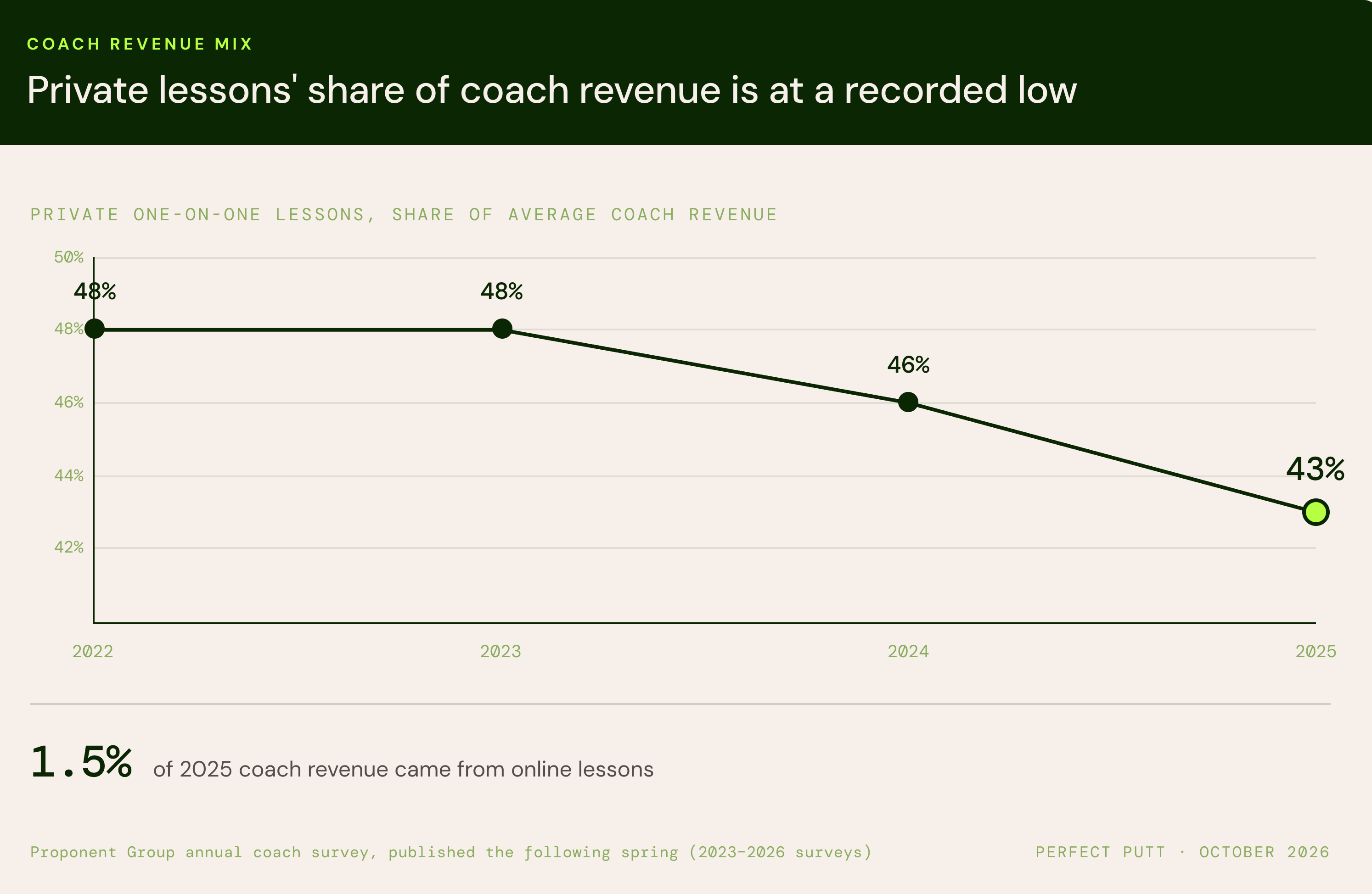
The pressure on the lesson comes less from YouTube than from coaches themselves. Proponent Group surveys career coaches each spring about the prior year. Its 2026 survey found that private one-on-one lessons fell to 43 percent of average coach revenue in 2025, the lowest share it has recorded, down from 48 percent in 2023. The share did not go online, where lessons produced about 1.5 percent of revenue. It moved into long-term programs, group clinics and schools. Coaches are replacing the hour with a package, not with a video.
Average Proponent member revenue reached about $210,000 in 2025. Meanwhile, PGA of America membership data shows head professionals falling about 10 percent between 2022 and 2025, to roughly 4,400, and the number of accredited PGA Golf Management university programs has dropped from 20 to 17. About 60 percent of PGA members have held membership for 25 years or more. The independent coach with a brand and a program is gaining; the salaried club professional is getting harder to recruit.
That matters to operators because the club pro is a customer acquisition channel for the facility, not just a line on its payroll. A Proponent study found that a coach producing about $80,000 in instruction revenue generated roughly $143,000 for the facility, most of it through fittings, dues and initiation fees. The split coaches pay on the lessons themselves averages 19 percent at private clubs and 26 percent at public ones. A club that loses its best teacher loses a membership funnel, not just a lesson split.
The Capital Implication
The investable shift in golf instruction is not from in-person to digital. It is from selling instruction as a service to building businesses around the customer relationship that instruction creates. Content lowered the cost of earning attention, but it did not remove the importance of proximity, trust or the coach. That makes the most valuable layer the infrastructure around the instructor: the products, programs and platforms that turn a relationship built through coaching into repeatable revenue.
That distinction changes what deserves a premium. A large audience can create demand, but it remains fragile when acquisition is rented from YouTube or Instagram, billing sits with another platform, or the product depends on one instructor continuing to produce. The stronger model owns more of the relationship and gives the customer reasons to remain after the initial lesson: a subscription, training product, group program, technology layer or network of coaches delivering a consistent method. In that sense, the instructor is most valuable not as the entire business, but as the wedge into a broader one.
The overlooked distribution advantage may sit with facilities themselves. Golfers still overwhelmingly discover and buy instruction locally, and the economics of a good coach extend into fittings, dues and other facility spending. Yet much of the innovation in conversion, retention and productization has happened outside the facility. Bringing those tools back to the lesson tee could allow operators and coaches to capture more value from demand that already exists rather than continually paying to manufacture new attention.
For capital, that puts the underwriting focus on whether a business can turn instructor credibility into an asset that compounds. The question is not how many people watch, or even how many lessons are sold today. It is whether the customer relationship can support additional products, survive beyond a single personality and become more valuable as the business grows.
The best way to support Perfect Putt is to share it with a friend.