
Value Created, Value Captured: The Economics of a Golfer

Golf keeps adding players, but not all of them are worth the same. A lifetime-value model shows how a golfer's economic worth compounds, or evaporates, depending on what happens after the first round.
Golf's participation numbers have risen for six straight years. The National Golf Foundation counted 29.1 million on-course participants in 2025, the most in nearly two decades, and expects total participation to pass 50 million in 2026. That is the clearest measure of golf's reach. What each golfer is worth is a separate question.
A new golfer might spend $1,000 before quitting or several hundred thousand dollars over a lifetime. A participation count measures how many people play, not what each one spends, so both golfers count the same. Separating them calls for a lifetime-value framework more common in subscription businesses than in golf.
Welcome to Perfect Putt, a newsletter covering the business and economics of the golf industry. If this was forwarded to you, subscribe to join 12,000+ readers who follow how capital flows through golf.
Read Time: 8 Minutes
What Golfers Spend
Three broad types of golfer anchor this analysis, distinguished by how deeply the game has embedded itself in their lives. An occasional golfer, someone who plays a handful of rounds a year without returning reliably, spends roughly $450 annually, concentrated in a starter set of equipment and the cost of getting onto a course. A committed golfer on public and daily-fee courses, playing something like 33 rounds a year, spends closer to $4,500. A private-club member spends roughly $15,750 a year in recurring costs alone, before the fee required to join.
These figures are built up category by category, from green fees and equipment to instruction, travel and food and beverage. No dataset tracks the same golfers' spending over multiple years, so they approximate typical patterns rather than measure them directly. A 2025 Censuswide/Whatnot survey reported by Axios found Millennial golfers expect to spend $4,557 a year, close enough to the public-core figure to serve as a useful check.
More interesting than the totals is how the composition shifts. An occasional golfer's spending concentrates in the basics: clubs and apparel bought infrequently, plus the green fees and cart cost of getting onto a course. A committed public-course golfer's wallet broadens into travel and instruction, categories that barely register for a casual player. A private-club member's spending concentrates again around a single recurring dues line, a median $8,850 a year per the Club Management Association of America's 2022 Finance and Operations Report, that funds most of a club's operations while food and beverage runs near cost. Spending doesn't just grow with engagement. It reorganizes.
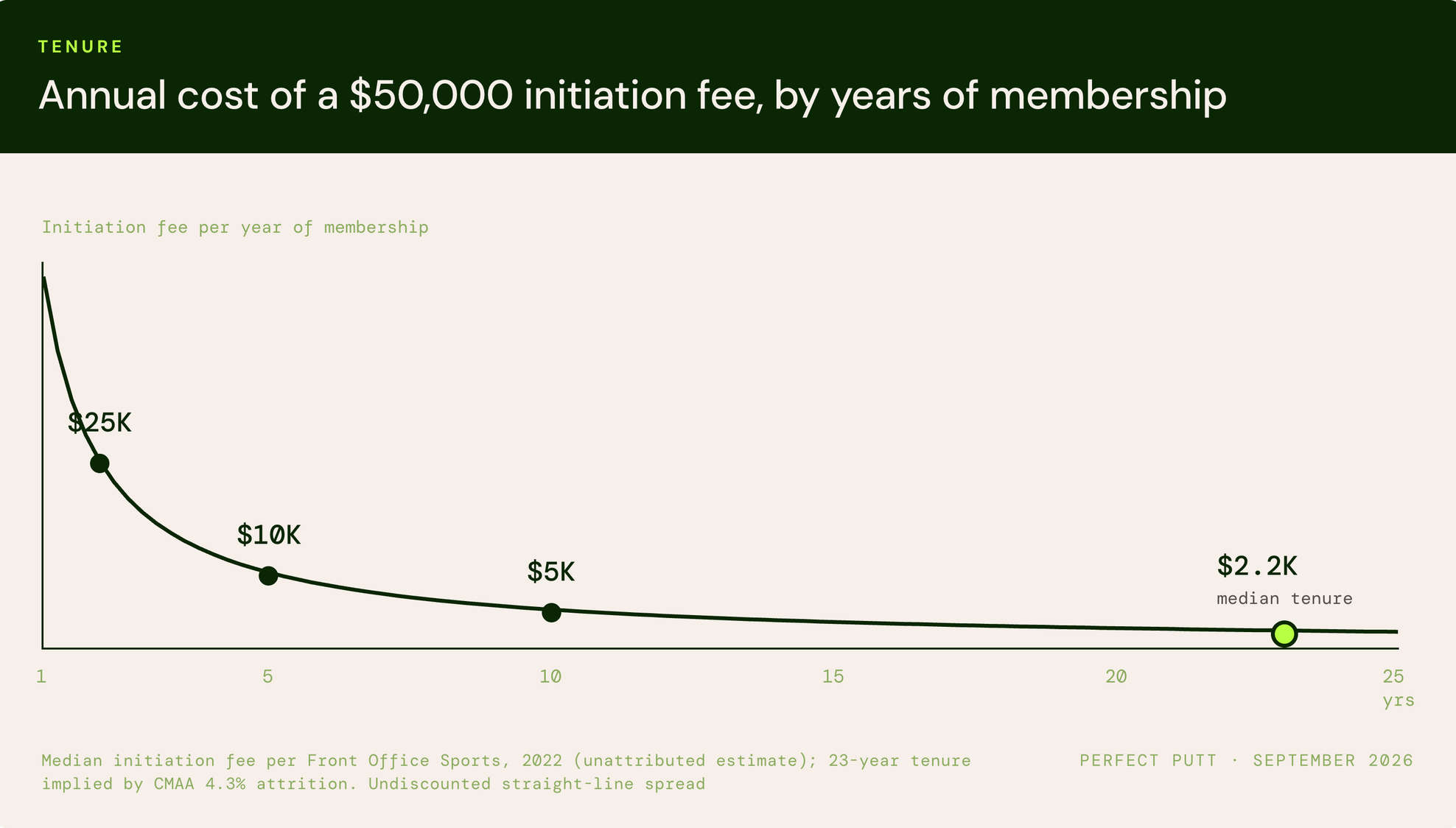
On top of that recurring total, members typically pay a one-time initiation fee. The sports-business outlet Front Office Sports reported that the median rose from about $29,000 in 2019 to roughly $50,000 in 2022, a 72 percent increase, though the figure traces to an unattributed social-media estimate rather than a disclosed survey, the softest-sourced number in this analysis, and no better-verified alternative exists. A payment that size only makes economic sense against how long someone expects to remain a member.
The Importance of Time
A membership behaves like a subscription because it's priced like one: dues paid whether or not a member plays that month, so its duration can be studied like any subscription's. The CMAA's 2022 report discloses a median full-membership attrition rate for golf and country clubs of 4.3 percent a year. Treat that as a steady state, the rate at which departures and new members balance out, and inverting it implies an average tenure of roughly 23 years, a mathematical consequence of the attrition rate rather than an observed average membership length, but a reasonable planning assumption in the absence of that data.
No equivalent attrition survey exists for public and daily-fee golfers, since those courses keep no membership roll to measure it against. This analysis assumes a 15-year tenure for a committed public-course golfer, a planning figure rather than a finding, since no comparable data exists.
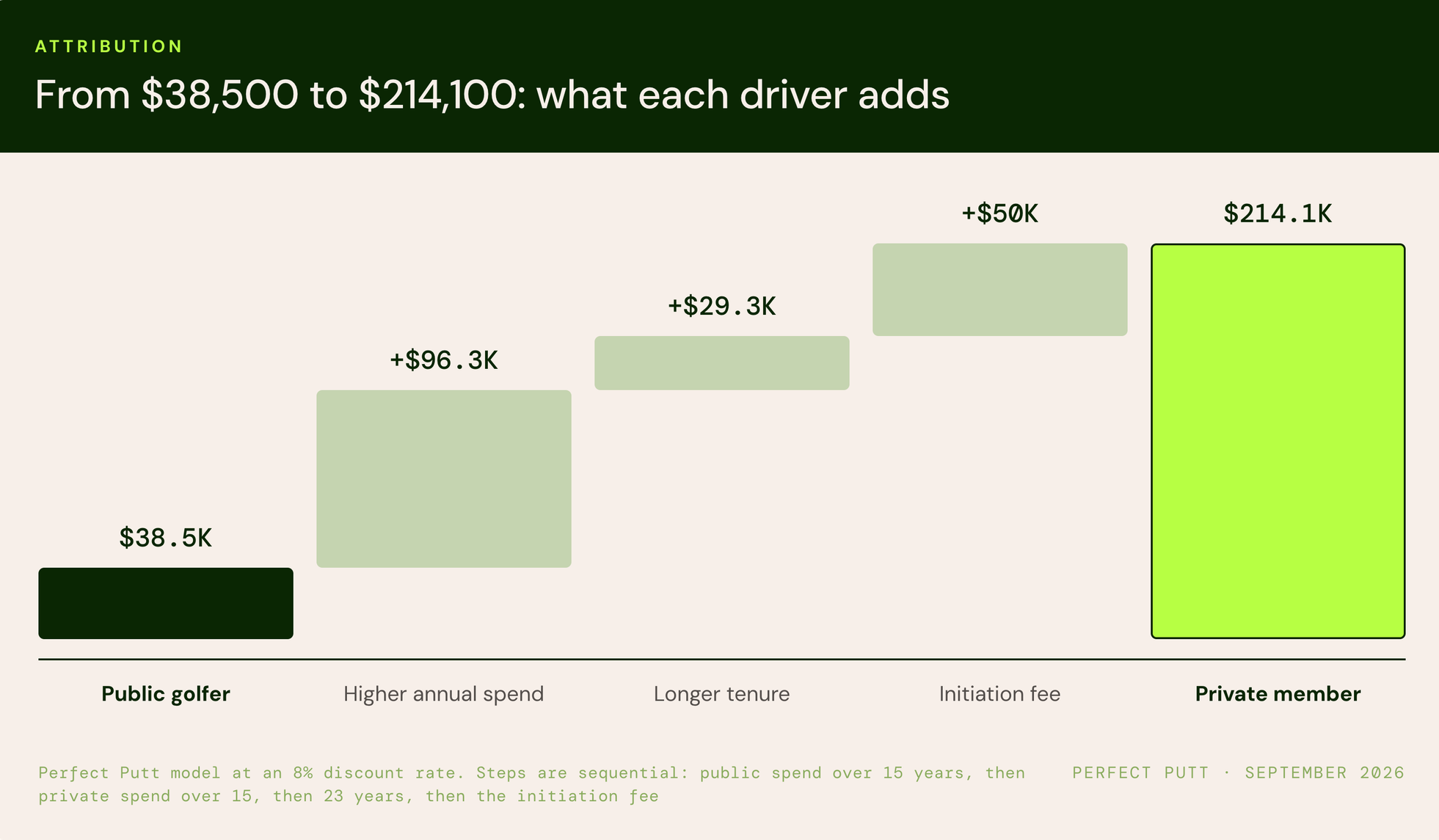
Multiplying spending by tenure and discounting the result at 8 percent, this model's assumed discount rate, turns duration into a present-value figure. A committed public-course golfer's $4,500 a year over 15 years comes to about $38,500. A private-club member's full recurring spending, $15,750 a year across dues, instruction, equipment, travel and food and beverage, comes to roughly $164,100 over 23 years; adding the $50,000 initiation fee, paid immediately, brings the total to about $214,100. Both figures value a golfer already in that state today, not a beginner's eventual arrival there discounted back to their first round. That roughly five-and-a-half-to-one gap comes from three things stacking together, not one: private-club members spend more annually, stay engaged longer, and pay a large fee to join.
The Economics of Conversion
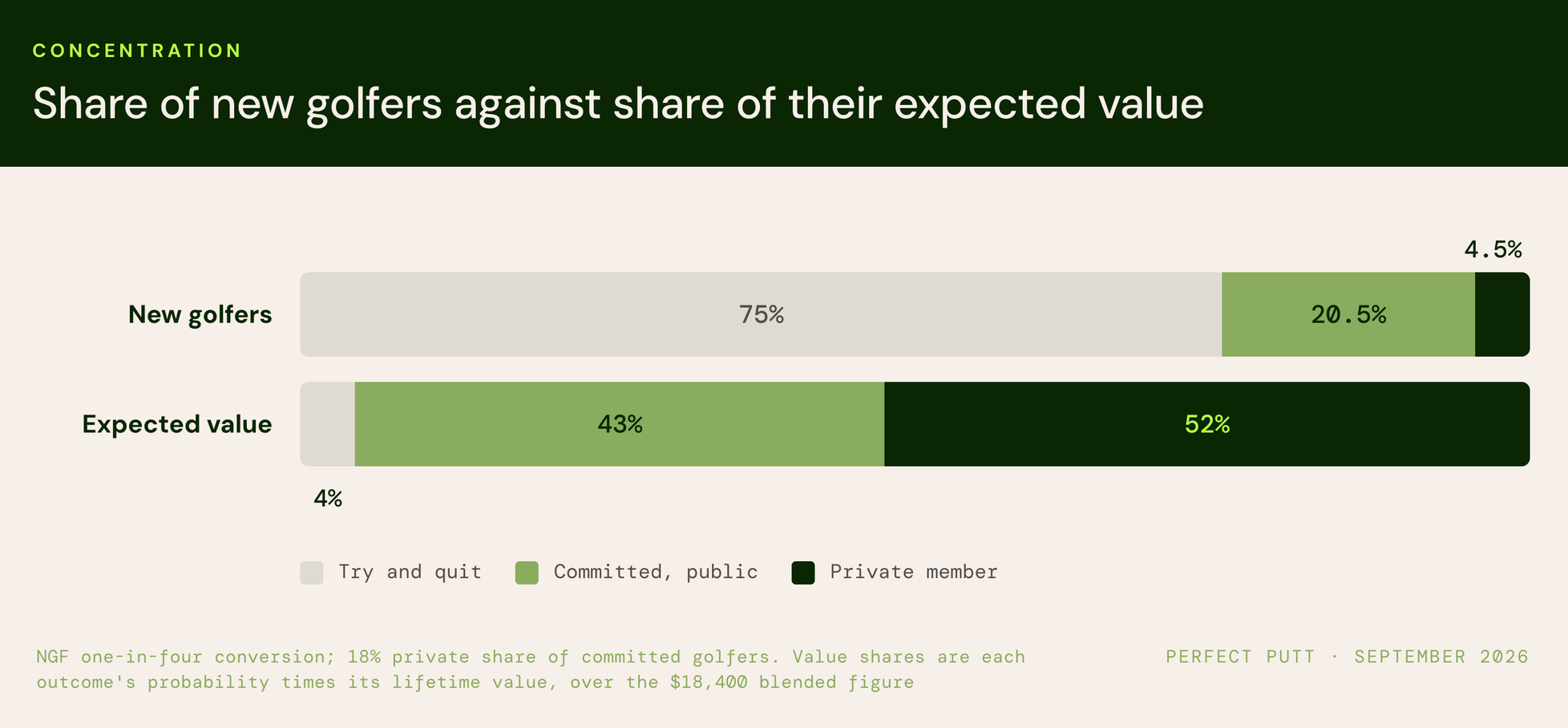
Both of those lifetime figures describe golfers who already made it, people who stuck with the game long enough to become committed; most never get there. NGF's retention research puts the beginner-to-committed conversion rate at about one in four, meaning most new entrants try the game, spend modestly, and stop. This analysis treats that trial-and-exit experience as worth around $1,100, roughly the cost of a handful of green-fee rounds plus a one-time starter-equipment purchase, well below GolfPass's own estimate of $1,849 to $3,349 for a genuine first season of lessons and weekly play, since most people who quit do so long before spending that much.
Of the quarter who become committed golfers, most remain on public and daily-fee courses. A smaller share end up at private clubs, and this analysis uses that group's current 18 percent share of the committed on-course population as a stand-in for the odds a newly committed golfer arrives there, not evidence that golfers actually move between the two. Splitting the 25 percent who convert that way leaves roughly one-fifth of all entrants (20.5 percent) as committed public-course golfers, worth $38,500, and a small remainder (4.5 percent) as private-club members, worth $214,100.
Weighted by how often each occurs, those three outcomes average to roughly $18,400, an illustrative, probability-weighted scenario built by blending values calculated at different starting points, not the actual expected present value of acquiring a beginner today. What it captures is the shape of the underlying economics, and that shape is the more useful finding. Three in four new entrants are worth close to $1,100. The rest are worth somewhere between thirty-five and nearly two hundred times more. An industry that reports participation as a single growing number is, in economic terms, averaging over one of the widest value distributions in consumer spending.
The Private-Club Economy
Private clubs look, on these numbers, like the golf economy's version of a great subscription business: high retention, dues that arrive whether or not the customer shows up, and a member relationship that can run two decades or more. Roughly 80 percent of a private club's gross profit comes from dues alone, per Club Benchmarking's analysis of club financials, with food and beverage typically priced near cost as a member convenience rather than run as a profit center. That's an unusually clean revenue structure for a business that also involves grass, weather and physical capacity.
That's where the subscription comparison breaks down. A software company can add another thousand subscribers without building another data center. A golf club cannot add another thousand members without running out of tee times, locker space and parking, which is why most cap membership and keep waitlists. The same course generating two decades of predictable revenue per member also carries real operating costs, groundskeeping, clubhouse staff, maintenance, plus periodic capital needs, a new irrigation system, a clubhouse renovation, that a low-overhead software business never faces. High revenue quality and high capital intensity coexist in the same asset.
Membership growth adds another layer. NGF reports private-club membership has grown roughly 50 percent since 2019, faster than on-course participation broadly, and its profile of private-club golfers hints at where that growth comes from: members of that group play more rounds, spend more, and report higher household income than the broader on-course population. That looks more like an already-engaged public-course golfer leveling up than a first-time player choosing a club as an entry point, though NGF doesn't track golfers as they move between the two, so this reads as who members tend to be, not a documented migration path. If it holds, private clubs compete less for wealthy newcomers than against every public course, instructor and travel operator already holding a piece of that spending.
Where the Spending Goes
Extend that competition outward and a broader pattern appears. A lapsed golfer's roughly $1,100 mostly lands with whichever retailer sold a starter set and whichever course collected a handful of green fees, a single, unrepeated transaction each. A committed public-course golfer's $38,500 spreads across courses, equipment makers, instructors, travel operators and increasingly golf apps and technology platforms, a wide roster of businesses, none holding the relationship exclusively. A private-club member's $214,100 concentrates the clear majority of that spending with one institution, through dues and the initiation fee, though equipment, instruction and travel still draw meaningful spending from businesses outside the club.
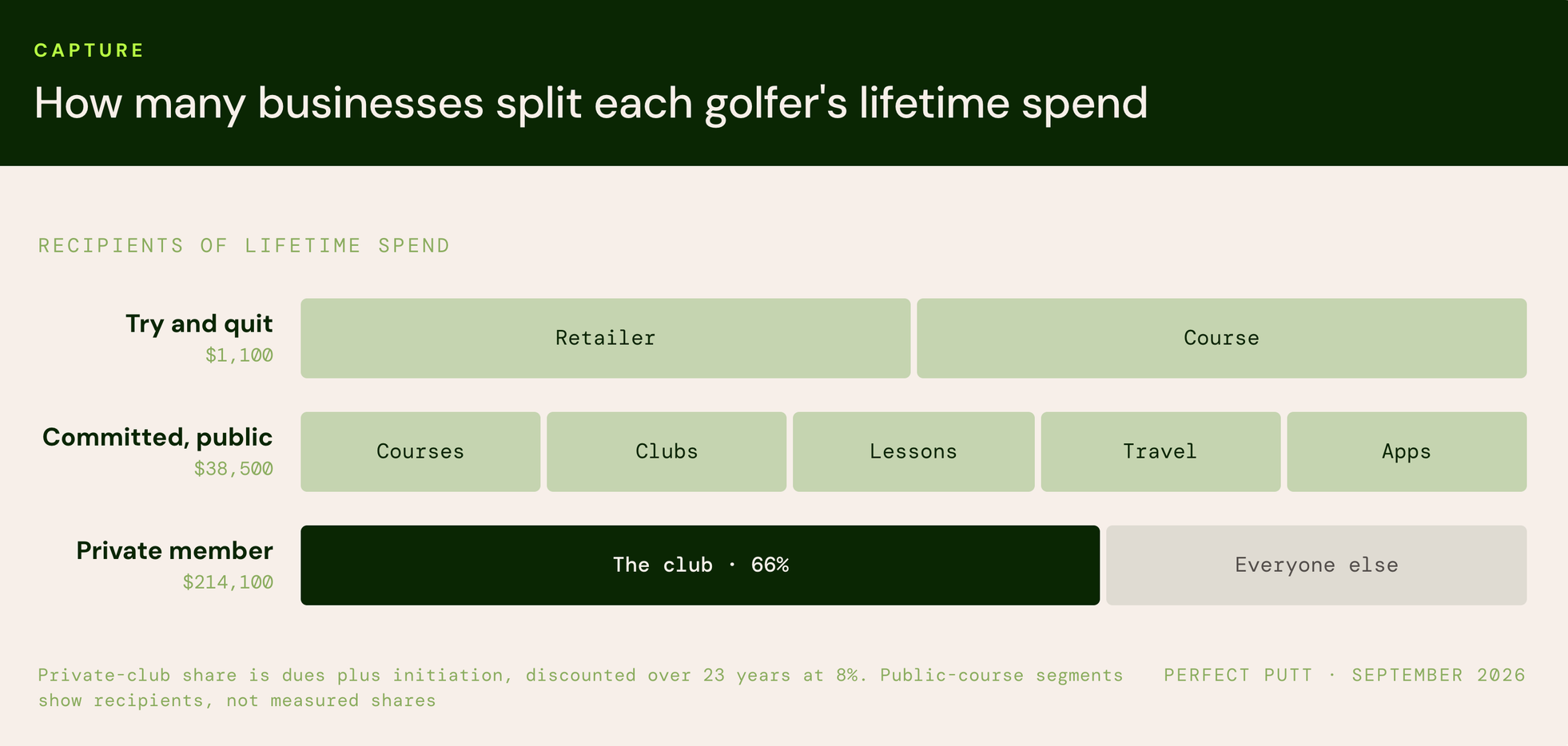
That distribution separates two things easy to conflate: the value a golfer generates for the golf economy, and the revenue any single business captures from that golfer. Suppose a junior clinic or a beginner-focused app did succeed in raising the odds a trial golfer becomes a committed one, something this analysis has no data to demonstrate either way. Even then, it would help create industry-wide value without necessarily capturing much of it; the equipment maker who sold that golfer's first driver has no claim on the lessons or travel spending that follow. That's a structural feature of how golf's spending is organized, not a flaw: a club captures value repeatedly, across years, while a retailer or a one-time clinic captures it once. Industry-wide spending is useful for sizing an opportunity, not for saying which business gets paid for it.
Capital Implications
That distinction between creating value and capturing it is the one an investor or operator evaluating a golf business needs to sit with longest, because everything else here flows from it. A pitch might reasonably point to the thirty-five-to-nearly-two-hundred-times gap between a lapsed golfer and a committed one as evidence that helping people convert is valuable work. It's true, and it's also a claim about the golf economy rather than that business's own economics, easy to blur together.
What actually determines whether a company captures a meaningful share of that value is a narrower set of questions, familiar from any consumer business but rarely asked with this precision in golf: does the company hold a recurring relationship with the customer, or interact once and move on? What does it cost to acquire that customer, net of what they contribute back? How long do customers actually stay, measured cohort by cohort rather than assumed from an industry-wide attrition figure? This describes the golfer's side of the transaction, not the business's; a company's actual acquisition cost, contribution margin and retention curve require company-specific diligence.
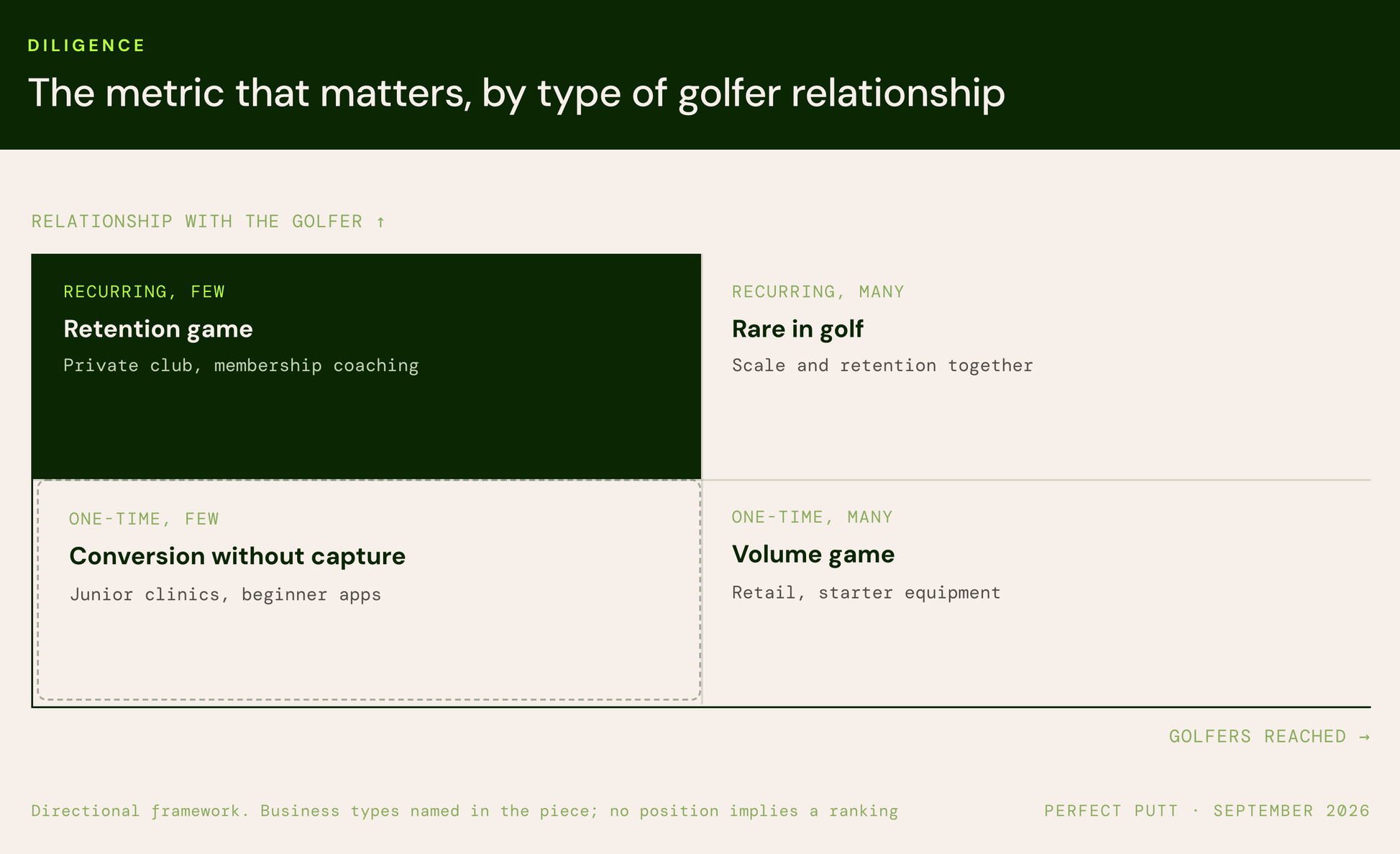
What this analysis does establish is where to look. A business earning a one-time fee from a large number of golfers is playing a volume game, where unit economics and repeat purchase rates matter more than any single customer's lifetime value. A business earning recurring revenue from a smaller number, a private club, a membership-based coaching program, is playing a different game, where retention matters more than addressable market size. A business that plays a role in conversion without capturing the value that follows needs a plan for capturing more of it, or an honest account of why it doesn't need to.
The best way to support Perfect Putt is to share it with a friend.