
The Geography of Golf Capital
Golf capital creates value through five channels: real estate, membership, hospitality and tourism, licensing, and technology. Which channel captures the return depends largely on who controls the underlying land.
Golf courses are expensive to build, and what capital can do with the land underneath it varies by place: buy it outright, ration who gets access to it, find it walled off from sale by trust or law, operate it on a sovereign's own terms, or face land constraints that make conventional development impractical. Each version of that question sends capital into a different channel, real estate, membership, hospitality and tourism, licensing, or technology, and the course itself is rarely where the return shows up.
What follows traces that logic across five channels, from land that trades freely to markets where ownership, regulation, or scarcity makes conventional golf development difficult.
Welcome to Perfect Putt, a newsletter covering the business and economics of the golf industry. If this was forwarded to you, subscribe to join 12,000+ readers who follow how capital flows through golf.
Read Time: 8 Minutes
Real Estate: The Value Lands Around the Course
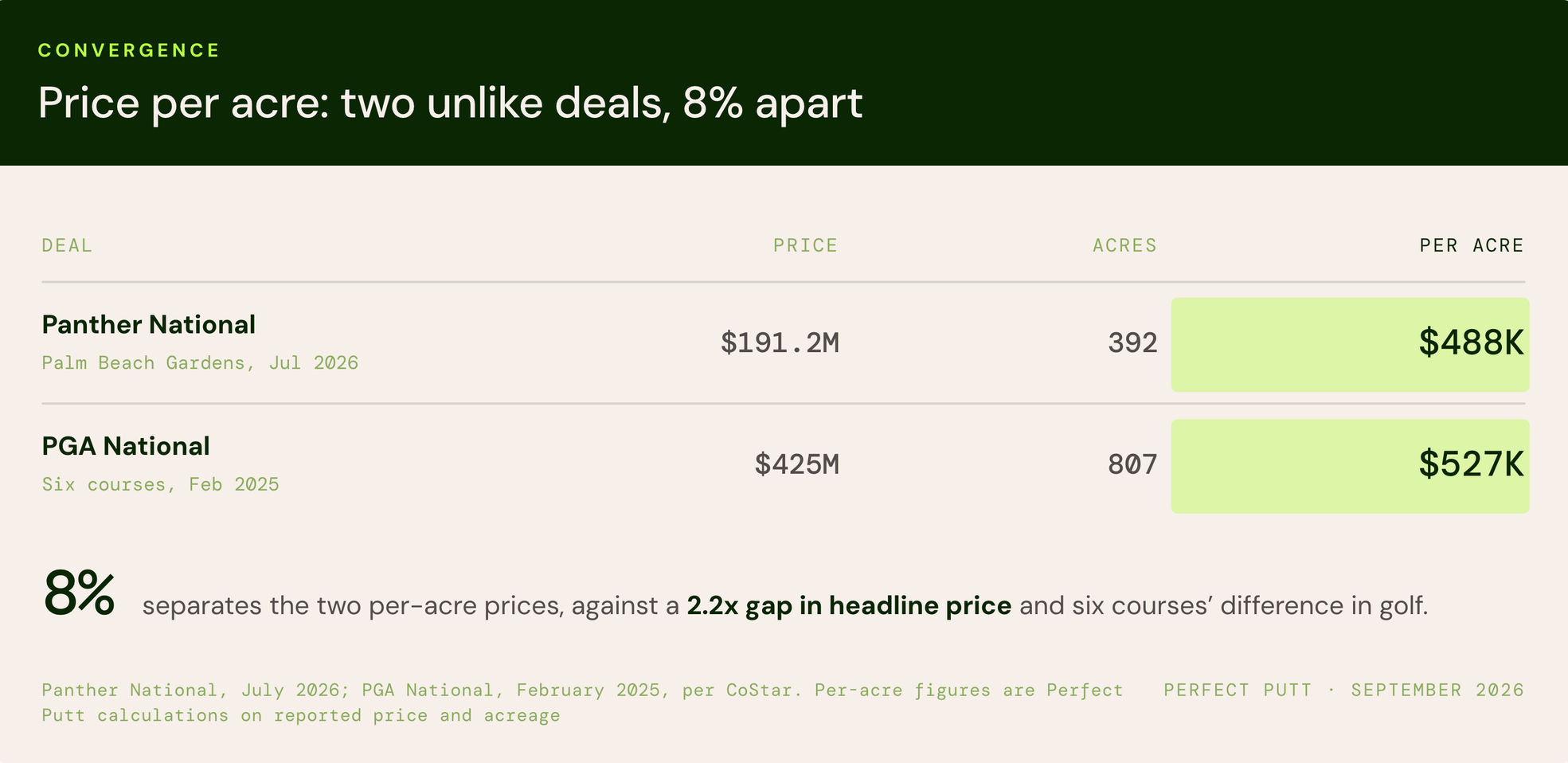
Real estate is the clearest channel, because the course itself does not have to generate most of the return. Panther National, 392 acres in Palm Beach Gardens, Florida, sold for $191.2 million in July 2026; PGA National, six courses on 807 acres nearby, sold for roughly $425 million in February 2025, per CoStar's reporting on the deal. Both transactions show how difficult it is to separate golf from the real estate and hospitality economics surrounding it. Private-club members represent less than eight percent of American golfers, yet more than half of U.S. courses under construction or active planning are private.
That value moves in both directions. GGA Partners, a golf-industry consulting firm, told Golf Digest that private clubs have raised the cost to join by 55 percent since 2020, with initiation fees now funding up to 65 percent of capital-improvement spending at some clubs, effectively turning new-member demand into a source of capital for the club itself. The building pipeline concentrates the same way: 29 new courses opened nationwide in 2024, the most since 2010, 35 percent of them in Florida, Texas, or South Carolina alone and more than 80 percent private, per the National Golf Foundation's Graffis Report. Course closures, meanwhile, hit their lowest rate since 2005.
Real estate can also create value through its tax treatment, although that value is subject to a very different test than a market sale. Golf-course acreage pledged as a conservation easement can support a charitable deduction based on the value of the development rights surrendered, but those valuations have faced heavy scrutiny in court. Of six golf-course conservation-easement cases reaching U.S. Tax Court, five were denied or reduced by more than ninety percent; in the Rose Hill case, a $15.16 million claimed deduction was ultimately valued at roughly $100,000. The distinction matters: appreciation is tested by what a buyer will pay, while an easement deduction depends on whether the claimed value survives tax and judicial scrutiny. Membership works differently again, because the club controls the supply of access itself.
Membership: Pricing Access to Scarce Land
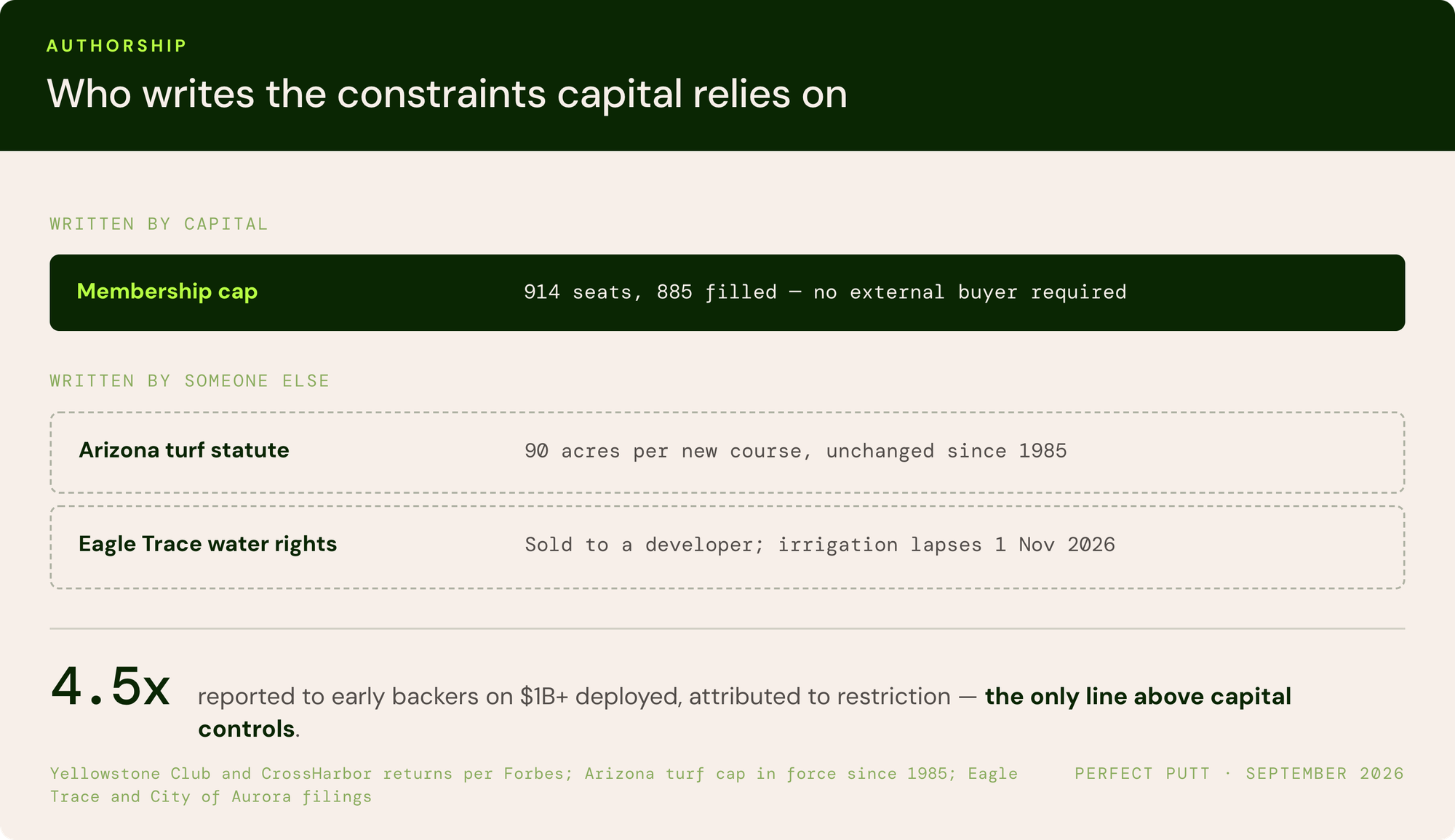
Membership sells scarcity without a land sale: a price capital can set through the amount of access it chooses to make available. Yellowstone Club caps membership at 914 and sits at 885; a refundable $500,000 deposit and $78,000 in annual dues buy access to real estate that starts at $10 million for raw land. CrossHarbor has put more than $1 billion into the property since a 2009 bankruptcy purchase, with early backers reporting, per Forbes' reporting on the club, a roughly 4.5-times return. The membership cap constrains supply, allowing the club to monetize scarcity as long as demand remains strong.
But membership still has inputs it cannot control. Water is one of them. Arizona has capped turf at new golf courses within its Active Management Areas at 90 acres since the 1980s, predating this capital cycle by four decades. The clearest case is Eagle Trace Golf Club outside Denver, where the course's historical water rights were sold to a developer, the city declined to spend an estimated $1.5 million to $2 million on replacement rights and infrastructure, and its temporary irrigation access lapses November 1, 2026, putting the course's future and roughly 500 surrounding homeowners in limbo. Self-imposed scarcity is a choice capital makes about membership. It is not always a choice capital gets to make about water, and at some of Scotland's most important golf assets, ownership itself is constrained.
Hospitality and Tourism: Capital Buys What It Can't Own Outright
Hospitality is one way capital participates when the course itself cannot be acquired conventionally. Some of Scotland's most important golf assets show why: ownership structures involving trusts and local authorities keep the underlying golf land outside a conventional acquisition market. The St Andrews Links are operated by the St Andrews Links Trust under a statutory structure, while Angus Council owns the land and courses at Carnoustie. Private capital can still participate around, and in some cases operate, these assets without owning the underlying golf land. Kennedy Wilson bought the hotel beside the Old Course for £32.4 million in 2014 and resold it in 2019, bundled with an unrelated business park, at an undisclosed price. Trump Turnberry's UK Companies House filings make the same broader point about hospitality economics: a first pretax profit in 2022, growing through 2023, then a loss in 2024 as rising finance costs erased a still-growing operating profit.
The contrast is gWest, a privately owned dormant Perthshire course that went on the market this month. Scottish agents describe the buyer pool as American, Middle Eastern, or Far Eastern capital, the same sources of capital appearing across golf hospitality and development elsewhere. The moment a course itself can be bought, the economic proposition changes: capital can underwrite the golf land and its development rights directly rather than capturing demand only through the hospitality layer around it. Licensing takes that logic one step further, allowing capital to participate without owning either the course or the hospitality layer around it, only the contractual right attached to land someone else already controls.
Licensing: What Survives Without Land Still Needs a Deal Behind It
Not every form of capital participation in golf requires ownership of the underlying land. Saudi Arabia provides one version through state-backed development. Golf Saudi operates alongside the Saudi Golf Federation and PIF-backed golf development, with PIF Governor Yasir Al-Rumayyan chairing both Golf Saudi and the federation. Its CEO was still issuing course-development targets in an August 2026 interview, with the country's course base expected to expand substantially through 2030. That is not licensing in the conventional sense, but it illustrates the broader point: capital can gain exposure to golf through a development mandate without buying each underlying parcel as a standalone golf investment.
Brand licensing is the more direct version. Qatari Diar, a developer founded and controlled by the Qatar Investment Authority, is building a Trump-branded course anchoring a $5.5 billion Simaisma tourism masterplan. Trump's 2025 disclosure reported roughly $12.5 million of management and licensing income from UAE projects that included the Trump International Golf Club in Dubai. In both cases, the brand economics sit on top of a masterplan or development someone else is already financing and building, requiring no golf-specific land purchase by the brand owner.
These structures shift rather than eliminate risk. A development mandate depends on continued institutional support and execution. A licensing agreement depends on the project being built, the counterparty performing, and demand materializing. Capital can participate without owning the land, but the economic right still needs a viable development underneath it.
When Land Runs Out: Capital Finds Another Channel
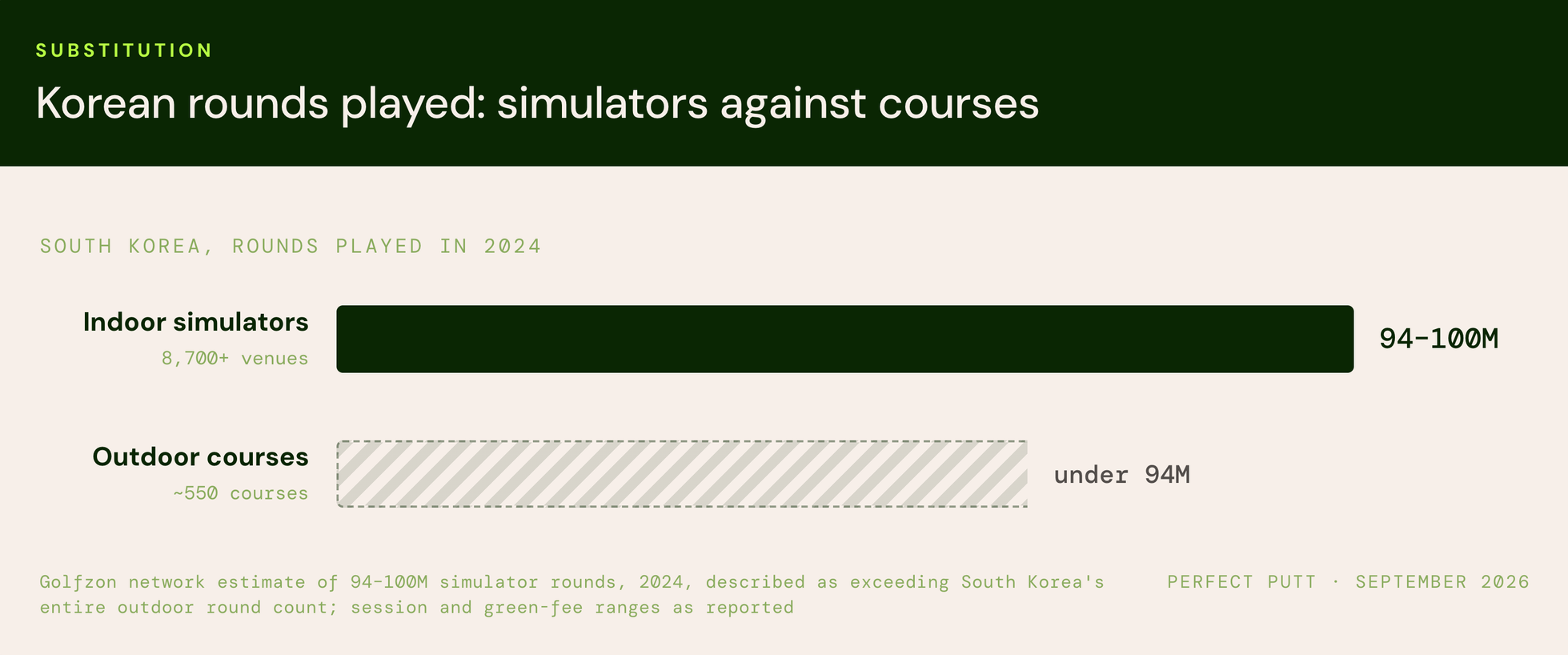
When conventional golf development becomes difficult, capital has to find another channel. Every channel so far assumes that land can support a conventional golf asset, even if ownership or access is restricted. Dense, expensive, or heavily regulated markets introduce another constraint, and capital finds other ways to serve the same demand. South Korea has, per Seoulz's count, roughly 550 golf courses for 51 million people against more than 8,700 indoor simulator venues; Golfzon's own network logged an estimated 94 to 100 million simulator rounds in 2024, more than the country's entire outdoor round count, at $12 to $20 a session against green fees running many times higher. The value there is built on square footage and franchise throughput.
China shows a regulatory version: a national moratorium on new golf-course construction, per the National Development and Reform Commission, has been in place since 2004 and never formally lifted. Enforcement has been uneven enough that courses continued to be built afterward, but the restriction makes conventional new-course development fundamentally different from an open land market. Where golf development proceeds, it does so within a regulatory environment that determines where and how projects can move forward, including tourism-oriented markets such as Hainan.
Vietnam provides a different contrast. The Trump Organization broke ground in May 2025 on a $1.5 billion golf and residential project outside Hanoi after the development received government approval. The groundbreaking occurred while the United States and Vietnam were engaged in active trade negotiations, and Reuters reported that Vietnamese Prime Minister Pham Minh Chinh said Eric Trump's visit had helped accelerate the project's administrative process. The chronology is notable, but the project itself remains fundamentally a golf and residential real estate development rather than evidence of a separate economic model built on the government relationship.
Across the three markets, the constraint is different: density and cost in South Korea, regulation in China, and a large approved development in Vietnam. The useful distinction is not that land disappears. It is that the economics and rules governing conventional golf change from market to market, pushing capital toward different formats and ownership structures.
Capital Implications
Follow that chain across five channels, from freely traded land to markets where conventional golf development is constrained, and the practical read for an allocator is that golf economics alone rarely explain the price. LIPG tracked 85 U.S. course sales in 2025 totaling $466.5 million, down from 2024 but still well above pre-pandemic transaction volume. That dataset captures conventional course transactions, while larger mixed-use golf assets can trade as resort, hospitality, or real estate deals outside that universe. Golf functions as the amenity, the membership product, the hospitality and tourism draw, the licensing hook, or the throughput play. The course creates the value. It is rarely where the entire return is booked.
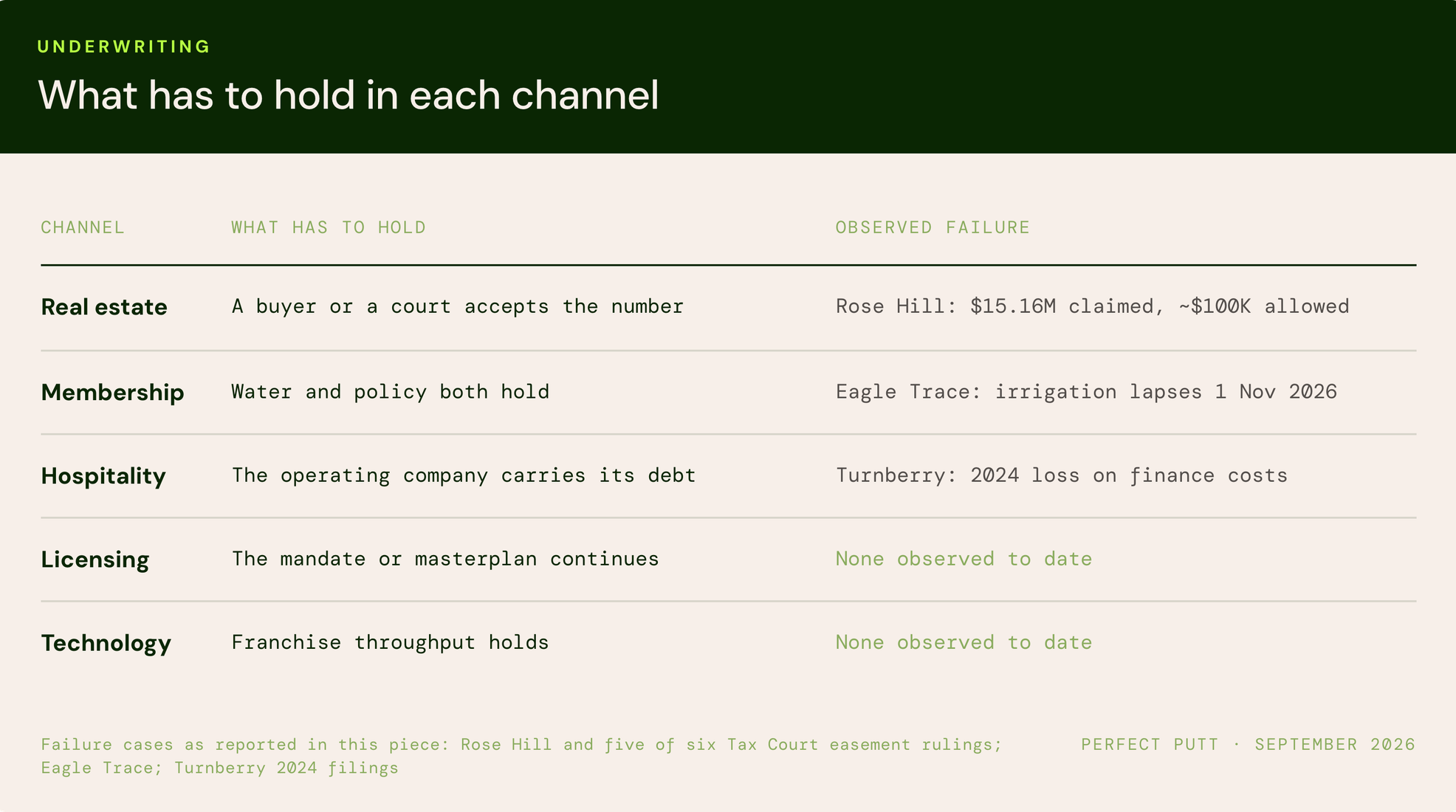
That is also why the downside case changes across every channel. Eagle Trace loses its water access, and the real estate premium built around it is exposed. Golf-course conservation easements can fail to support their claimed deductions when the underlying valuation does not survive judicial scrutiny. A state-backed building program carries execution and institutional risk, while a licensing agreement depends on the underlying project and counterparty. Where conventional development becomes impractical, capital can move the value elsewhere, including into simulator bays and other lower-footprint formats.
The underwriting question is not simply how many people play golf or what a round costs. It is whether the asset capturing the value, the real estate, the membership, the hospitality business, the license, or another economic right, holds up on its own terms.
The best way to support Perfect Putt is to share it with a friend.