
When One Hole Becomes the Main Event

How golf's most recognizable holes turn attention into hospitality, media, merchandise, and pricing power, and where the value actually gets captured.
An iconic golf hole does something for a course that ordinary architecture can't. TPC Sawgrass's 17th, a nerve-wracking shot to a green surrounded by water, and TPC Scottsdale's 16th, a stadium-built par 3 played in front of one of the loudest crowds in golf, are both genuinely difficult, distinctive holes. But their economic significance goes beyond the shot itself: a hole like that concentrates attention, golfers who build a trip around it, spectators who camp beside it all day, broadcasters who point extra cameras at it, and a public that shares and buys merchandise without ever visiting.
Welcome to Perfect Putt, a newsletter covering the business and economics of the golf industry. If this was forwarded to you, subscribe to join 12,000+ readers who follow how capital flows through golf.
Read Time: 8 Minutes
Hospitality Sells the View, Not the Round
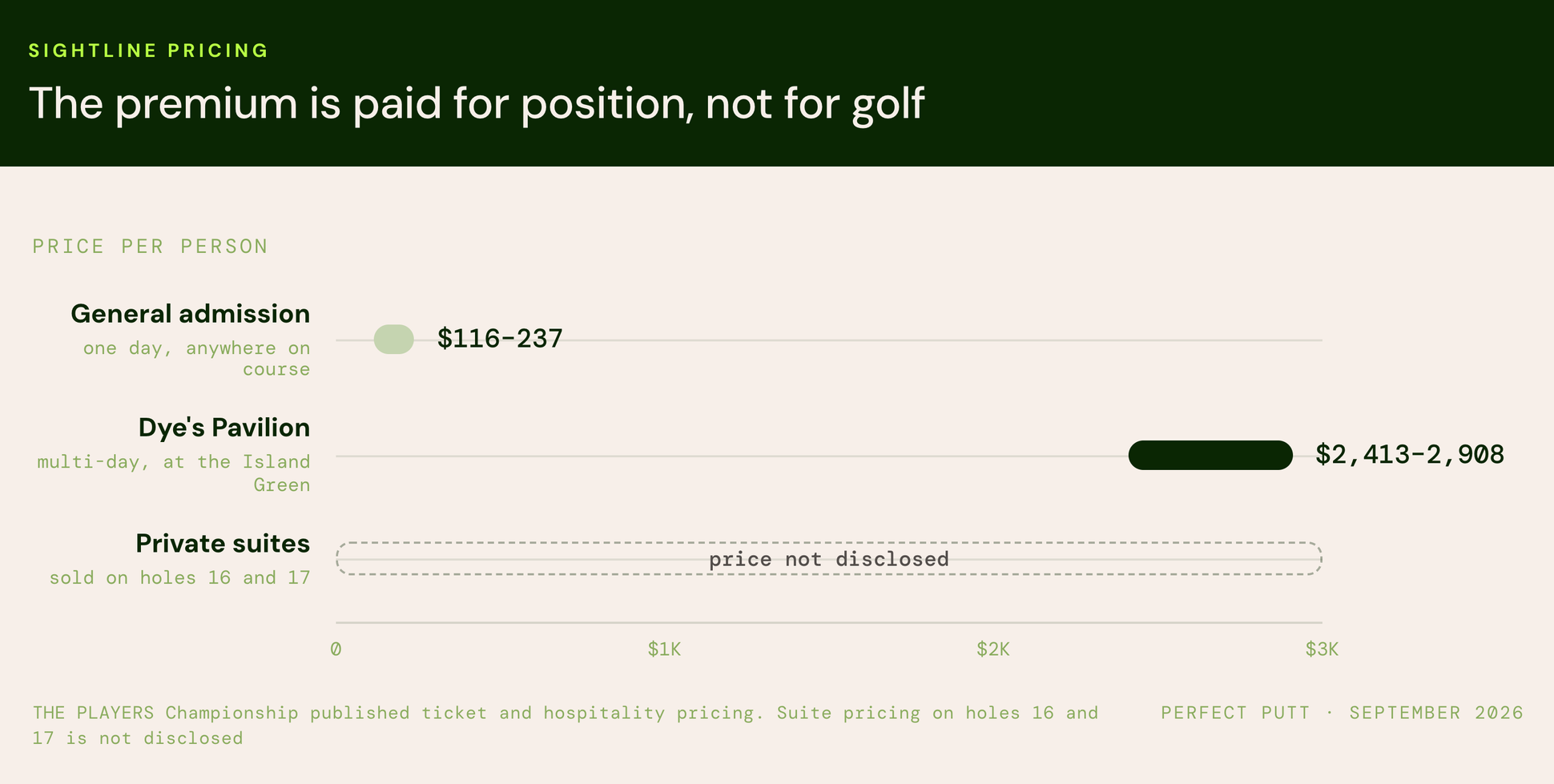
THE PLAYERS Championship offers a clear example of an iconic hole becoming a revenue-generating asset. A single-day general admission ticket ranges from $116 to $237, while Dye's Pavilion, at the 17th's Island Green, sells multi-day hospitality packages for $2,413 to $2,908 per person, and private suites are sold specifically on holes 16 and 17.
The important distinction is what the hospitality buyer pays for: not more golf, but scarce real estate around the event's most recognizable hole, a fixed footprint, an unobstructed sightline, proximity to where spectators expect the defining moments. Once attention concentrates on one green, that land becomes limited commercial inventory that, unlike merchandise or a broadcast impression, cannot be reproduced indefinitely.
That scarcity gives an operator something unusually tangible to monetize. The Island Green likely also creates value through television exposure, social sharing, and the Stadium Course's broader reputation, but those benefits are hard to isolate on a P&L. Hospitality is different: fame converts directly into a priced product tied to physical proximity.
A Waiting List Is a Price Signal
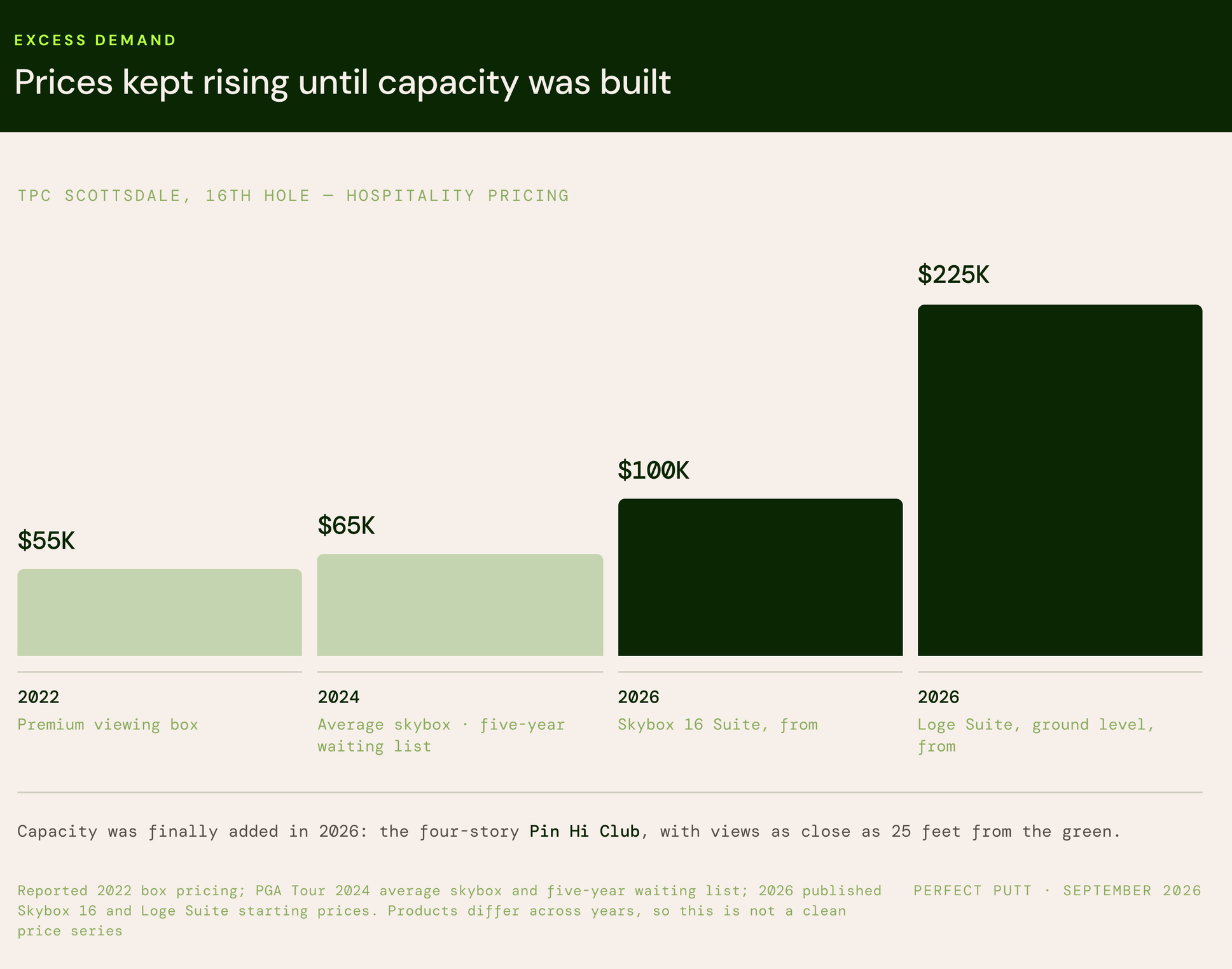
TPC Scottsdale's 16th takes the scarcity dynamic further. A premium viewing box was reported at $55,000 in 2022; by 2024, the PGA Tour put the average skybox at roughly $65,000 and cited a five-year waiting list. For 2026, a Skybox 16 Suite starts at $100,000, and a ground-level Loge Suite starts at $225,000. The products have changed over time, so this isn't a clean price series, but prices keep rising while demand keeps exceeding supply.
That is what should happen when attention concentrates around a physically constrained asset: only so much sellable space exists around one green, and adding capacity means actually building more of it. In 2026, organizers did just that, opening the four-story Pin Hi Club with views as close as 25 feet from the green.
One widely cited estimate puts the 16th's annual economic value at roughly $50 million, from an Arizona sports columnist with no published methodology, so treat it as directional rather than a valuation. More telling are the behaviors underneath it: six-figure hospitality products, years of excess demand, rising prices, and new capital deployed to expand capacity, making the 16th look more like scarce event real estate than famous architecture.
TPC Scottsdale's 16th also raises a question hospitality pricing alone can't answer: whether the stadium environment did more than monetize an already-famous hole. Concentrating spectators, noise, and cameras around one green can itself help produce the memorable shots that build a hole's reputation, each loud Saturday adding to a reputation that supports even higher prices the next year, attention and infrastructure reinforcing each other over time. The AT&T Byron Nelson is effectively testing whether that loop can be started deliberately: its 17th at TPC Craig Ranch was built as a stadium-style hole explicitly modeled on Scottsdale's 16th, rather than waiting decades for fame to build organically. It is too early to know whether Craig Ranch can match that pricing power, since part of Scottsdale's value comes from decades attached to the same turf, something capital cannot manufacture overnight. But copying the format is revealing on its own: it suggests operators believe infrastructure can help produce fame, not just capture it.
Attention Nobody Bills For
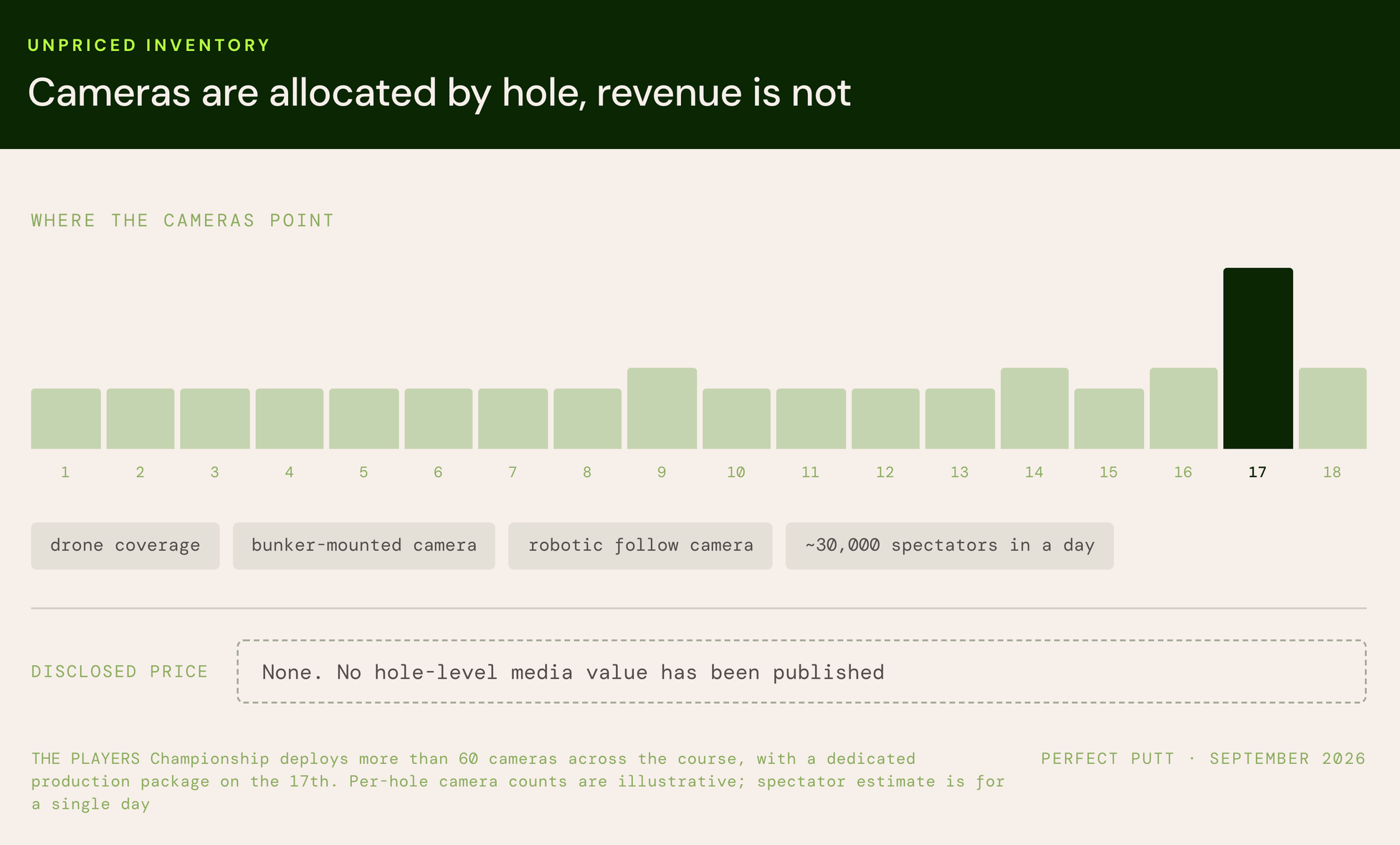
THE PLAYERS Championship deploys more than 60 cameras, but the 17th gets its own production package: drone coverage, a bunker-mounted camera, and a robotic follow camera tracking shots into the green, plus an estimated 30,000 spectators watching on a single day. Attention at a golf tournament is not distributed evenly across 18 holes.
That concentration has economic value, but not all of it flows to the same place. Every camera angle, replay, and spectator around the Island Green reinforces the image that sells hospitality, merchandise, and TPC Sawgrass's broader reputation, value that reaches the broadcaster and sponsors as readily as the course itself. Unlike the hospitality inventory around the green, none of that attention has a disclosed price.
Sponsorship-valuation firms routinely estimate the ad-equivalent value of a logo's broadcast exposure, but no comparable analysis has been applied to a golf hole. The 17th behaves like recurring media inventory without being accounted for as such, returning value every March because it reliably produces moments people want to watch. That value is not necessarily uncaptured, only unmeasured at the hole level, more likely folded into the tournament's broadcast rights and the course's overall reputation than isolated and priced hole by hole. Hospitality monetizes scarcity directly; media multiplies the attention that makes that scarcity valuable, without anyone yet measuring how much belongs to the hole itself.
The Image Travels Beyond the Hole
TPC Sawgrass sells roughly ten product designs built around the Island Green, apparel, hats, towels, and novelty items that sell the mythology of the 17th as much as the course itself. As the resort's director of merchandising put it, "It's our iconic hole," and customers specifically seek out products carrying No. 17.
That is a different kind of monetization: a suite sells scarce physical proximity to the hole, while merchandise lets the image travel. No sales volume has been disclosed, but a dedicated product line shows the hole has become a commercially recognizable brand asset, independent of the round itself.
Sponsorship points the same direction. In 2024, Jani-King Southwest sponsored a $100,000 hole-in-one contest at TPC Scottsdale's 16th, funding prizes rather than a disclosed rights fee, so it shouldn't be read as a hole-specific valuation. But the choice of hole matters: the sponsor deliberately attached itself to the reputation and audience concentrated around one hole rather than the tournament generally. Golf has stopped short of a formal rights market; merchandise and sponsorship show the image can sell, but neither tells us what it's worth.
The Hardest Channel to Isolate
The most intuitive economic argument for a famous hole is also the hardest to prove: that golfers choose a course, and pay more to play it, because of one hole.
Some evidence suggests individual holes influence where golfers want to go: in GOLF.com's 2024 reader survey, Augusta National's 12th was the most-selected bucket-list hole at 31%, ahead of Cypress Point's 16th at 15.5% and Augusta's 13th at 12.4%, one of the few data points asking about a hole itself rather than the course around it.
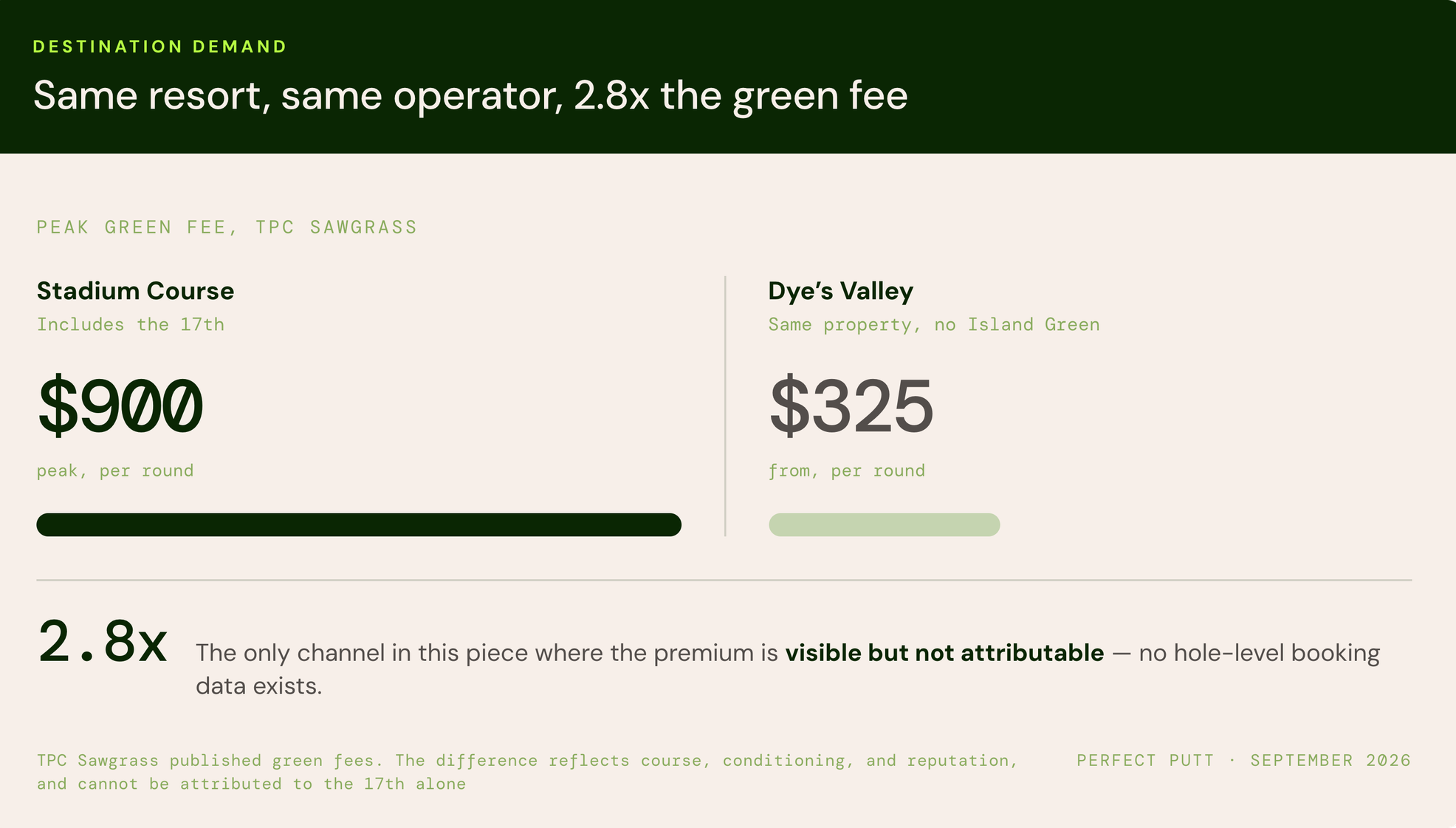
TPC Sawgrass offers a more direct comparison. The Stadium Course charges a peak green fee of $900, while Dye's Valley, its companion course at the same resort, starts at $325. Same operator, same property, but only one gives golfers a shot at the Island Green. The roughly 2.8x difference cannot be attributed to the 17th alone, but it is difficult to separate the Stadium Course's pricing power from the hole that defines its identity.
What's missing matters too: little public evidence isolates how many rounds, resort stays, or golf trips are generated specifically by one famous hole. Access restrictions at Pebble Beach and St Andrews apply to the broader course or resort, and no hole-specific booking or travel data surfaced in this research.
That makes destination demand different from hospitality. At Scottsdale's 16th, the economic chain is visible: limited inventory, disclosed pricing, a waiting list, new capacity. With rounds, the relationship is mostly inferred; a famous hole may be one reason a golfer pays to play a course, but the industry has done little to measure how much of the round's value belongs to that piece of turf.
Capital Implications
A structural tension runs underneath the economics of a famous hole. The products with the clearest pricing power, a skybox, a suite, a seat overlooking the Island Green, are scarce; only so much inventory fits around one green. The things that spread a hole's reputation furthest, broadcast coverage, photography, social content, work the opposite way, reaching millions without another seat being built.
That is the scalability paradox running through this piece: the easiest value to monetize is the hardest to scale, and the easiest value to scale is the hardest to monetize. Hospitality is scarce, measurable, and already selling at six-figure prices, but it is physically capped by how many suites and seats fit around one green. Media, imagery, and social reputation can reach a far larger audience with no such ceiling, but this research found almost no hole-specific measurement, and no disclosed way to convert that reach directly into revenue.
Those two sides still reinforce each other: distribution builds the fame that makes physical proximity worth paying for, and scarcity gives an operator something to charge for it. TPC Scottsdale shows what that loop looks like once running, six-figure hospitality products, a multi-year waiting list, new construction around the 16th, all evidence of capital following demonstrated demand. TPC Craig Ranch's attempt to copy the format bets that the same infrastructure can help start that loop elsewhere, not just monetize a reputation that already exists.
Beyond hospitality, the same pattern repeats: a hole can generate real value for the tournament, the broadcaster, sponsors, merchandise buyers, and the course's broader reputation without the operator capturing all, or any, of it directly. Merchandise and sponsorship show a hole's image is commercially real, but neither has enough disclosed data to size the opportunity. Media is the largest version of the same gap: cameras and airtime are clearly allocated to specific holes, but almost nothing measures social engagement or destination demand at the hole level, golf measures its economics almost entirely above the hole even where attention is concentrated below it.
That distinction matters for capital. The opportunity today is not "invest in famous holes"; it is identifying where concentrated attention can be converted into something measurable, scarce, and sellable. Hospitality already passes that test. Merchandise, sponsorship, and destination demand may eventually, but the evidence is still thin, and media remains the largest unresolved case: the industry clearly knows which holes attract disproportionate attention but has not built a standard way to measure or price it independently of the tournament around it. For an operator that already owns a genuinely iconic hole, the more useful question is not the turf itself, but the infrastructure built around its reputation.
The hole creates the attention. The investable asset is whatever turns that attention into something scarce, measurable and sellable.
The best way to support Perfect Putt is to share it with a friend.