
A Decade of Capital in Golf
What four deals taught us and the broader shift to golf as an institutional asset class.
Welcome to Perfect Putt, a newsletter covering the business and economics of the golf industry. If this was forwarded to you, subscribe to join 12,000+ readers who follow how capital flows through golf.
Read Time: 10 minutes
In April 2026, KSL Capital Partners agreed to pay $2.6 billion in enterprise value, roughly 8 times a $350 million EBITDA base, to reacquire a golf club platform it once owned. The company is called Invited Clubs today; most members still know it as ClubCorp. KSL bought it in 2006 for $1.8 billion, took it public in 2013, watched Apollo Global Management take it private again in 2017 for $2.2 billion, and is now paying $2.6 billion to get it back, financed through a $1.7 billion private credit facility led by Ares.
Run that math plainly: nine years, a genuine expansion in American golf participation, membership, and course revenue across the stretch, and an 18 percent gain in enterprise value. That is not a growth story. It is what a cost-cutting hold does to a brand, and what it costs to buy back, priced this time by the same private-credit lenders, Ares among them, now institutionalizing this kind of financing across sports and leisure real estate.
That single transaction is a useful place to start, because it forces a question most golf coverage skips: not whether private equity is active in golf, which it obviously is, but what kind of capital actually works in this category, why it works, and what kind quietly destroys value while looking, on paper, like discipline.
Four Ways to Own a Golf Asset
Ten years of golf dealmaking sorts into four repeatable patterns, each with a different relationship to leverage, growth, and time. Understanding which pattern a deal belongs to before it closes is most of what underwriting golf actually is.
The first is the strategic misfit: a corporate buyer acquires an asset sharing its customer but not its capital structure, lease profile, or growth mechanism. The second is the financial engineering harvest: a control buyer optimizes an existing asset for cash return, cuts cost, and holds through a cycle, preserving capital while eroding what made the asset valuable. The third is the thesis-driven platform build: a sponsor backs an operating idea before it has revenue, and compounds it through disciplined, opportunistic acquisition. The fourth is the growth partnership roll-up: a sponsor takes a position alongside existing management, funds acquisitions, and exits on a multiple within a few years. Four answers to the same question: what is capital actually doing here, and does the structure match the asset.
Today's Sponsor
This edition is brought to you by The Club, a private investment community from Old Tom Capital, built for golfers who are also serious investors. Hundreds of vetted members: operators, founders, and accredited investors who know the game from the inside.
Last year the team reviewed 600 investments and brought only the best into the room. Members have had a look at proprietary deals in companies like TGL (TMRW Sports), Grass League, Birdie Houses, TerraRad, and TRUE Linkswear.
Membership is $500 a year, with no obligation to invest in anything. They send the deals, you decide where to lean in.
The Strategic Misfit: Topgolf and Callaway
In 2020, Callaway Golf paid roughly $2 billion in an all-stock deal for Topgolf, betting that an entertainment venue operator with 30 million annual visitors could become a customer acquisition engine for golf clubs and apparel. The logic, on a slide, was clean: cross-sell equipment to casual visitors, build fitting centers inside venues, and use Topgolf's data to sharpen marketing across the portfolio.
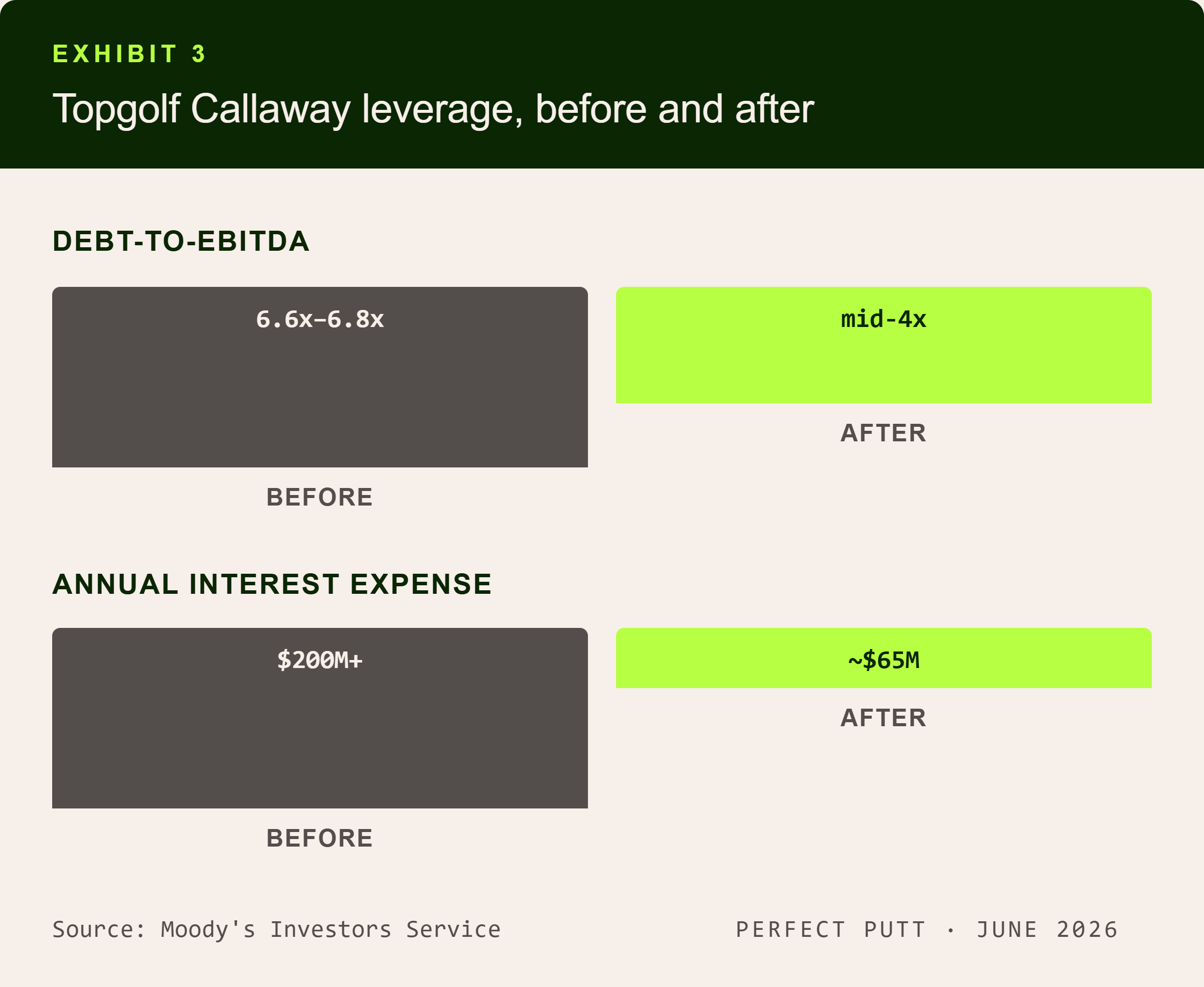
The logic broke on contact with the balance sheet. By December 2023, Topgolf Callaway carried roughly $1.2 billion in term loan debt and, more tellingly, approximately $2.9 billion in lease obligations, the weight of 15-to-20-year ground leases signed on 10-to-15-acre parcels before a venue proves out its economics. Combined debt-to-EBITDA ran to 6.6 times as of Moody's March 2024 review, which flagged that deleveraging below 5.5 times "would take longer than previously anticipated," pushing its outlook to negative on softening demand for corporate events and midweek outings. Interest expense on the combined entity ran north of $200 million a year. None of that is an equipment company's balance sheet. It is a real estate developer's, and Callaway had never operated as one.
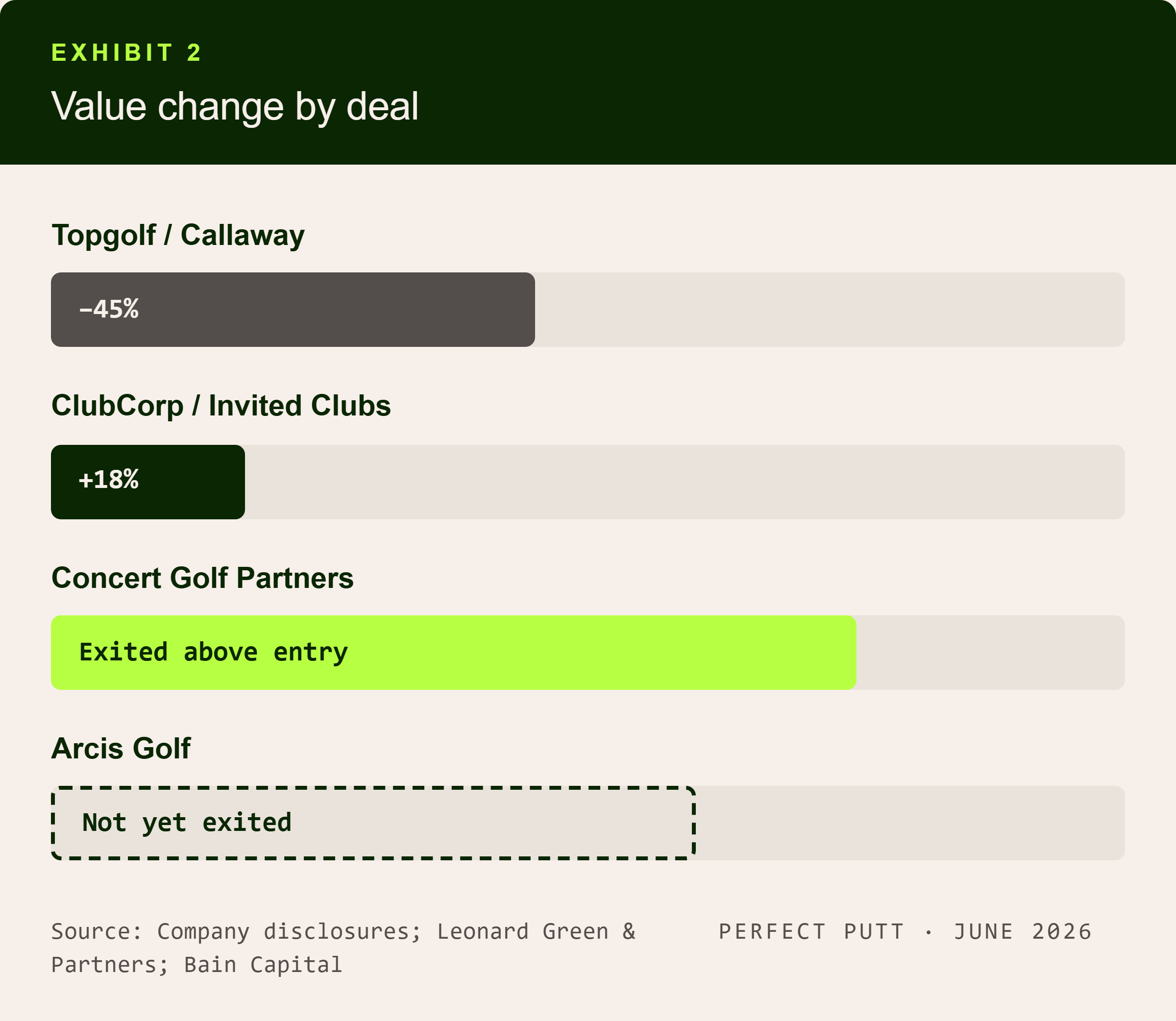
Five years after the acquisition, Callaway sold 60 percent of Topgolf to Leonard Green & Partners at a $1.1 billion enterprise value, a 45 percent markdown from the 2020 purchase price. Callaway kept a 40 percent stake, collected roughly $770 million in net cash proceeds, and used $500 million of it to prepay term debt at closing, taking pro forma cash to roughly $1.1 billion. The payoff was immediate and structural: interest expense on the standalone Callaway business dropped from over $200 million to an estimated $65 million, and Moody's confirmed a stable outlook in November 2025, projecting leverage would fall to a mid-4 times range in 2026 from 6.8 times that September, because separating the entertainment division simplified Callaway's capital structure and removed the venue financing burden.
The cross-selling that justified the deal in 2020 never showed up in a number management was willing to cite. What did show up was a real estate liability three times the size of the funded debt, invisible in 2020 and fully exposed once the Federal Reserve moved rates from near zero to restrictive. Leonard Green, whose portfolio already includes Troon Golf, Life Time, and Crunch Fitness, is a sponsor built to carry this kind of long-duration, real-estate-heavy risk. Callaway, a golf equipment manufacturer with a 40-to-50 percent margin and minimal capital expenditure, was not. That mismatch, not any flaw in Topgolf's underlying customer proposition, is what cost Callaway 45 percent of its purchase price.
The Financial Engineering Harvest: ClubCorp to Invited Clubs
Apollo's 2017 acquisition of ClubCorp bought a company with more than 200 properties and 430,000 members across the United States, Mexico, and China, at $17.12 per share, a 30.7 percent premium to the prior close, financed as $1.1 billion in equity against $1.1 billion in assumed debt. Under Apollo, the company was rebranded Invited Clubs and run on a control-buyout program: staff reductions and deferred course maintenance that preserved cash flow to service debt while eroding conditions and member sentiment across the hold, a pattern trade coverage of the private club industry has described consistently.
The 2026 exit reveals how that program actually performed. KSL's $2.6 billion enterprise value works out to roughly 8 times a $350 million EBITDA base, financed through a $1.7 billion facility led by Ares as administrative agent, with existing first-lien holders including Ares, KKR, HPS, and Lord Abbett priced at a spread of 475 to 500 basis points over SOFR against a 2032 maturity. KSL is folding the company into its own 47-course Heritage Golf Group to form a roughly 172-club combination larger than either Arcis Golf or Concert Golf Partners, with Mark Burnett, Invited's former president and now Heritage's CEO, returning to run it.
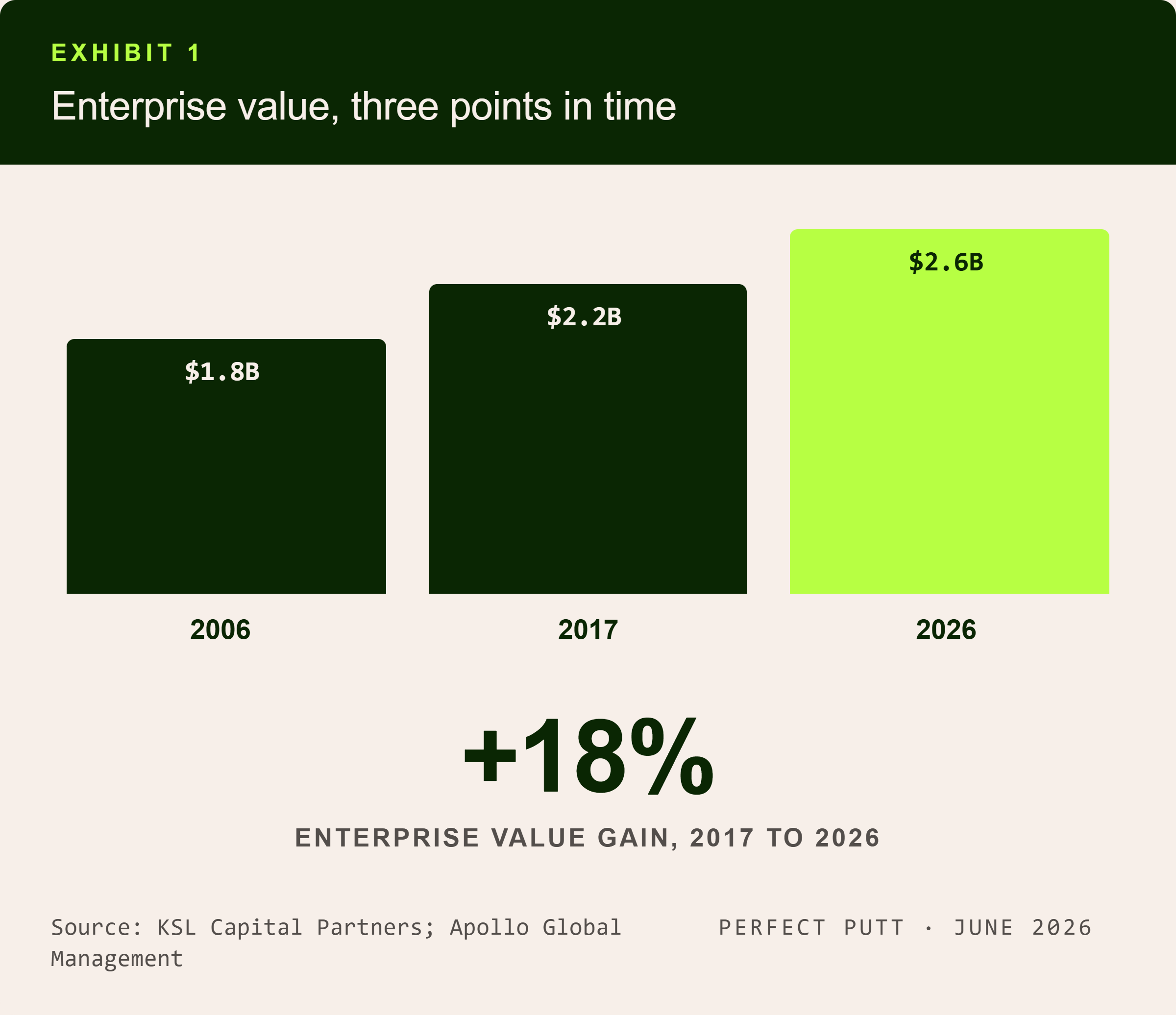
At a roughly stable multiple, that 18 percent gain reflects modest EBITDA growth financed largely by cost reduction rather than reinvestment or membership expansion, precisely what a control-buyout program is designed to produce: capital preservation and cash yield, not compounding. The brand erosion Apollo's program generated over nine years is now KSL's problem to rebuild, priced into the deal whether either side says so or not.
The financing is the sharper story. These same private-credit lenders are the exact mechanism Apollo's own research describes as filling a multi-trillion-dollar financing gap in sports and leisure real estate that traditional banks underserve. Apollo effectively wrote that playbook when it took ClubCorp private in 2017. A decade later, the same capital pool is financing the platform's exit to a different sponsor, proof the financing infrastructure has matured faster than the operating returns it supports.
Two of these four deals technically "worked," in the narrow sense the sponsor exited above entry basis. Only one, Concert Golf, worked by growing the business rather than cutting into it or riding out a cycle on borrowed cash flow. The table understates how different those two paths are, which is why each deserves its own dissection.
The Thesis-Driven Platform Build: Arcis Golf
In 2013, Blake Walker left ClubCorp with an operating thesis and no company. He had identified what he described as roughly $3.5 billion in near-term golf industry debt maturities, a hangover from the 2000s course-financing boom, as a buying opportunity, and pitched the idea to multiple sponsors before Fortress Investment Group agreed to back him, an unusual underwriting decision given Walker had no revenue, cash flow, or company to diligence, only the thesis. He took no compensation for his first six years running it.
The largest early acquisition tells a more precise story than Walker's own maturity-wall framing suggests. In June 2014, CNL Lifestyle Properties, a non-traded REIT, agreed to sell 48 golf courses to an Arcis entity for $320 million, following a strategic alternatives review the REIT's board had engaged Jefferies to run since that March. CNL Lifestyle described the sale as providing liquidity to its stockholders rather than as a distressed disposal, netting roughly $208 million after retiring about $90 million in property-level debt. Read plainly, that is not a maturity wall forcing a sale. It is a yield-oriented REIT, built to hold stabilized commercial real estate, recognizing it lacked the operating capability, agronomy management, membership sales, food and beverage, that golf courses require. Arcis, run by an operator rather than a REIT trust, was a buyer purpose-built for exactly that gap.
A further investment from Atairos in 2020 extended the balance sheet through the pandemic and funded continued acquisition. Today Arcis operates roughly 70 courses with 7,000 employees and 35,000 subscribers nationally, the second-largest golf course operator in the country behind ClubCorp itself, at an estimated institutional value of $1.5 billion, with management pointing to $2 to $2.5 billion as achievable in the near term.
Arcis has not exited, which is what makes it the most useful counterweight to ClubCorp: patient, thesis-first construction, a sponsor backing operating judgment before there was a business to underwrite, compounding through opportunistic acquisition rather than forcing growth on a fund's timeline. Whether it beats the harvest model in the end depends on how and when Fortress and Atairos choose to exit, and at what multiple. But the trajectory to date, real course growth, a rising valuation, no reported erosion in conditions, looks structurally different from a leveraged buy-and-cut.
The Growth Partnership Roll-Up: Concert Golf Partners
Clearlake Capital made a growth investment into Concert Golf Partners in April 2022, structured as a partnership with the founding management team rather than a control buyout, when the company operated 25 private golf and country clubs. What followed is worth naming directly: Centroid Investment Partners, the owner of TaylorMade Golf Company, joined as an additional strategic investor once the club count reached 27, citing an existing multi-year commercial partnership between the two companies. Centroid's managing director joined Concert Golf's board as an observer, and Paul Major, the former chief executive of American Golf Corporation, one of the largest club roll-ups of the 1990s, joined the board as an independent director.
That board composition is not incidental. American Golf Corporation's own roll-up, built a generation earlier on aggressive lease-based expansion, struggled through the 2000s as the format it pioneered proved harder to sustain than to build. Having its former chief executive sit on Concert Golf's board is a direct institutional-memory transfer between this decade's consolidation wave and the lessons of the one before it, and the TaylorMade stake creates a live commercial channel between equipment manufacturing and club distribution that neither Arcis nor Invited Clubs has.
Over roughly three and a half years, Clearlake backed 14 acquisitions and, by its own account, doubled both revenue and profitability, growing the platform to 39 clubs. In November 2025, Bain Capital acquired the business from Clearlake at a valuation north of $1.3 billion, with both firms describing it as a continuation of a long-term strategy of consolidating and operating private clubs across the country. The specific debt-to-equity split on the exit was not disclosed, so that figure should be read as directional rather than precise. What is verifiable is the shape of the deal: a partnership structure with existing management, a defined operating program, a disciplined acquisition pace of roughly four clubs a year, and an exit within four years that did not require cutting into the asset to generate a return.
What the Decade Actually Teaches
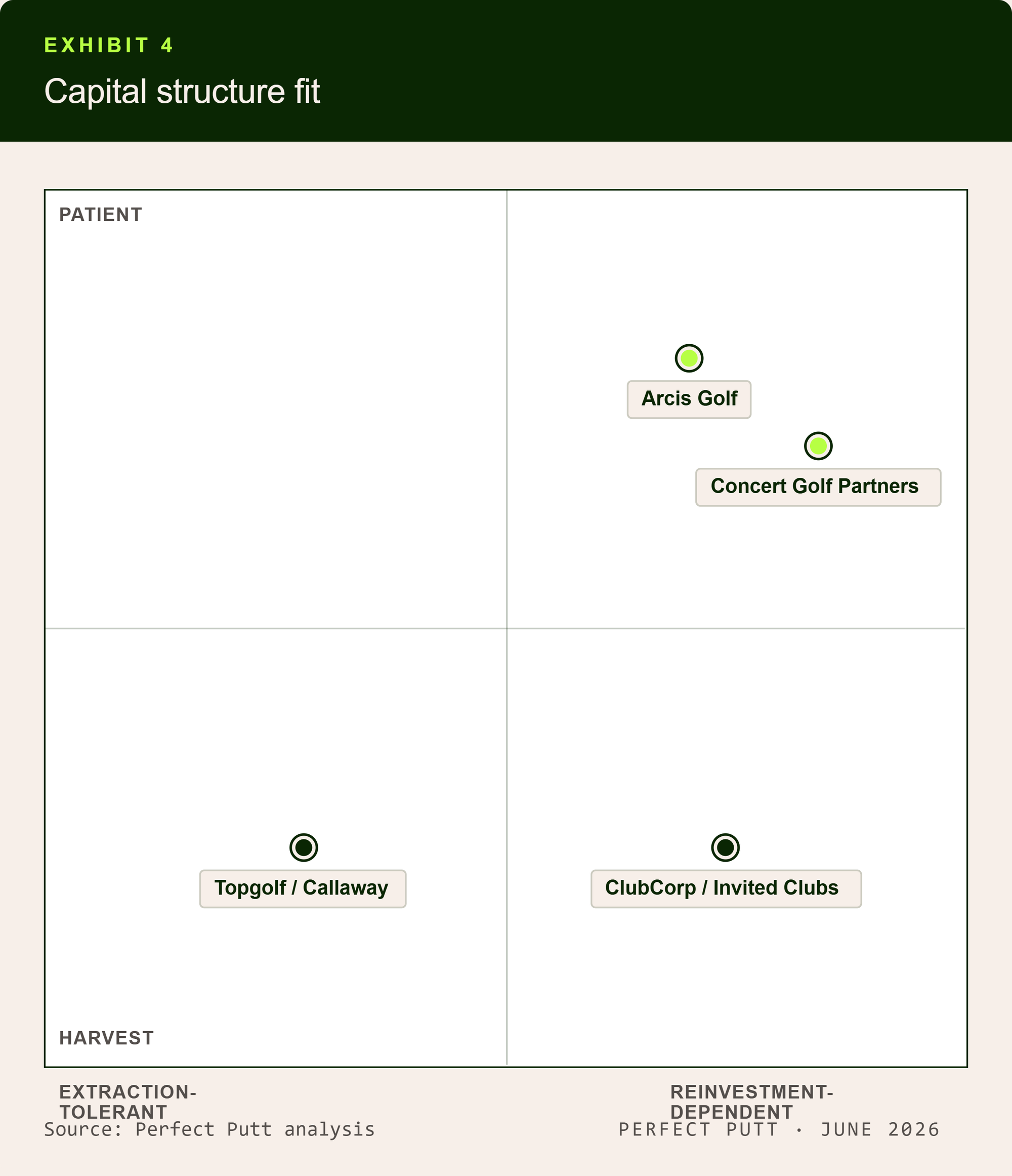
Line the four cases up and one mechanism holds across all of them: the deals that worked matched the capital's own constraints, cost of funds, lease appetite, operating capability, to what the asset actually required, and the deals that destroyed or merely preserved value forced a mismatched structure onto an asset that needed something else. Topgolf needed a real estate-literate, patient sponsor and got a golf equipment manufacturer's balance sheet; the mismatch showed up in the $2.9 billion lease book nobody priced correctly in 2020. ClubCorp needed reinvestment in course conditions and member experience and got a cost program, financed by the same private-credit infrastructure Apollo's own research says the industry needs, just deployed toward harvesting rather than building. CNL Lifestyle needed an operator and was a REIT, so it sold to one. Arcis and Concert Golf both received capital suited to genuine expansion, one through slow, opportunistic platform-building, one through a faster, board-connected partnership roll-up, and both compounded.
None of this is unique to golf, but golf's lease-and-land profile, membership relationships built over years and damaged in months, and a brand sensitivity that shows up in retention before it shows up in an income statement make a mismatched structure costlier, and slower to reveal, than in most consumer categories. A cost-cutting program on software shows up in churn within a quarter. On a golf club it shows up in course conditions and member sentiment over years, by which point the sponsor has often already priced an exit around it.
Capital Implication. For any golf asset under diligence, the underwriting question that matters most is not the headline multiple. It is whether the asset's growth mechanism, membership expansion, course acquisition, brand stewardship, requires patient reinvestment or merely tolerates cash extraction, and whether the capital being deployed against it is actually built to carry that specific liability profile, real estate development risk, REIT-style passive ownership, or operator-led platform-building. Assets that require reinvestment and receive extraction will preserve capital and quietly destroy long-term value, visible only years later in a markdown or a buyback at a modest premium. Structure the capital to the asset's actual mechanism, not to a fund's return target, and the returns tend to follow.
Thanks to Perfect Putt for giving us the floor. If any of this resonates, you can explore more of our thinking, portfolio, and approach at Old Tom Capital.
And for those who want to get closer to the opportunities and people shaping where golf goes next, take a look inside The Club.