
The Economics of the Caddie Program

Caddie programs are expanding beyond the private clubs that sustained them for generations. The operating model behind them has not kept pace.
A club can recruit, train, schedule, supervise, and price a caddie's work without technically employing or paying the person doing it. That arrangement has survived largely because it worked. As caddies spread across more of golf, the economics and employment structure supporting them are becoming harder to ignore.
That creates a different business question than whether golfers want caddies. It is what has to change for more courses to offer them.
Welcome to Perfect Putt, a newsletter covering the business and economics of the golf industry. If this was forwarded to you, subscribe to join 12,000+ readers who follow how capital flows through golf.
Read Time: 8 Minutes
The Caddie Market
Caddie fees average $113 for an adult round and $86 for a junior round nationally. At Pebble Beach, the contracted operator recommends roughly $120 a bag, close to the national average despite the property's prestige. In the New York metro area alone, the Metropolitan Golf Association counted more than 7,500 caddies working across roughly 200 clubs as of 2020, an average of more than 35 caddies per club.
Caddies have also stopped being an exclusively elite-club fixture. The number of courses in the $50 to $79 green-fee tier offering the service has roughly quadrupled since 2018, even as the total footprint grew 65 percent, from 775 to 1,282 courses. Clubs outside the traditional prestige tier are increasingly treating a caddie as a differentiator, not just an inherited tradition.
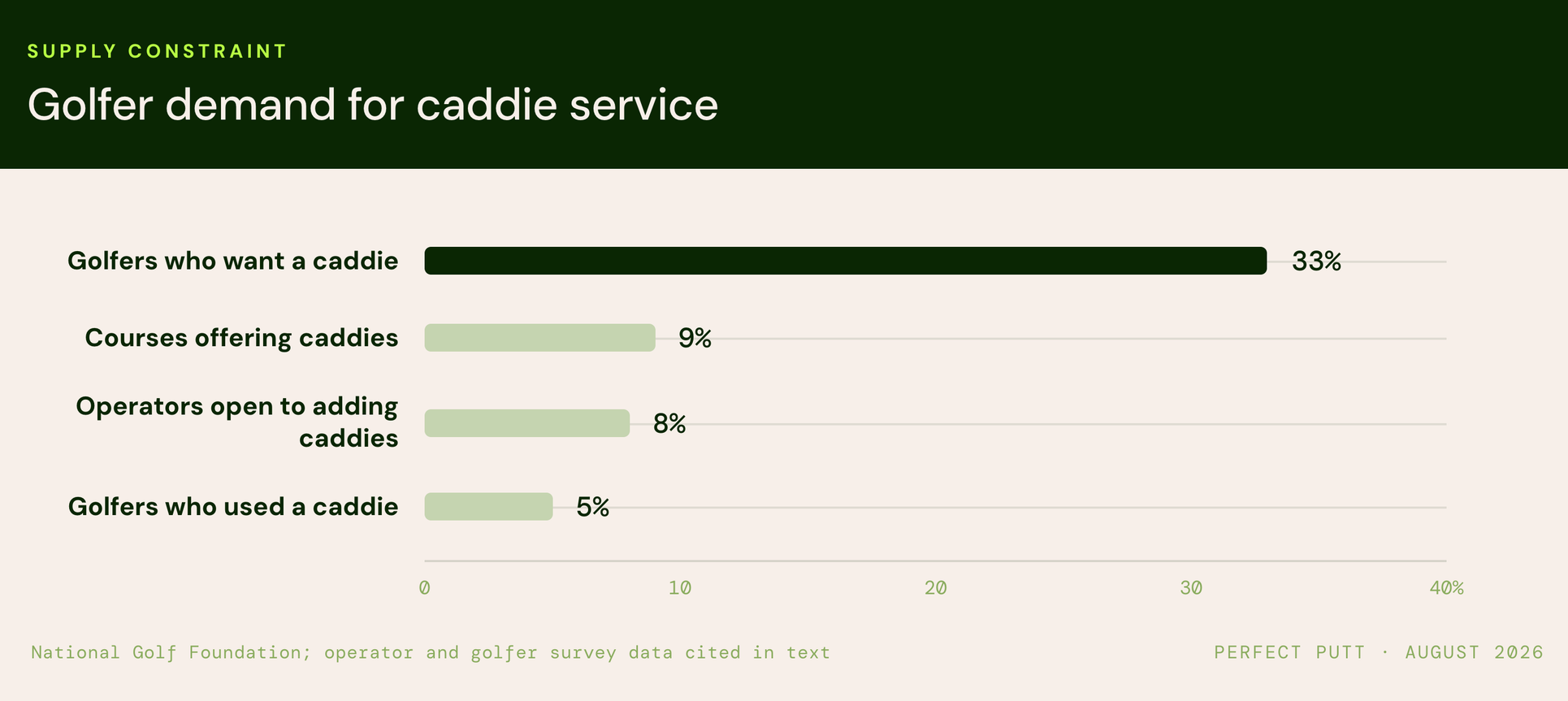
Even so, only 9 percent of U.S. courses offer caddies, and only 5 percent of golfers used one in the past year. Set against the third of golfers who wish they could and the 92 percent of operators who are not interested in adding the service, the shortfall does not look like weak demand. Golfers are willing to pay a fee approaching the cost of a round and consistently ask for the option.
The constraint sits on the supply side. Something about operating a caddie program costs a course more, in effort, economics, or exposure, than the additional service is worth.
How Caddie Programs Operate
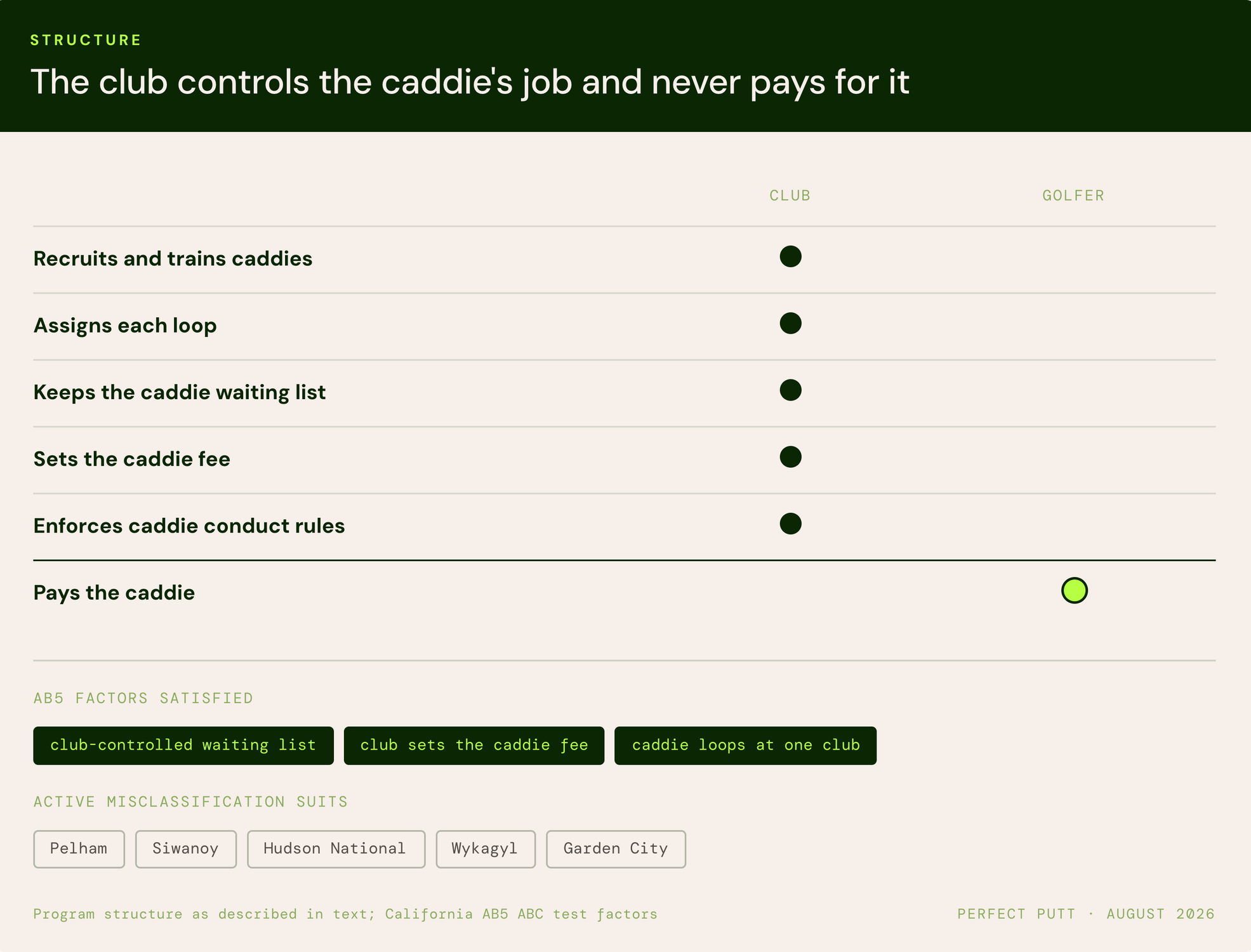
A caddie program is structured differently from almost every other job on a golf course. The club recruits and trains caddies, assigns loops, manages availability, and typically sets or recommends the fee. Yet the golfer pays the caddie directly, traditionally in cash.
That creates an unusual separation between control and employment. The club organizes, supervises, and prices work it does not directly fund, allowing it to offer a labor-intensive service without carrying the payroll and employment infrastructure normally attached to it.
Worker-classification law is putting pressure on that separation. California's AB5 test considers factors embedded in traditional caddie programs, including control over access to work, pricing, and whether workers independently serve multiple clients. Misclassification suits have been filed against several prominent New York clubs, while California's rules contributed to Pebble Beach's caddie operator seeking a legislative exemption. Some of the country's largest caddie markets also sit in states with stricter classification standards, concentrating the exposure where the service is most established.
If greater control ultimately brings greater employment responsibility, the economics change. Payroll taxes, insurance, workers' compensation, compliance, and payment administration move closer to the club or an intermediary willing to assume them.
The structure that historically made caddies inexpensive for clubs to administer is increasingly the same one creating demand for a new layer of infrastructure.
Employment and Payroll Infrastructure
Golf already uses that infrastructure for almost every other seasonal role on a course.
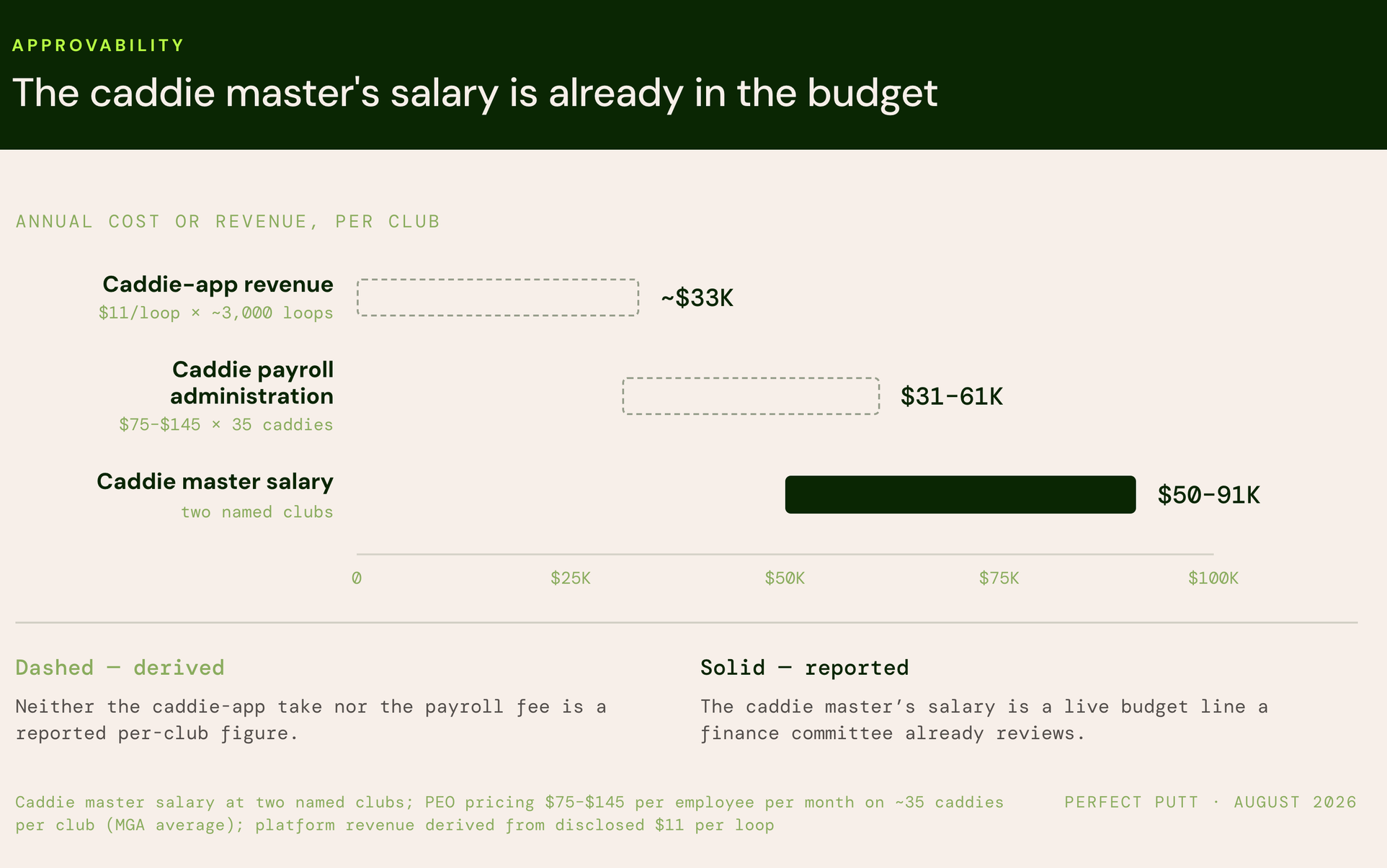
Golf-focused Professional Employer Organizations such as PEO Metrics and KeyHR provide co-employment payroll, seasonal onboarding, tip handling, unemployment administration, workers' compensation, and ACA compliance. Their services generally target clubs with 30 or more employees and cost roughly $75 to $145 per employee per month. The economic pitch extends beyond compliance: providers advertise workers' compensation savings of 20 to 45 percent through pooled risk and group health coverage 15 to 32 percent below what smaller employers might obtain independently.
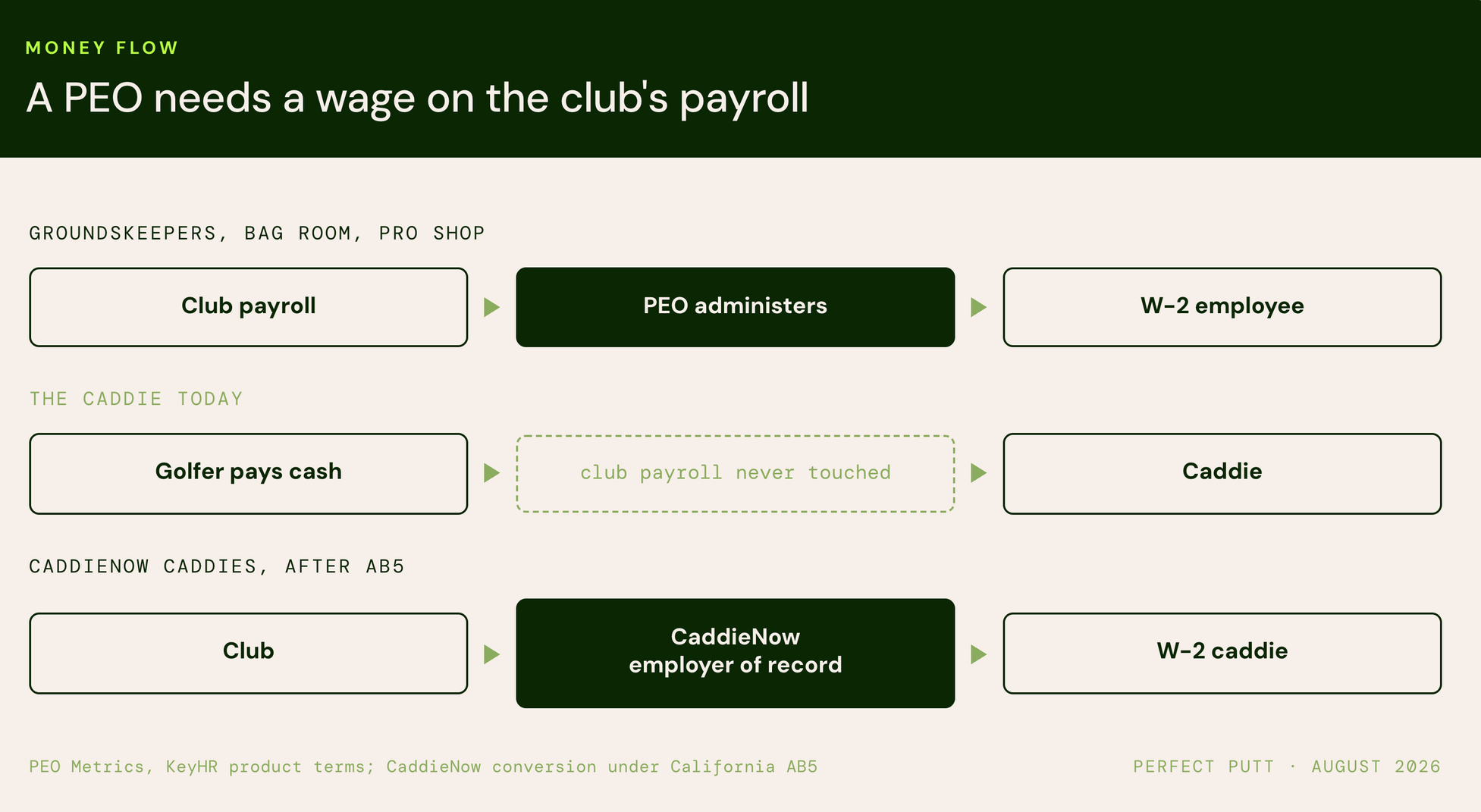
Groundskeepers, bag-room staff, and pro-shop employees can already sit inside that infrastructure. Caddies generally do not.
The reason is structural. A traditional PEO relationship assumes the employer pays the worker. Wages, withholding, workers' compensation reporting, and payroll administration then run through the employer before the PEO manages those functions. In the traditional caddie model, the golfer pays the worker directly.
Changing that flow of funds therefore matters more than simply putting scheduling software on top of the existing system.
There is already evidence that the structure can change. When California's AB5 forced the classification issue, CaddieNow converted its California caddies from independent contractors to W-2 employees. CaddieNow became the employer while continuing to place those workers at golf courses. The club itself did not have to absorb every caddie onto its own payroll.
That distinction opens a broader product opportunity. Once an intermediary becomes responsible for the worker, scheduling is no longer the entire service. Payments, payroll, insurance, compliance, onboarding, and labor management can sit inside the same relationship.
It also creates a harder economic test. Formal employment adds costs that the traditional caddie model was specifically structured to avoid. Payroll taxes, workers' compensation, administration, and insurance do not disappear because software manages them. An intermediary only creates durable value if the efficiency and risk transfer it provides are worth more to the course than the incremental cost of formalizing the labor.
The Economics of a Loop
The first generation of caddie technology monetized a much narrower part of that problem.
ClubUp, a Charlotte startup before Troon acquired it in 2022, provides the clearest disclosed example. Golfers paid $55 per round for a caddie booked through its app, tip included. ClubUp kept 20 percent and caddies received 80 percent, producing roughly $11 of platform revenue per loop. At the point those terms were reported, the company had serviced 175 rounds across four Charlotte-area clubs after raising a seed round described only as hundreds of thousands of dollars from roughly ten investors.
By the time Troon acquired it, ClubUp had grown to more than 8,000 independent-contractor caddies across 65 clubs and resorts, including Shinnecock Hills and Los Angeles Country Club. That represented a sixteenfold increase in club count from its early footprint.
What that growth produced in revenue was never disclosed. If the roughly $11-per-loop take rate remained and an average program generated a few thousand loops annually, an estimate rather than a reported figure, per-club platform revenue would likely remain in the low tens of thousands of dollars.
That is difficult software economics. Each course requires selling, onboarding, integration, and support, while no individual account necessarily produces enough transaction volume to become especially valuable. The model depends on aggregating many clubs and retaining them efficiently.
ClubUp nevertheless became strategically valuable enough for Troon to acquire. That distinction matters. The transaction demonstrates that organizing caddie labor has value inside a larger golf operation, but it does not establish that scheduling alone supports a large standalone software company.
The more interesting possibility is that the problem is economically meaningful while the first product built to solve it monetized too narrow a layer. A platform responsible not only for assigning loops but also for payments, employment, payroll, insurance, and compliance would have a deeper relationship with each course and more ways to generate recurring revenue.
Whether the economics support that broader model remains unproven.
Where the Market Consolidates
The regulatory pressure is concentrated where caddie programs are most established. While federal policy has moved toward a more flexible independent-contractor standard, New York, California, and Maryland maintain stricter classification tests. Those states also contain some of the country's densest and highest-value caddie markets, including Westchester and Long Island in New York and the Monterey Peninsula and Los Angeles corridor in California. The exposure is therefore not evenly distributed across golf; it overlaps with markets where caddie programs matter most.
Strategic activity remains limited. Troon, which manages more than 470 courses globally, acquired ClubUp in 2022 as part of a broader pattern of buying specialized services it can distribute across existing management relationships. Viewed that way, ClubUp does not need to become a major standalone profit center to create value. It can deepen Troon's relationship with a club while spreading its technology across a portfolio that already exists.
Other logical buyers have not publicly followed. Invited and Arcis Golf show little dedicated caddie infrastructure, while Jonas Software, whose broader Club Caddie platform serves more than 2,500 clubs, has not built or acquired a dedicated caddie product. That could reflect an immature category, limited recurring revenue, or simply the absence of an attractive target.
The common constraint is distribution and revenue density. A standalone provider has to acquire clubs one at a time against relatively modest account values. An operator, PEO, or vertical-software company can distribute the same product through relationships it already owns. As more of the caddie relationship moves from individual loops into contracted payments, payroll, compliance, and labor management, that strategic advantage becomes more valuable.
Troon's acquisition offers the first evidence of that path. The next stage of consolidation likely depends on whether caddie infrastructure can produce enough recurring revenue per club to make the category worth owning.
Capital Implications
The evidence points to a distinction between an attractive problem and an attractive business model.
Scheduling software alone appears too shallow. At roughly $11 of revenue per loop, the economics depend on aggregating a large number of courses without allowing sales and support costs to overwhelm relatively modest account values. ClubUp's eventual sale to Troon demonstrates strategic utility, but not yet the economics of a large standalone marketplace.
Employment infrastructure could change that proposition because it monetizes against expenses and risks clubs already carry. Caddie masters themselves represent meaningful budgeted costs, with disclosed salary ranges around $50,000 to $90,000 at individual clubs. Payroll administration, workers' compensation, insurance, compliance, and classification exposure create additional costs that are largely absent from a scheduling-only product.
A platform that consolidates those functions could capture more revenue per course, increase switching costs, and replace fragmented operating expenses with a recurring contract. That is a better foundation for durable enterprise value than collecting a small percentage of individual loops.
But formalization cuts both ways. Moving caddies into an employment structure adds payroll taxes, insurance, workers' compensation, and administrative costs that the traditional model largely kept outside the club. If an intermediary cannot offset those costs through labor efficiency, reduced administration, risk transfer, or greater caddie utilization, regulation may make programs less attractive rather than create a valuable new software category.
That makes the likely outcome more strategic than venture-scale. The natural owners are businesses that can spread the infrastructure across existing distribution: course operators such as Troon, payroll and PEO providers, or vertical-software consolidators once enough recurring contracted revenue exists.
The opportunity is therefore not simply to digitize a caddie program. It is to determine whether the fragmented responsibilities around employing one can be consolidated economically.
Caddie programs are growing while the structure that supported them for generations is becoming harder to sustain. If that transition produces a scalable business, the value will likely sit with the company that can absorb the complexity clubs increasingly do not want to carry themselves.
The unresolved business in caddies may not be helping golfers book one. It may be helping golf courses employ one.
The best way to support Perfect Putt is to share it with a friend.