
When Access Became an Asset

Japan’s golf-membership market shows what has to be true for access to behave like a financial asset, what happens when that structure breaks, and which of those conditions exist in the U.S. private-club market today.
In February 1990, a membership at Koganei Country Club outside Tokyo was valued at between $2.4 million and $3.8 million, with the higher figure reflecting an unsolicited offer the club reportedly declined. Membership was capped at just 300, including two former Japanese prime ministers. But scarcity alone does not explain what happened.
Japan’s golf memberships became financial assets because a market developed around them. Memberships could be transferred, financed, and valued independently of their underlying use. That distinction matters today. U.S. private-club initiation fees have risen sharply, but high prices alone do not make a membership a financial asset. The more useful question is what made that transformation possible in Japan, and whether the same infrastructure exists in the United States.
Welcome to Perfect Putt, a newsletter covering the business and economics of the golf industry. If this was forwarded to you, subscribe to join 12,000+ readers who follow how capital flows through golf.
Read Time: 8 Minutes
When Access Became Tradeable
Japan’s dominant club structure, the deposit membership, emerged in the early 1960s as a way to finance course development. Members paid a large, refundable deposit, typically eligible for repayment after roughly a decade, in exchange for access. Developers received capital without giving up ownership.
A 1975 Japanese Supreme Court ruling clarified what members owned: the right to use the club, a claim to eventual repayment of the deposit, and an obligation to pay fees. Japan’s tax authority similarly treats membership as a single composite contractual right.
The deposit paid no interest, making transferability critical to any value beyond use of the course. Clubs controlled transfers and charged fees ranging from roughly ¥100,000 to as much as ¥15 million at marquee clubs. By the early 1990s, an estimated quarter to a third of memberships were held by corporations, primarily for client entertainment but, according to some accounts, also as investments.

But the structure alone did not make membership a financial asset. It also needed a market price.
A cooperative of Kanto-region membership brokers formed in 1973. By 1990, licensed dealers were publishing indicative prices for individual clubs, giving buyers and sellers a visible reference point for membership value.
Some dramatic statistics from the period are harder to substantiate. Reports of a Tokyo trading floor handling 400 transactions a day, a membership index rising tenfold between 1982 and 1990, and a total market worth roughly $200 billion all appear in contemporary or later accounts, but the underlying data are difficult to verify.
The broader pattern is better supported. Trade publications described memberships as being “traded like securities,” while a 1994 account documented investor-members who rarely, if ever, played. A secondary market had separated the value of membership from the value of actually playing golf.
That explains how memberships could behave like financial assets. It does not explain why their prices became so extraordinary.
What Turned Scarcity Into Speculation
Scarcity explains part of the rise. Course construction lagged growing participation through the 1980s, corporate entertainment created durable institutional demand, and land constraints limited supply. But those conditions alone do not explain a market that reportedly appreciated 34.7 percent annually for five consecutive years.
Credit appears to have amplified demand, although the evidence is thinner than later accounts suggest. A 1990 report documented Tokai Bank offering loans of up to roughly $323,000 for membership purchases at approximately 9 percent interest over 30 years. Later accounts claim the membership certificate itself served as collateral, but the original report does not establish that. No second comparable lender or reliable estimate of total membership financing has been identified.
The evidence therefore does not support the full reflexive credit cycle often assumed in retellings of the bubble. Credit reached the membership market, but its contribution to the price increase cannot be quantified.
There is stronger evidence that the buyer base changed. A 1994 trade account documented clubs with significant numbers of investor-members who rarely played. When Japan eliminated a tax provision in 2014 allowing membership losses to offset other income, membership prices stopped tracking a rising stock market, further evidence that part of their value had been financial rather than recreational.
Reliable turnover and holding-period data from the bubble years are unavailable, so the effects of scarcity, credit, and speculative demand cannot be cleanly separated. But the structural change is clear: buyers no longer had to value membership solely for the golf it provided. Once expected resale value entered the equation, the price of access could separate from the value of access itself.
Follow the Loss
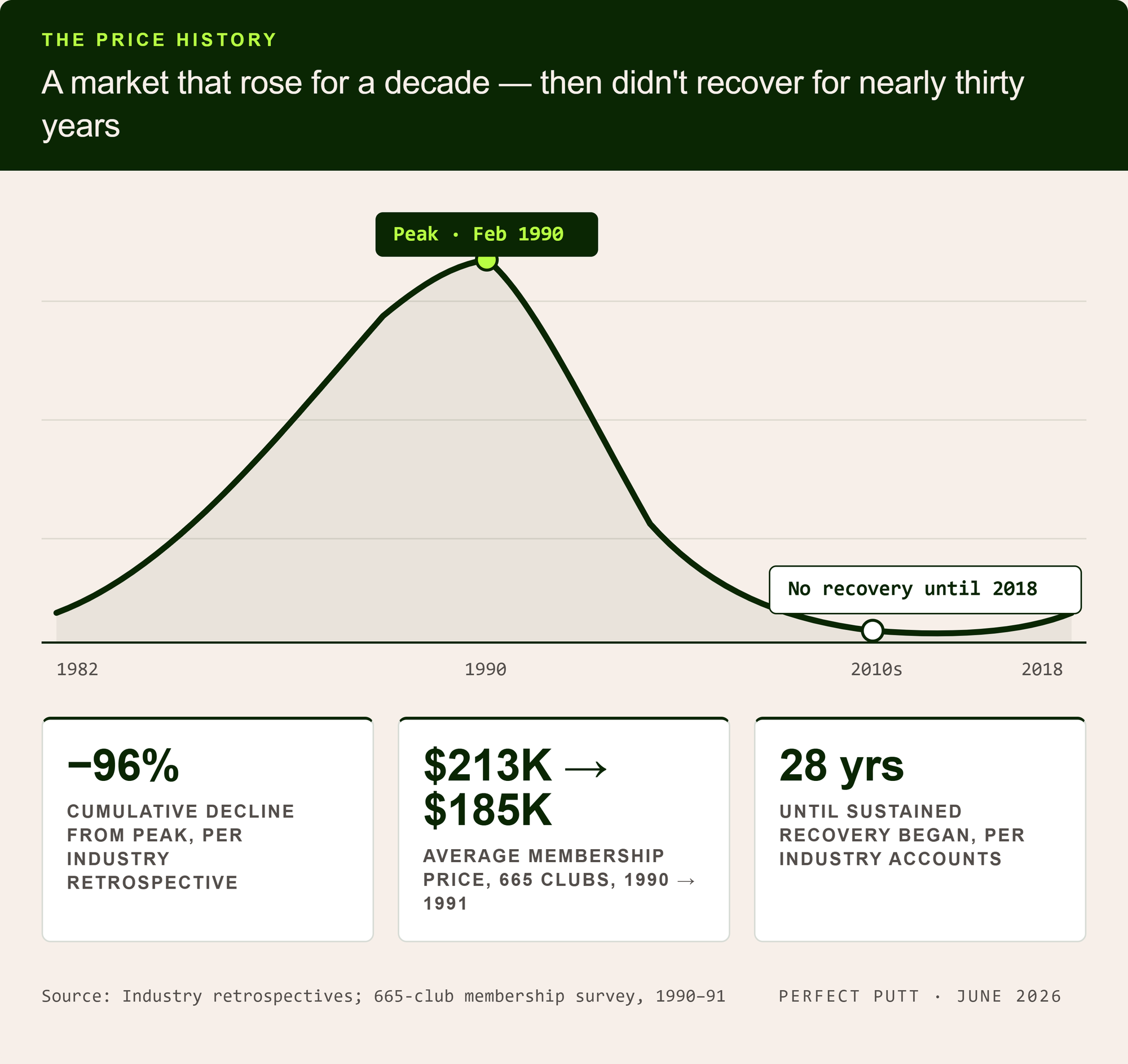
Japanese membership prices peaked around February 1990. A survey of 665 clubs found average membership prices fell from $213,000 in 1990 to $185,000 in 1991. By 1992, Japanese banks had largely stopped extending golf-related credit. One industry retrospective puts the cumulative decline from the peak at roughly 96 percent, with no sustained recovery until 2018.
But the collapse did not affect every claim equally.
The refundable deposit was an unsecured claim against the club operator, ranking behind secured lenders and certain priority claims. Under Japan’s Civil Rehabilitation Act, a court-approved restructuring could reduce that claim over a member’s objection. Documented cases show deposit haircuts of 80 to 99 percent.
The liability also did not automatically disappear when a course changed hands. Two Japanese Supreme Court rulings held that buyers retaining a club’s name could remain liable for predecessor membership deposits if they failed to promptly disclaim that assumption. The claims were often reduced to a fraction of face value, but still had to be underwritten.
What survived was the operating asset. Roughly 2,200 Japanese golf courses still operate today, with participation above 2019 levels. Membership resale values collapsed and deposit claims were heavily impaired, yet the courses continued generating revenue.
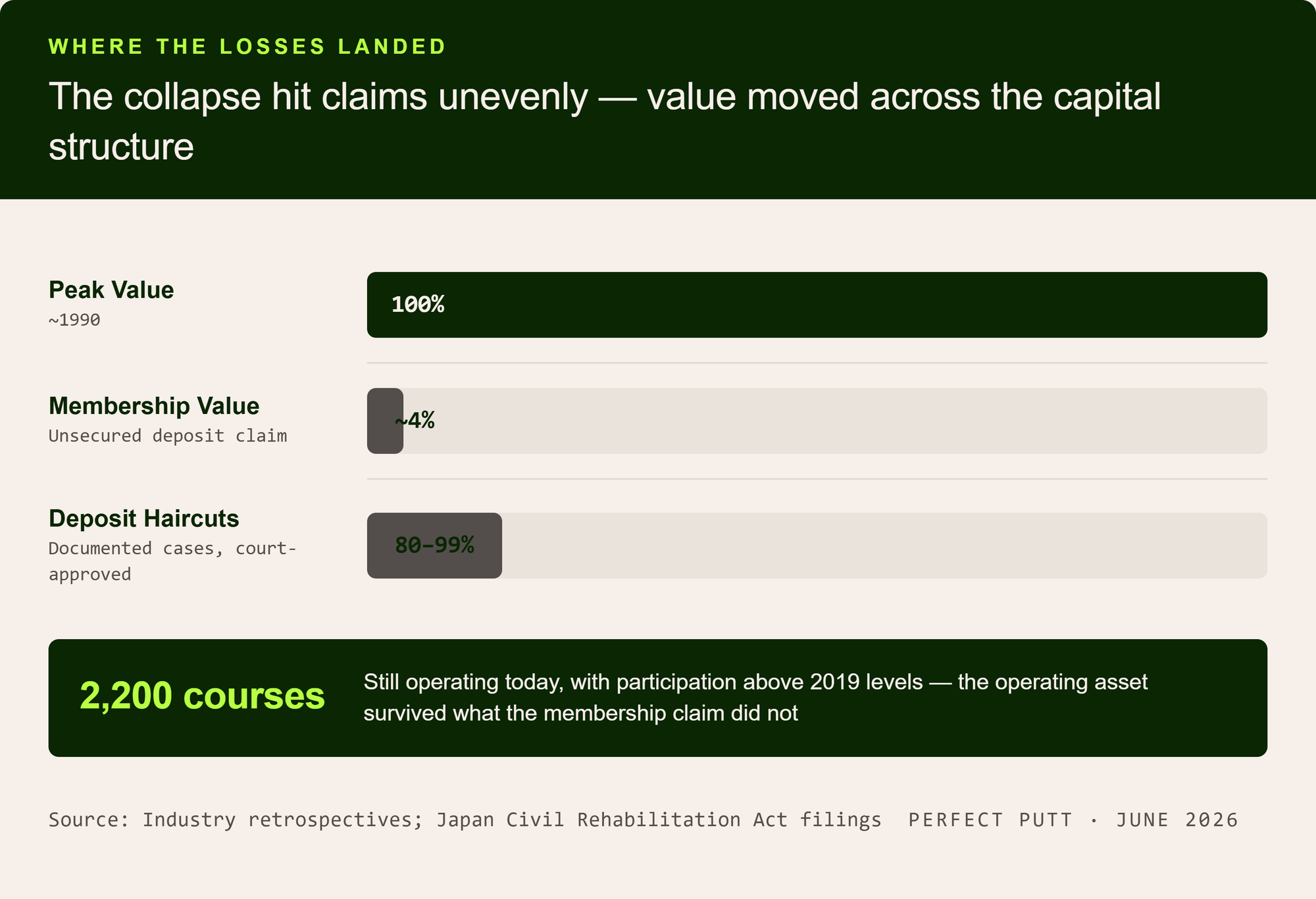
The golf asset did not disappear. Value moved across the capital structure.
The Second Trade Was in the Courses
That collapse created a different investment opportunity in the courses themselves.
Lone Star Funds began assembling what became Pacific Golf Management in 2001 from the bankrupt Chisan group, eventually reaching 111 courses by 2007. Goldman Sachs took control of bankrupt Nittoh Kogyo in 2003 and built what became Accordia Golf, growing from roughly 29 courses to nearly 60 within a year.
These investors were not betting on membership prices recovering. They acquired operating assets after surrounding claims had been heavily impaired, underwrote the remaining deposit liabilities, consolidated fragmented portfolios, professionalized operations, and centralized functions such as booking. Goldman later separated part of Accordia’s real estate into a publicly listed trust that raised roughly $560 million in 2014.
The opportunity narrowed as the businesses recovered. By 2007, Lone Star abandoned its target of 200 courses as bankruptcy bargains became harder to find. Per-course acquisition prices had risen two to three times from distressed lows while operating income had more than doubled year over year.
Neither investor captured Japan’s eventual participation recovery. Goldman exited its remaining Accordia stake in 2011, as did Lone Star with PGM, nearly a decade before golfer participation began recovering around 2020.
The distinction matters. Membership exposure and course-operating exposure were different investments. The collapse destroyed value for one class of claimant while creating a distressed entry point into the operating assets underneath it.
What America Has Reproduced, and What It Hasn't
U.S. private-club membership is up roughly 50 percent since 2019, according to National Golf Foundation data. Median initiation fees reportedly increased from $29,000 to $50,000 between 2019 and 2022. Zero Bond in New York reportedly has a waitlist above 10,000 people against only a few hundred annual admissions.
On scarcity and price appreciation, the parallels are clear. The similarity largely ends there.
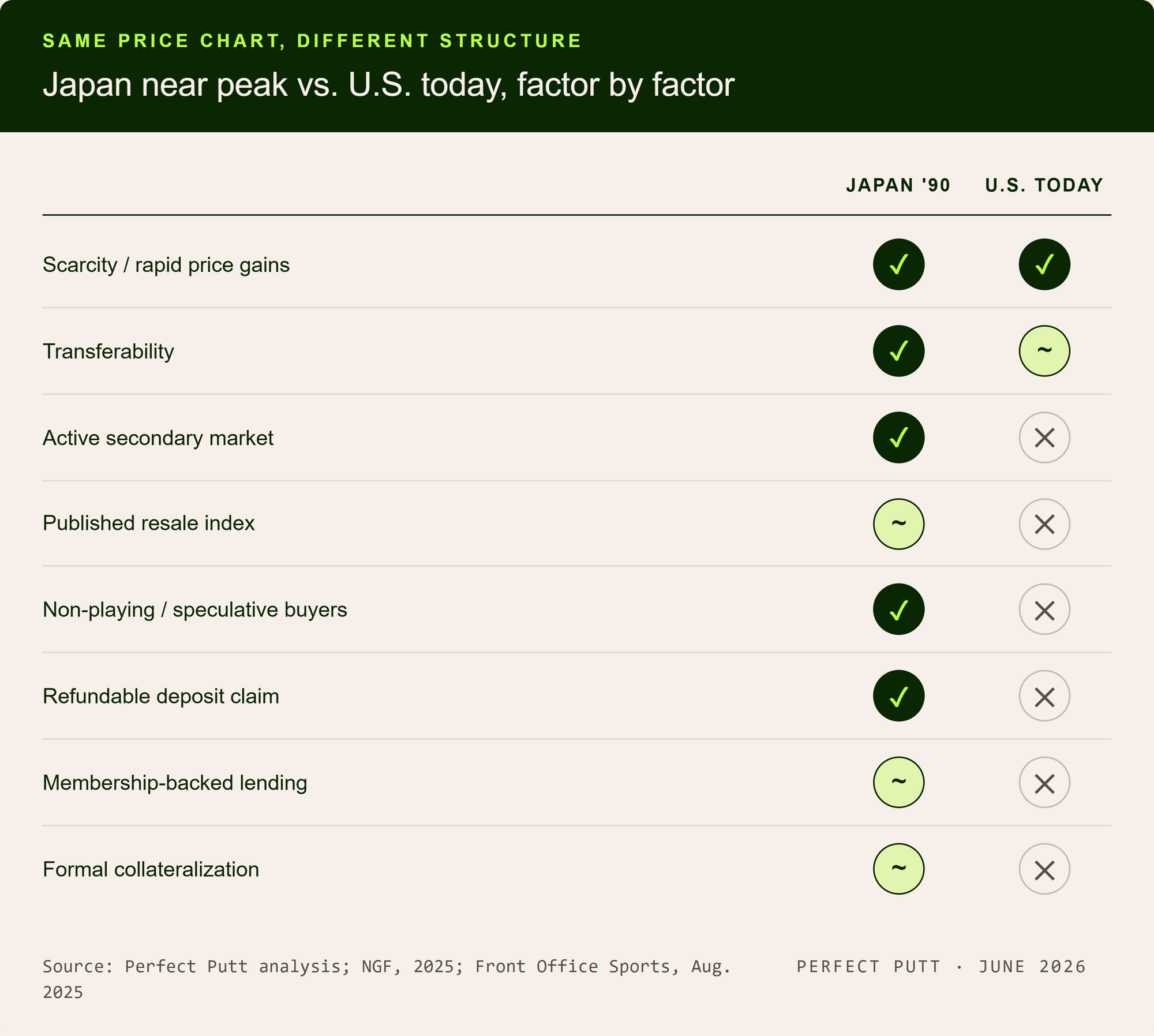
This research found no U.S. equivalent of Japan’s refundable deposit claim at scale, no lender treating membership equity as collateral, no standardized resale index, and no evidence of buyers purchasing primarily to resell. Japanese members held an unsecured financial claim against the operator. Most U.S. members hold no equivalent claim.
That changes how a downturn travels through each market. In a leveraged market, weakening demand can produce forced selling, collateral impairment, and lender losses. In a predominantly cash-funded market, it is more likely to appear through shorter waitlists, slower fee growth, and price concessions. Price tells you how expensive access has become. Capital structure tells you how a correction gets transmitted.
The relevant question, then, is what would make the comparison more meaningful. The clearest signals would be lenders accepting membership interests as collateral, standardized resale pricing, dedicated secondary marketplaces, shorter holding periods, or clubs partnering with financing providers.
One path is buyer-pool compression. As initiation fees at the highest end approach $500,000 and beyond, the number of buyers willing to fund the entire purchase from liquid assets should narrow. Financing could preserve demand at higher prices.
But it is not inevitable. Wealthy buyers may continue paying cash. Clubs may accept smaller buyer pools to preserve exclusivity. Fee growth could slow. Alternative membership structures could broaden access without leverage.
Financing is therefore a condition worth watching, not a forecast. Until it appears alongside transferability and a functioning secondary market, rising U.S. initiation fees remain primarily a story of scarcity and willingness to pay, not financial speculation.
Capital Implications
Price alone is a weak diagnostic. Japan’s memberships became financially fragile when scarcity was joined by transferability, financial buyers, and credit. Market structure determined how access was valued. Capital structure determined how losses traveled when prices reversed.
The U.S. has reproduced pieces of that structure before. Refundable and transferable equity memberships exist, and American secured-lending law provides a framework through which transferable property rights can potentially serve as collateral. What has not emerged is the system around them: standardized resale, broad transferability, transparent pricing, membership-backed lending, and a meaningful population buying primarily for appreciation.
That absence appears to reflect club design as much as legal constraint. Most private clubs tightly control admission and transfer, while many modern memberships provide access without a freely saleable ownership interest. Those restrictions preserve exclusivity, but they also prevent the liquidity and collateral value required for a financial market to develop.
There is also a natural regulatory boundary. A membership does not become a security simply because its price rises. But a structure marketed around expected appreciation or profits generated by others could raise securities-law questions that ordinary access memberships generally do not.
So the U.S. is not at the beginning of Japan’s cycle. It sits in a different structure altogether. Scarcity and rising prices are already here. Isolated examples of refundable and transferable memberships are here too. What remains absent at scale is the infrastructure that connects price to liquidity, leverage, and speculative ownership.
That is the threshold worth watching. If high initiation fees are eventually joined by transferable economic interests, organized resale, and credit against those interests, the comparison with Japan changes materially. Until then, America has expensive access, not a financialized membership market.
The best way to support Perfect Putt is to share it with a friend.