
The Architect Premium

Marquee architects have long played a role in how golf communities are designed, positioned and sold. How much economic value their names create, and where that value ultimately shows up, is harder to measure.
Welcome to Perfect Putt, a newsletter covering the business and economics of the golf industry. If this was forwarded to you, subscribe to join 12,000+ readers who follow how capital flows through golf.
Read Time: 8 Minutes
An architect's design choices can influence the economics well beyond the course. Developers may accept higher construction costs when those decisions strengthen the finished product enough to support higher pricing for memberships and surrounding homesites. The resulting value can extend across the broader development, while the developer ultimately controls how it is monetized.
That separation between who helps create the value and who captures it runs through the rest of this piece.
What the Name Buys
Golf development has a built-in information gap: buyers are often asked to commit before the course is finished. Homesites and memberships may be marketed before there is a finished course, an operating history, or a reputation built through rankings and word of mouth. A recognized architect can fill part of that gap.
Discovery Land Company founder Michael Meldman, whose communities have used Tom Fazio on roughly 15 courses, told LINKS Magazine that prominent architects' names “still resonate and make a difference” to buyers deciding whether to commit to something that does not yet exist.
The value is partly informational. A buyer who has never played the unfinished course can still form an expectation of it because the architect's name brings a body of prior work to a project with no track record of its own. Before the course can be judged on results, reputation gives buyers something else to judge it by.
That makes the architect's name potentially most valuable when the development itself is hardest to evaluate.
Measuring the Golf Premium
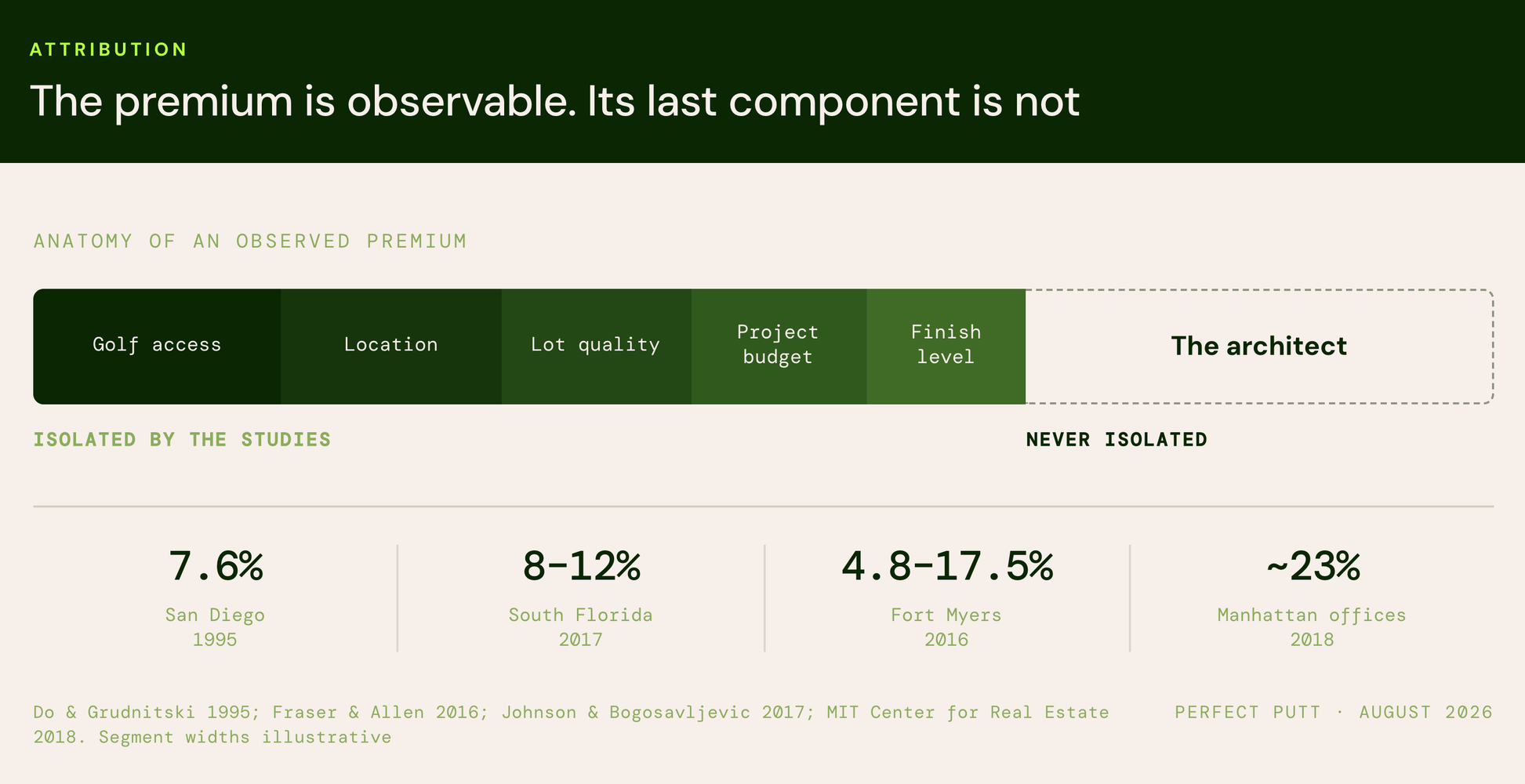
What can be measured is narrower than what gets marketed. Three peer-reviewed studies, spanning San Diego in 1995, Fort Myers in 2016, and three South Florida counties in 2017, found golf-adjacent homes carrying premiums of roughly 7.6 to 12 percent, with a wider year-by-year range reaching 17.5 percent.
None isolates the architect. Each compares golf-adjacent property with non-golf-adjacent property, or membership-bundled units with non-bundled ones, within a development or metro area. No peer-reviewed study isolating a Nicklaus-specific or Doak-specific premium, separate from the value of golf itself, turned up in this research.
The closest analogue comes from another asset class. A 2018 MIT Center for Real Estate study of Manhattan office buildings found a roughly 23 percent transaction-price premium associated with award-winning architects. But the authors could not cleanly separate the architect's contribution from the larger budgets and higher-quality projects on which prominent architects tend to work. Even with decades of transaction data and a hedonic-regression framework, attribution remained difficult.
Golf presents the same problem with fewer transactions and less data. Developers hiring a marquee architect are making a capital-allocation decision, often a seven-figure one, without a reliable benchmark for the incremental return on that spending.
That does not mean the architect creates no economic value. It means mature property prices may be the wrong place to look for all of it.
Architect Economics and Value Capture
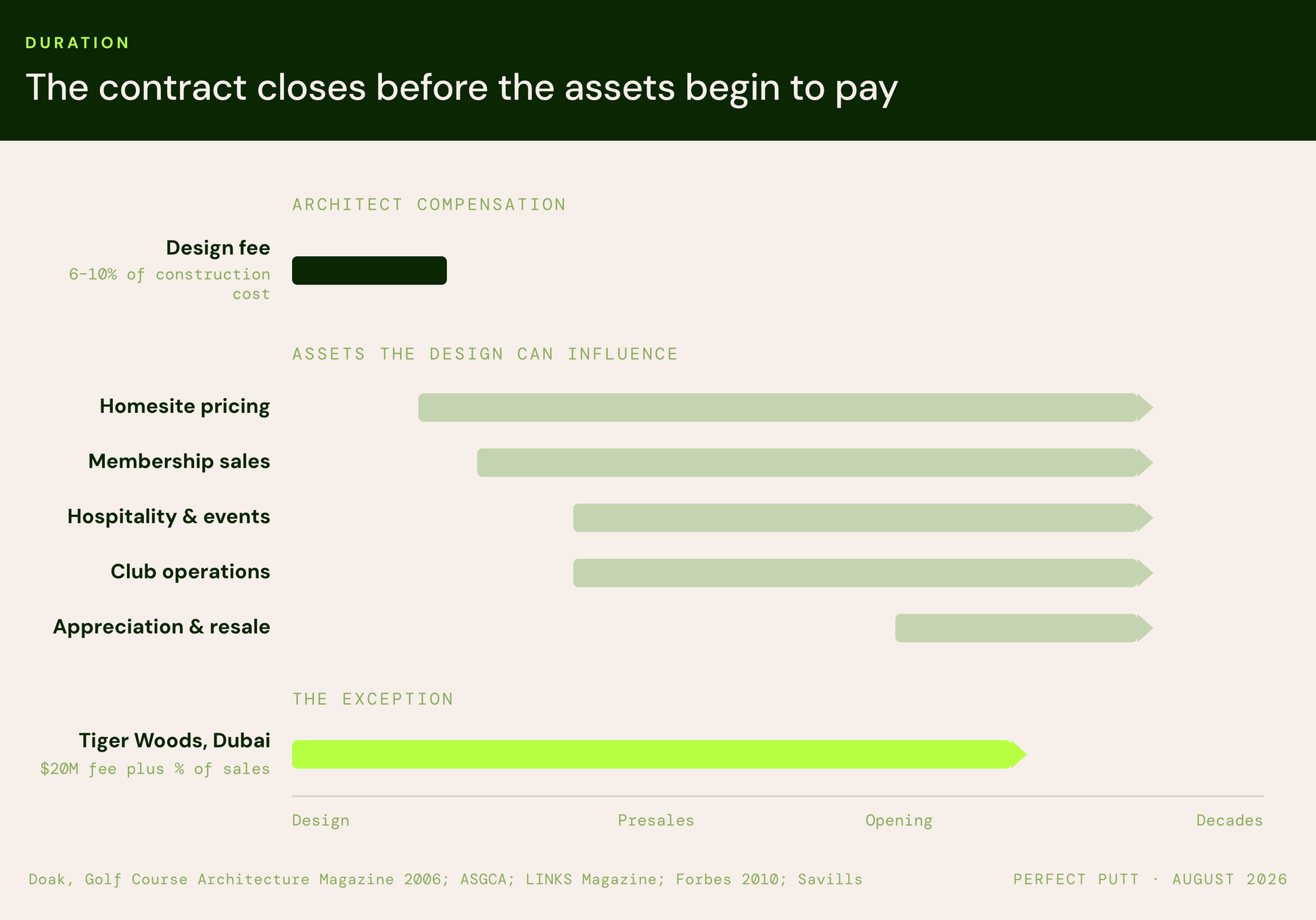
The next question is how much of that value flows back to the person supplying the name. Golf architecture has historically operated as a fee-for-service business, with compensation tied to the design engagement rather than the performance of the surrounding development.
Tom Doak described the disconnect in Golf Course Architecture Magazine in 2006, writing that fees were “based vaguely on name reputation, but not really on value.” He was experimenting with royalties tied to course profitability at the time, but performance-based compensation does not appear to have become standard practice.
The industry's trade body still describes golf architects as being compensated much like other design professionals. That differs from branded residential real estate, where brands and operators can receive royalties tied directly to property sales. Comparable arrangements in golf architecture remain rare.
Discovery Land Company illustrates the divide. Tom Fazio has designed roughly 15 of its courses, but Discovery owns the land, memberships and operating assets through which any increase in value or recurring revenue is ultimately realized. The architect earns a design fee; the developer retains the economics of the broader development.
Tiger Woods' reported 2008 Dubai agreement was a notable exception. His $20 million design fee also included a percentage of real estate sales, extending his compensation into the development his name was helping market. In effect, the structure gave him participation in some of the asset-level economics that golf architects typically leave with the developer.
The distinction matters because creating economic value and capturing it are separate questions. A marquee architect may help strengthen demand for an entire development, while owning few, if any, of the assets through which that demand is monetized.
Where the Premium Shows Up
Mature home prices may capture only part of the potential economic effect. For a developer, when inventory sells can matter almost as much as what it sells for. Faster presales and absorption pull cash flows forward, reduce the amount of capital tied up in the project and shorten the period over which the developer carries inventory risk.
Lenders already treat absorption as more than a marketing statistic. The Office of the Comptroller of the Currency (OCC) incorporates projected absorption rates into its guidance on speculative construction lending, making sales velocity an explicit consideration in financing risk.
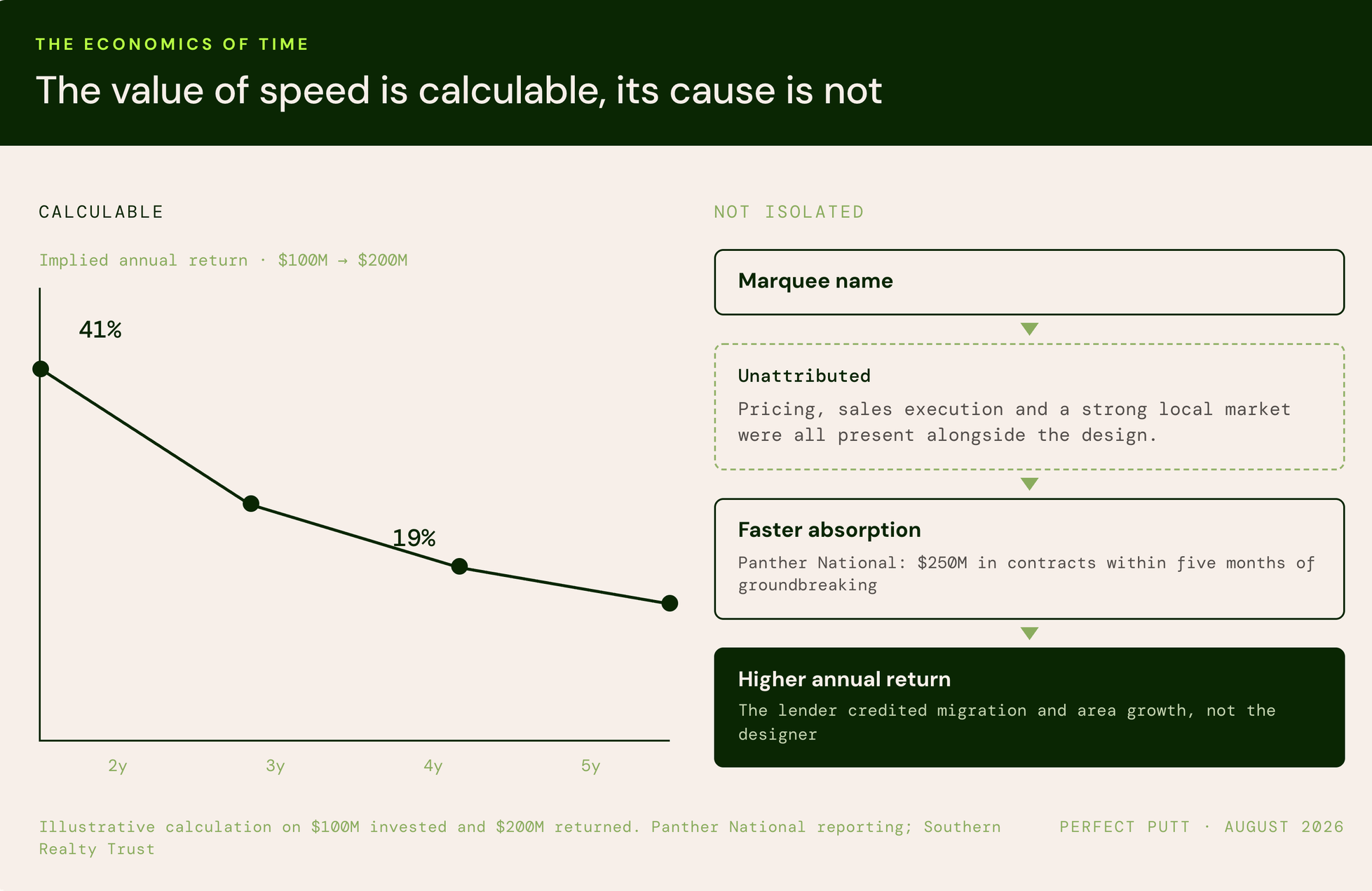
Panther National, a Jack Nicklaus and Justin Thomas design in Palm Beach Gardens, offers one example of the scale involved. According to Panther National, the development had $250 million in contracts and unit-specific reservations by July 2022. By 2024, real estate sales had surpassed $300 million, according to lenders Southern Realty Trust and Sunrise Realty Trust, which provided a $160 million financing package for the development that year. In announcing the financing, Southern Realty Trust CEO Brian Sedrish pointed to strong demand for premium residential living when discussing the project's appeal.
The economics of faster absorption can be significant even if the eventual selling price does not change. Holding total proceeds and cost fixed, turning $100 million of invested capital into $200 million in two years produces an annualized return of roughly 41 percent, compared with about 19 percent if the same outcome takes four years.
For a developer, the benefit can extend beyond IRR. Faster sales can reduce interest carry, release equity sooner, lower exposure to unsold inventory and improve the financing profile of later phases. A marquee architect therefore does not necessarily need to produce a lasting premium in property values to influence a project's economics. If the name helps pull sales forward, some of the value can accrue through the timing and financing of the development rather than through its terminal prices.
None of this establishes that marquee architects cause faster absorption. Pricing, location, product quality, sales execution and market conditions all influence velocity, and each was present at Panther National alongside the marquee design.
But it broadens where the architect premium might be measured. An effect that is difficult to isolate in mature home prices could still be economically meaningful earlier in the development cycle, when shortening the cash-conversion period has the greatest impact on returns.
When the Premium Matters
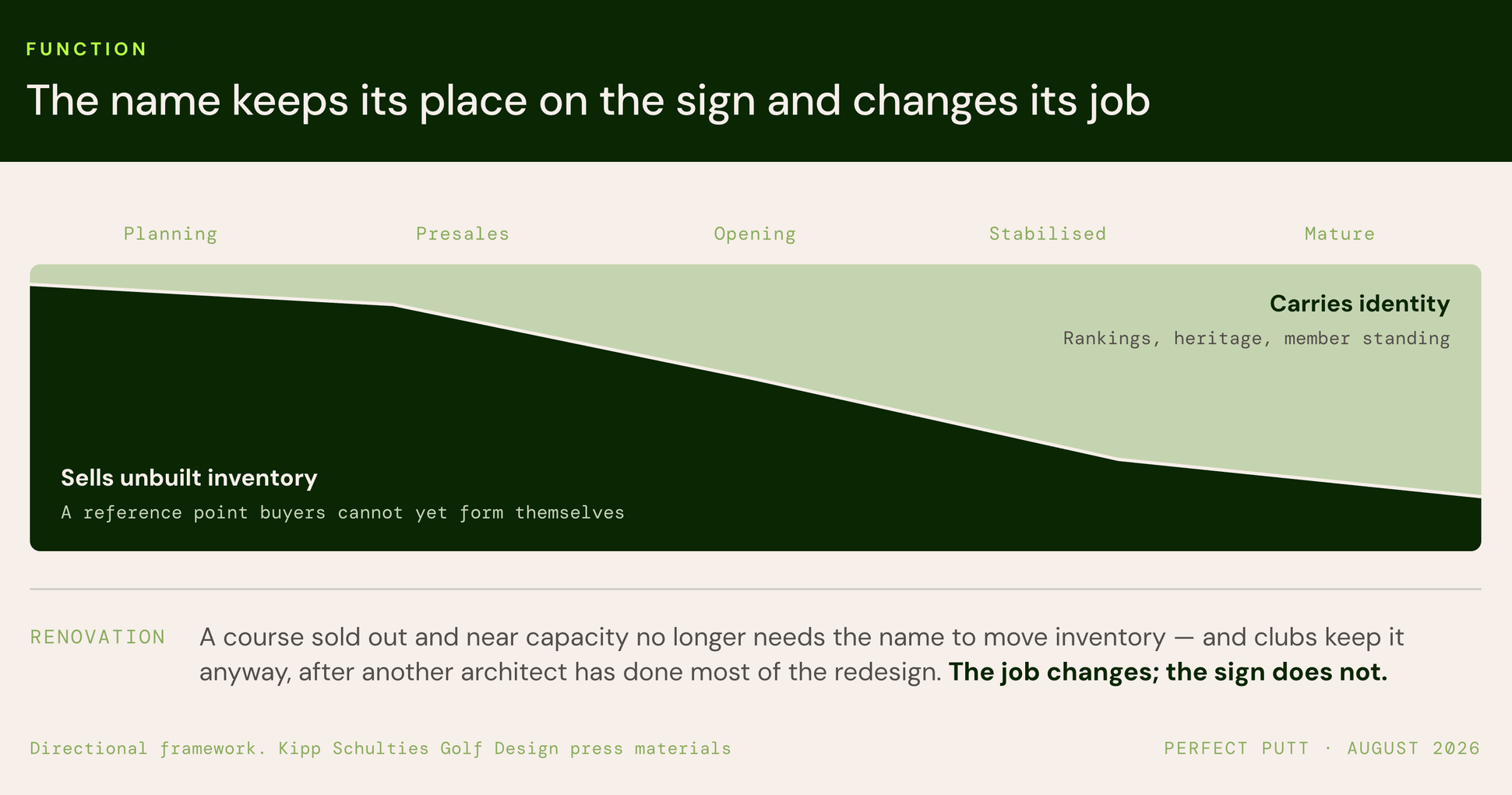
The value of a marquee name may change as a development matures. Architect Kipp Schulties has built a practice renovating courses originally designed by more prominent names, and clubs often retain the original architect's association even after substantial redesign work.
“Jack's name will always be bigger than mine. I understand why they should keep his name on it.” — Kipp Schulties, golf course architect
The example points to an important distinction. Once a community is sold out and membership is near capacity, buyers no longer have to rely primarily on the architect's reputation to judge the product. The course has years of member experience, rankings, resale activity and operating history on which it can be evaluated directly.
The architect's name can still retain prestige and marketing value. But its role has changed. Early in a development, reputation can substitute for information that does not yet exist. As the asset matures, realized course quality and operating performance increasingly provide that information instead.
That suggests the architect premium may follow a lifecycle. Its economic relevance is potentially greatest when the project is unbuilt and uncertainty is highest, particularly while developers are selling memberships and real estate. Once the development establishes a track record of its own, the name remains part of the brand, but becomes one signal among many.
Underwriting the Name
Taken together, the evidence suggests that the value of a marquee architect may be concentrated earlier in a project's life. The name appears most economically relevant while a development is still unbuilt or unproven, when buyers have limited information and the project has yet to establish a reputation of its own. Evidence for a lasting architect-specific premium in mature real estate values is much weaker.
That changes how the expense should be underwritten. Rather than assuming a marquee name will command a fixed premium on the finished real estate, developers can ask which parts of the development economics it is expected to influence. Can it accelerate presales or absorption? Support membership pricing? Reduce the cost of acquiring buyers? Strengthen confidence among lenders and other capital providers?
Those effects can matter even if two developments ultimately sell their homes for the same price. Pulling sales forward can reduce interest carry, release equity sooner and shorten exposure to unsold inventory. The relevant return on the architect's fee may therefore appear in the timing and certainty of cash flows rather than in terminal property values alone.
That also makes value capture important. Architects are generally paid for the design engagement, while developers own the land, memberships and operating assets through which most of the broader economic benefit is realized. The more a marquee name improves the economics beyond the course itself, the more valuable it becomes to own the assets surrounding it.
The repeated use of marquee architects across high-end golf development suggests the industry sees commercial value in reputation. The evidence is less clear on exactly how much that value is worth. The better question may not be what premium a famous architect adds to a finished home, but whether the name can improve the speed, certainty or economics of selling the development before the project has a reputation of its own.
The best way to support Perfect Putt is to share it with a friend.