
Owning the Purchase Decision
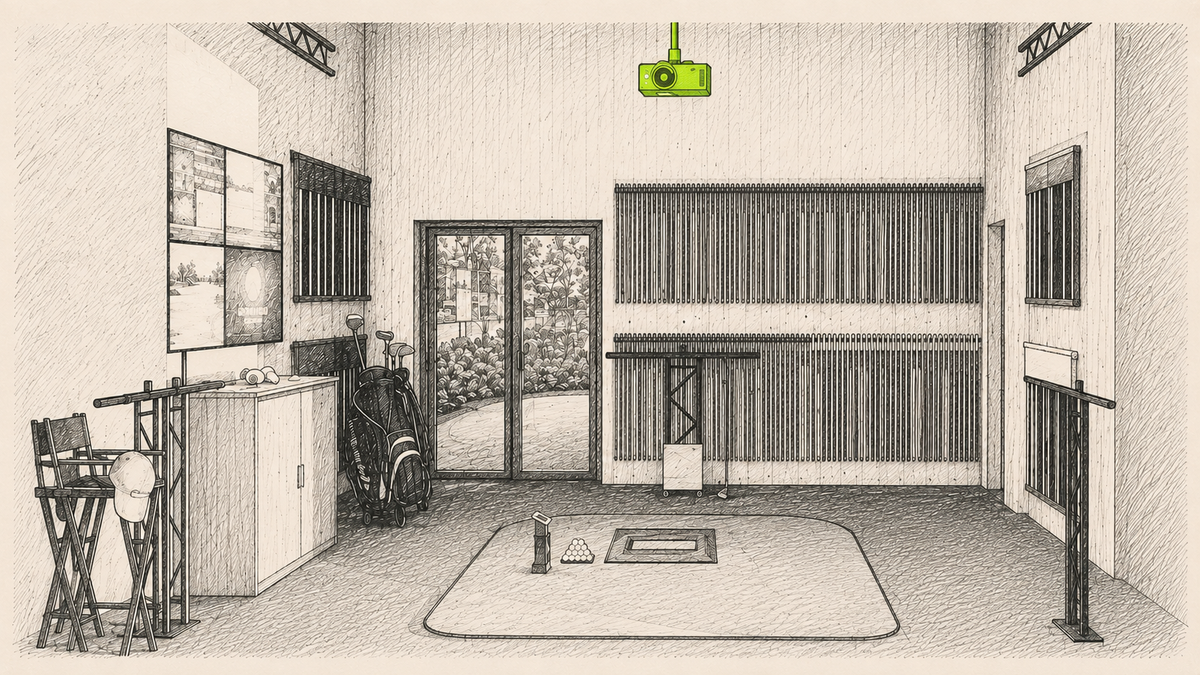
Club fitting is priced and organized like a specialty retail service. Its underlying economics look more like a distribution channel: the point where customer acquisition, equipment purchasing, retailer strategy, and manufacturer distribution converge in a single appointment.
Equipment manufacturers once competed primarily by building better clubs. Increasingly, they compete by influencing the moment a golfer decides which clubs to buy. Club fitting has become that decision point, making distribution, rather than manufacturing, one of golf's emerging strategic assets.
Welcome to Perfect Putt, a newsletter covering the business and economics of the golf industry. If this was forwarded to you, subscribe to join 12,000+ readers who follow how capital flows through golf.
Read Time: 8 Minutes
The Fee Funds Acquisition
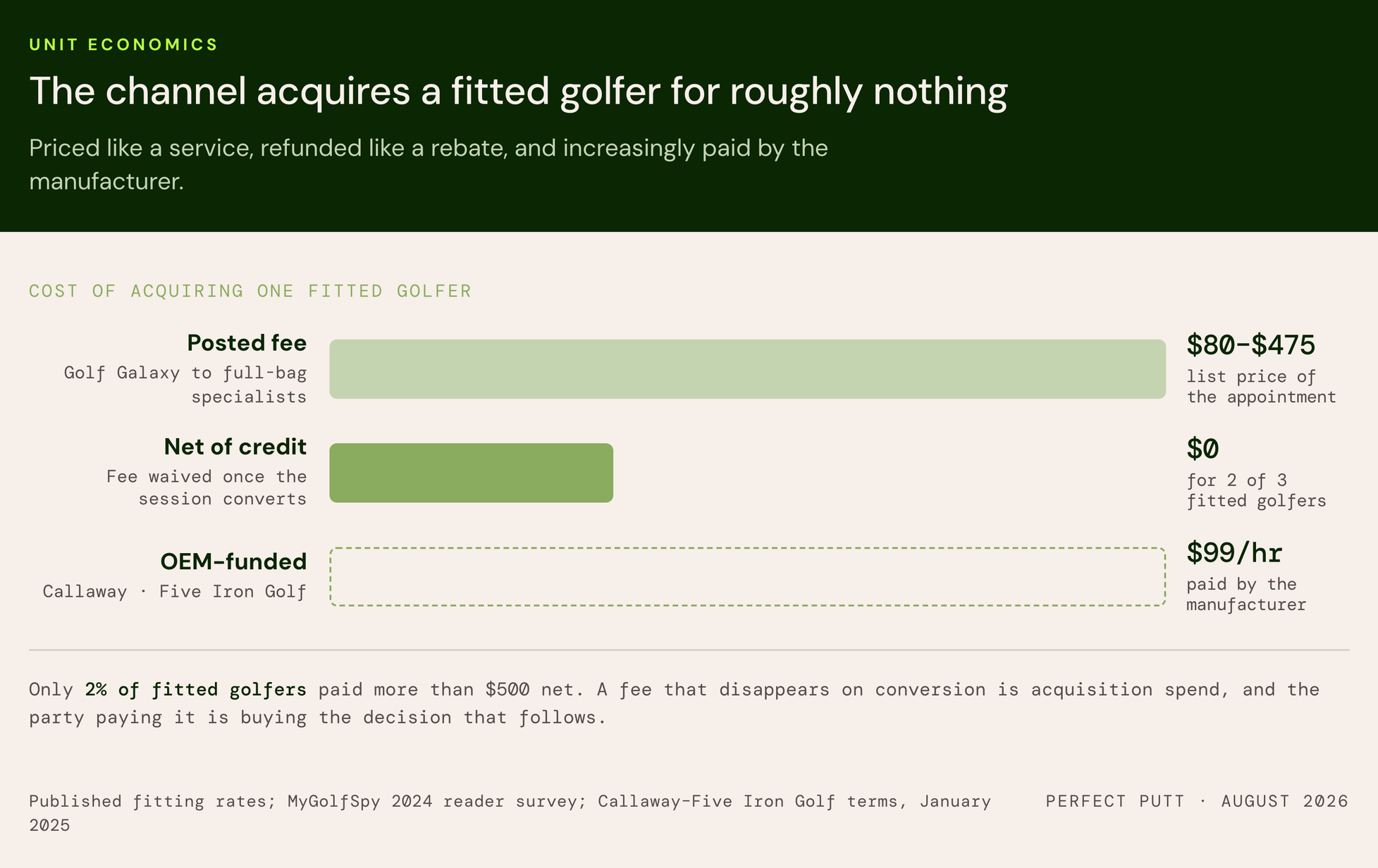
A club fitting is priced like an à la carte service: $79.99 for a driver fitting at Golf Galaxy, $99.99 at PGA Tour Superstore, $175 at Club Champion or True Spec Golf, and up to $475 for a full bag at specialist fitters. On its face, the fee appears to be the product being sold.
The way that fee is actually used tells a different story. MyGolfSpy's 2024 reader survey found that roughly two-thirds of fittings become free once the session converts to a purchase, while only 2 percent of fitted golfers reported paying more than $500 net. Callaway's fitting partnership with Five Iron Golf removes the pretense entirely. Golfers pay a flat $99 per hour with no purchase requirement, while Callaway effectively pays for the opportunity to participate in the buying decision rather than charging for the fitting itself.
Five Channels, One Customer
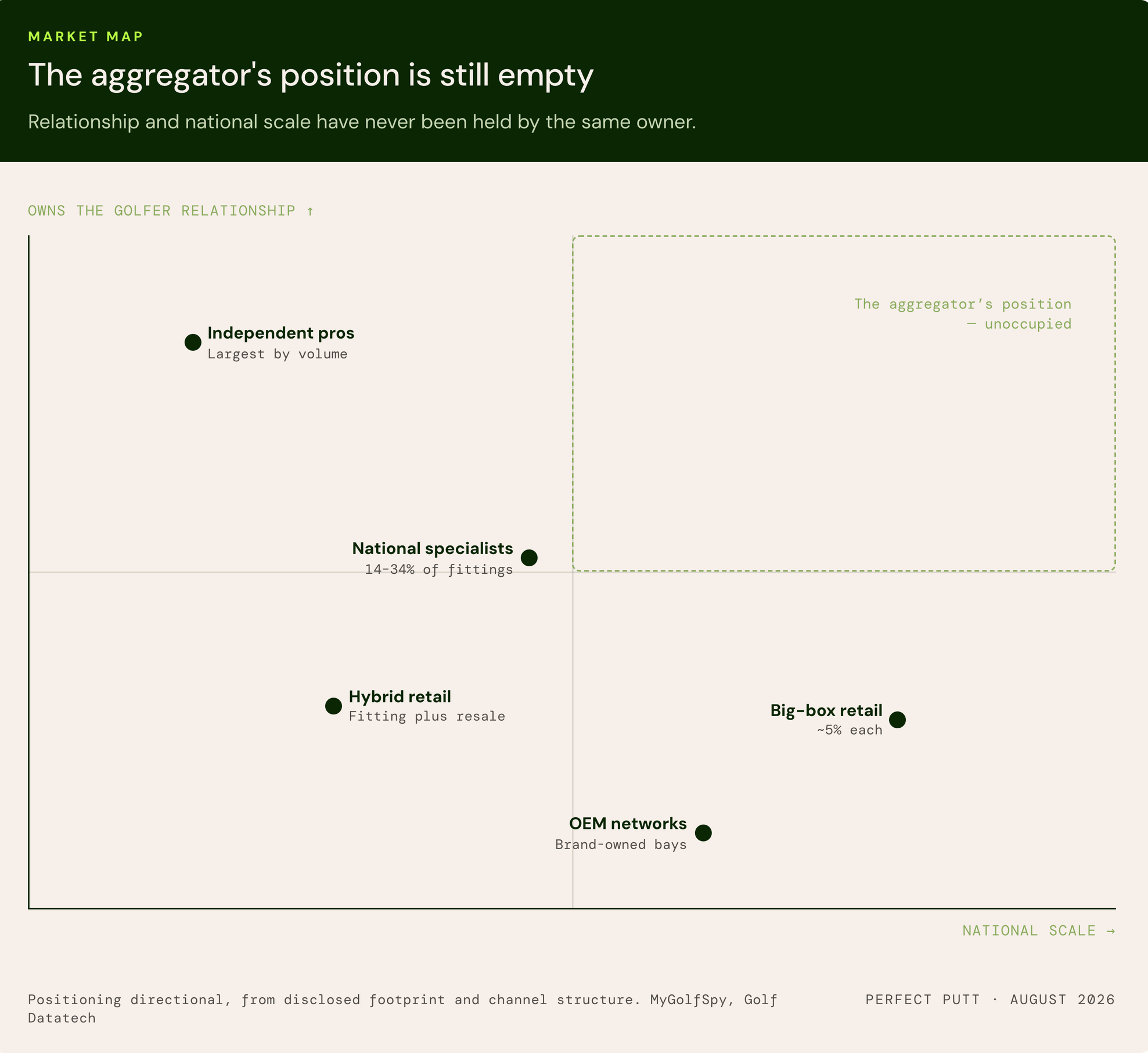
If fitting is where customer acquisition happens, the more important question is who owns that moment. The available data does not point to a single controlling owner. Instead, ownership is fragmented across retailers, specialists, manufacturers, and independent professionals, each capturing only part of the purchase journey.
National specialty chains such as Club Champion and True Spec account for an estimated 14 to 34 percent of fittings, depending on which of Club Champion's disclosed figures is used. Big-box retailers, including PGA Tour Superstore and Golf Galaxy, account for roughly 5 percent each. PGA Tour Superstore alone reports more than 100,000 fittings and 50,000 lessons annually, the largest publicly disclosed fitting volume in the category. Independent PGA professionals and pro shops remain the largest channel by volume in MyGolfSpy's surveys. OEMs operate their own networks through facilities like TaylorMade's Kingdom and partnerships such as Callaway's relationship with Five Iron Golf, while hybrid retailers like 2nd Swing combine fitting with used-club resale.
Golf Datatech's longitudinal research shows that more than 95 percent of serious golfers have been custom fit since the study began in 2001. A purchasing moment this common would typically consolidate around one dominant distribution channel. Instead, fitting remains divided across five structurally different owners, none of which controls the path from equipment consideration to purchase. Rather than a mature service category, fitting increasingly resembles a distribution channel still waiting for its aggregator.
Why Fitting Hasn't Consolidated Yet
The more interesting question is not that fitting is fragmented. It is why a purchasing moment used by more than 95 percent of serious golfers has stayed fragmented for so long.
Several structural factors help explain the delay. Golf equipment has historically been sold through local, relationship-based channels: a member's head professional, a trusted fitter, or a familiar golf shop. Those relationships are difficult to scale into a national platform. OEMs have also benefited from maintaining a neutral fitting ecosystem, since controlling the recommendation process too directly could undermine the credibility that makes fitting effective. Finally, the technology and economics have only recently become attractive enough to support a scaled platform. Launch monitors capable of producing reliable recommendations reached today's levels of accuracy and affordability within the past decade, while most of the category's largest acquisitions have occurred only in the last five years.
Several of those barriers now appear to be weakening. E-commerce has normalized guided, data-driven purchasing across consumer categories built on personal fit and preference, while younger golfers are increasingly comfortable relying on recommendation engines rather than traditional retail. At the same time, launch-monitor technology has become widely accessible, with Trackman-grade data now available in big-box retailers and indoor golf venues, not just flagship fitting studios. If the forces that kept fitting fragmented are beginning to erode, the more relevant question is no longer whether the category consolidates, but who will consolidate it first.
Reading the Transactions
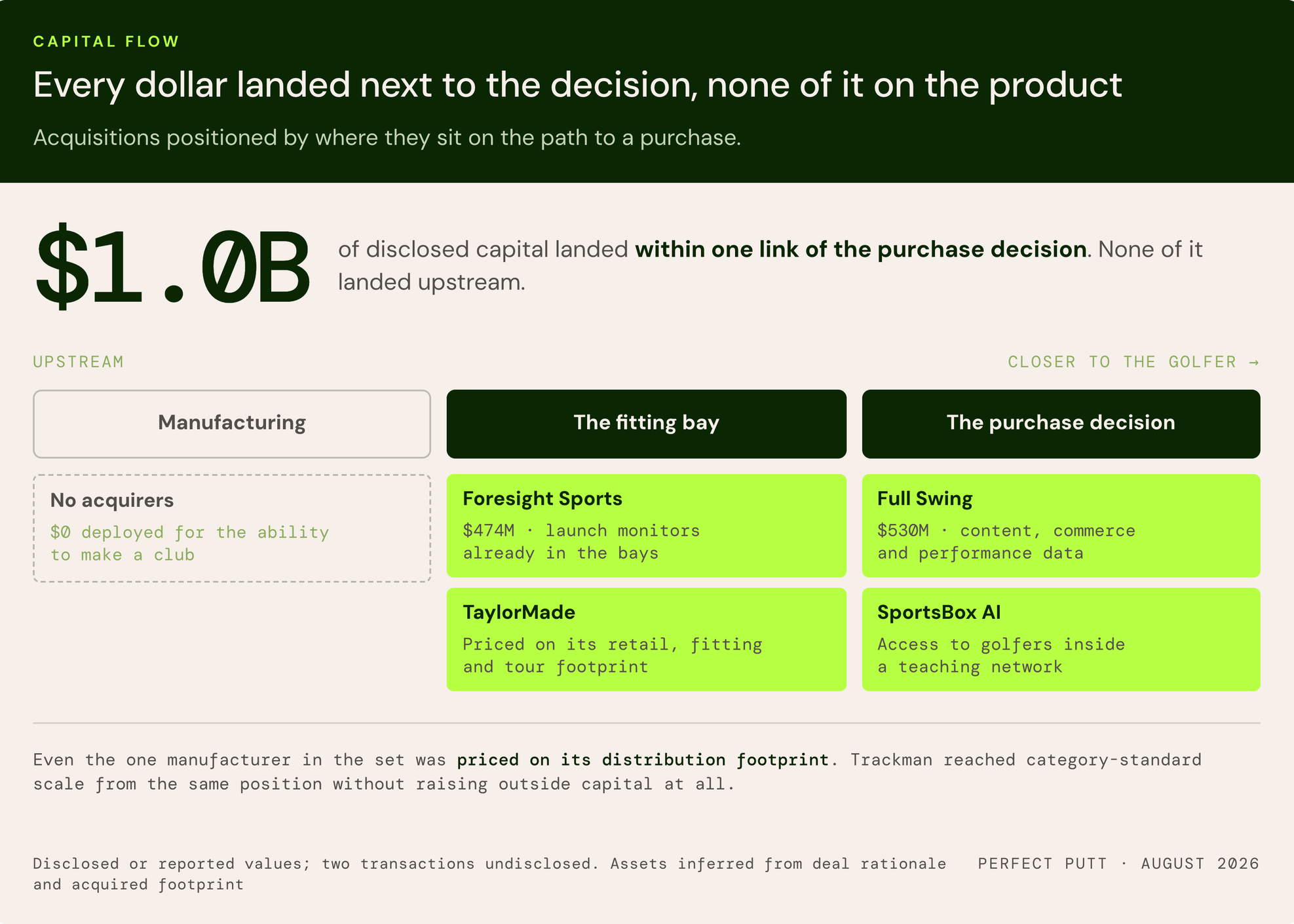
The category's largest acquisitions look different once the question shifts from which company had the better technology to what position in the purchasing journey the buyer was actually acquiring.
That pattern appears repeatedly. Vista Outdoor paid roughly $474 million for Foresight Sports in 2021, acquiring a launch-monitor platform already embedded in thousands of fitting bays. Versant Media Group's roughly $530 million acquisition of Full Swing in 2026 was built around combining content, commerce, and performance data, extending its reach into golfers actively researching and purchasing equipment. The PGA of America's investment in SportsBox AI provided earlier access to golfers already moving through its teaching and fitting network. TaylorMade's ownership transitions, first from Adidas to KPS Capital Partners and later to Centroid Investment Partners, reflected the value of a brand with an established retail, fitting, and tour distribution footprint, not product innovation alone.
None of these buyers were simply acquiring launch monitors, software, or fitting studios. They were acquiring a position inside one of golf's highest-intent purchasing moments, where a golfer has already decided to spend money and is only deciding what to buy, and through whom. As equipment purchases become increasingly guided by data and recommendation rather than self-directed browsing, that position may prove more valuable than the manufacturing capability behind it. Trackman reinforces the same point from the opposite direction. Its enduring advantage is not simply its radar technology, but its position inside the distribution layer itself. Increasingly, distribution appears to be one of the assets these transactions were pricing.
Renting Distribution
Callaway's fitting strategy offers one of the clearest publicly observable answers to a question every equipment manufacturer faces: build a fitting network from scratch, or rent access to one someone else has already built.
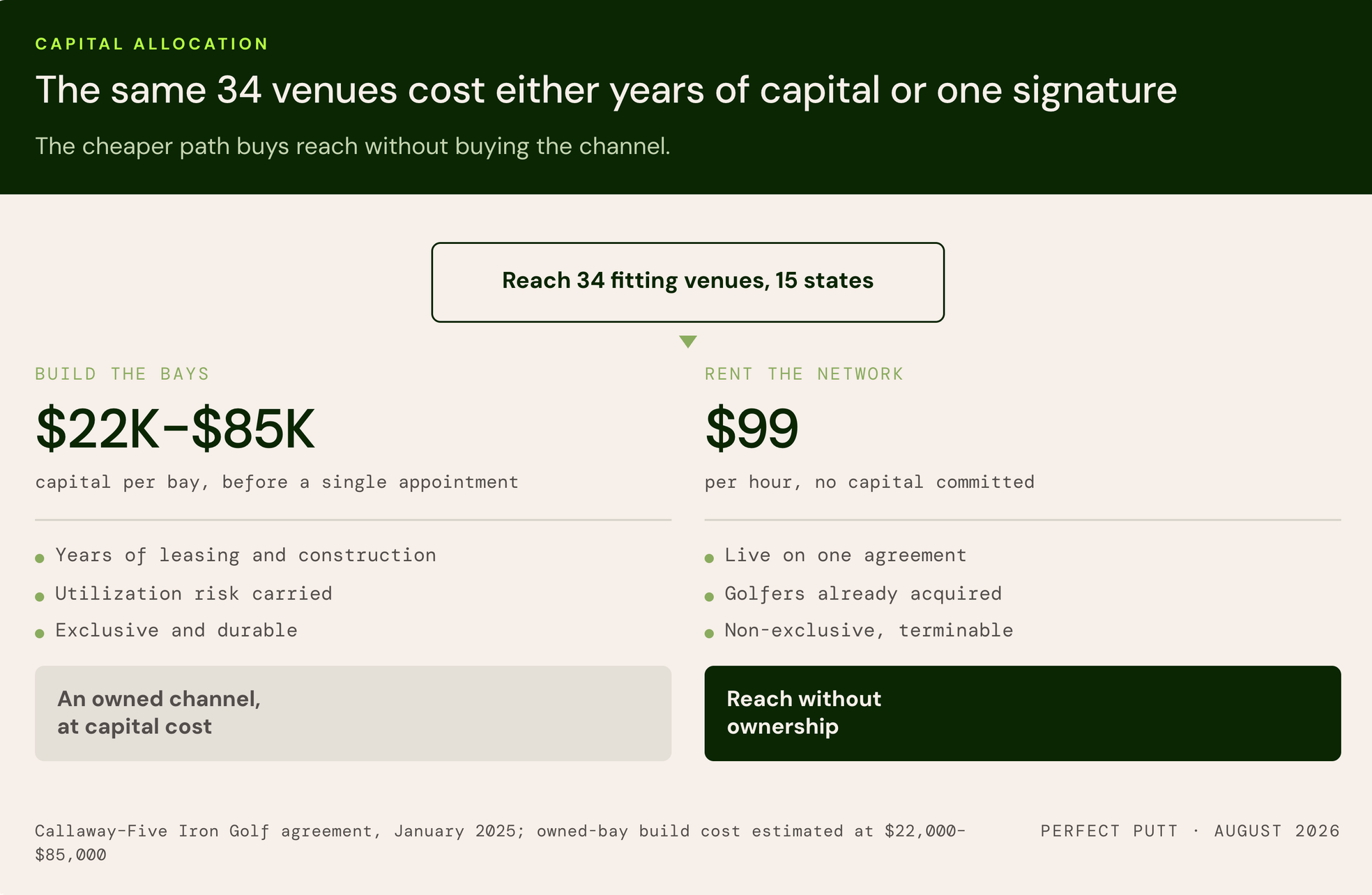
In January 2025, Callaway partnered with Five Iron Golf, designating its coaches as "Callaway Certified Fitters" across 34 venues in 15 states and five countries at a flat $99-per-hour rate. Rather than investing in real estate or simulator infrastructure, Callaway gained immediate access to an established fitting footprint. Building a comparable network through owned studios, at an estimated $22,000 to $85,000 per bay, would have required years of leasing, construction, and hiring. Renting it required a single partnership.
The timing is worth noting without overreading it. One year later, Callaway completed the sale of 60 percent of Topgolf to Leonard Green & Partners, generated roughly $800 million in cash, repaid $1 billion of debt, and repositioned itself as a pure-play equipment company. Callaway has not publicly linked those decisions, nor does one example establish a broader industry strategy. What is observable is that, during a period of greater capital discipline, the company chose to expand its fitting footprint through a partnership rather than owned infrastructure.
The economics of that decision are revealing. Callaway is not paying for leases, labor, or simulator utilization. It is paying for immediate access to golfers that Five Iron had already spent years and significant capital acquiring. If the primary value of fitting were the service revenue or the data generated during the appointment, ownership would capture more of both. Choosing to rent the channel instead suggests the scarcer asset is access to golfers at the moment they are evaluating equipment. It also reflects a broader shift in capital allocation. Manufacturers no longer need to own every touchpoint with the customer. Increasingly, they can lease distribution from partners that have already built the network.
Data Compounds Reach
The businesses that control access to golfers inside the fitting channel are also the ones accumulating the richest data on equipment preferences, swing characteristics, and purchasing behavior. That relationship suggests data is less an independent business than a byproduct of owning distribution.
Club Champion illustrates the dynamic. Its MyAccount platform and AI Fitter Co-Pilot, which process roughly one million TrackMan swings each month, sit on top of a network of more than 140 fitting locations. The value of those analytics comes from the scale of the distribution generating them. The same software layered onto a five-location chain would produce far less valuable data. Club Champion's 2022 acquisition of TXG similarly expanded its distribution footprint first, making the resulting data more valuable as that footprint grew. Golf Datatech follows the same pattern. Its longitudinal research business exists because the fitting market has become large enough to generate meaningful information over time.
The relationship is reinforcing rather than linear. More golfers moving through a distribution channel generate more fitting outcomes, improving recommendation accuracy, inventory planning, OEM relationships, and customer conversion. Those improvements make the channel more valuable to both golfers and manufacturers, attracting even more volume and creating a self-reinforcing cycle. Data matters because it strengthens the underlying distribution asset, making it progressively harder to replicate. That is why two fitting businesses running identical software can possess fundamentally different competitive advantages.
Owning the Purchase Decision
Club fitting may become the first category in golf equipment to reorganize around ownership of the purchasing decision rather than ownership of inventory or manufacturing. Comparable shifts have reshaped industries ranging from eyewear to automotive retail, where the businesses that captured the greatest share of value were often those that controlled customer acquisition, not those that built the underlying product. Golf equipment appears to be moving in the same direction, with fitting emerging as the industry's primary point of influence.
That shift reframes the strategic question. It is no longer which company has the best launch monitor, the richest customer data, or even the best clubs. It is which business, retailer, OEM, specialist, or a new entrant, becomes the default gateway through which equipment decisions are made. The company that owns that moment earns more than a sale. It shapes customer acquisition, OEM relationships, pricing power, inventory decisions, and the data generated from every subsequent purchase.
The next category leader in golf equipment may not manufacture the best clubs or operate the largest fitting network. It may simply become the platform golfers trust when making equipment decisions. If that happens, fitting stops being a service business measured against other service businesses. It becomes one of golf's most valuable distribution assets, with manufacturing increasingly built on top of it rather than the other way around.
The best way to support Perfect Putt is to share it with a friend.