
Pricing Certainty: The Hidden Logic of Golf Outings

Golf outings convert uncertain demand into guaranteed revenue months before a tee shot is hit. Most courses still price them as if they were selling volume.
Welcome to Perfect Putt, a newsletter covering the business and economics of the golf industry. If this was forwarded to you, subscribe to join 12,000+ readers who follow how capital flows through golf.
Read Time: 6 Minutes
Most golf courses price outings based on headcount. Larger groups receive larger discounts.
But an outing is more than a group of golfers. It is an advance commitment to fill part or all of a day's tee sheet. The value of that commitment depends on the date. A discount that makes sense on an empty Tuesday can become unnecessary on a Friday the course was likely to sell out anyway.
What a Golf Course Is Actually Pricing
Golf outing pricing is really the price of certainty.
When a single golfer books a Saturday tee time two months in advance, there is no guarantee they will play. They may cancel, and the course still has to fill the remaining tee times. The revenue is uncertain until the day arrives.
An outing is different. A company or nonprofit reserving a date six or twelve months in advance commits to filling a meaningful portion—or all—of the tee sheet. The course trades a lower price for guaranteed demand months before the event takes place.
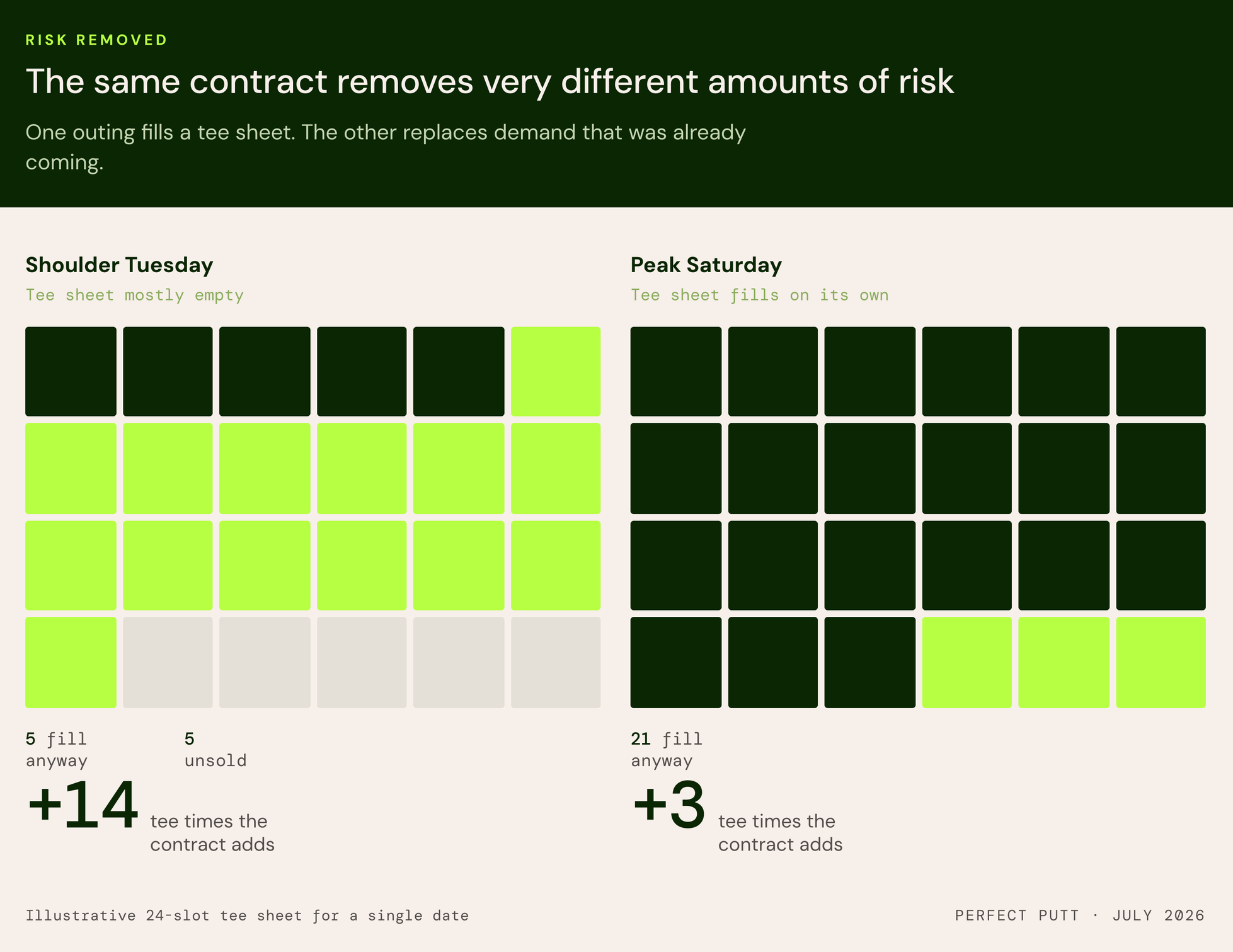
The value of that guarantee depends on the date, not the number of players. A 144-player outing on a Tuesday in April removes far more demand risk than the same outing on a sold-out Saturday in July. April demand is uncertain. July demand often isn't.
Consider a course with an $85 public green fee that books a full-field outing for $70 per player. It has discounted revenue by more than $2,100 before a single golfer arrives. On a slow April Tuesday, that may be an attractive trade because the outing secures revenue the course might never have earned. On a peak July Saturday that was likely to sell out anyway, the same discount simply transfers value from the course to the customer.
That is why pricing solely by headcount misses the economics of the transaction. The number of golfers determines how much capacity is sold. The value of the contract is determined by how much demand risk it eliminates.
Pricing the Date
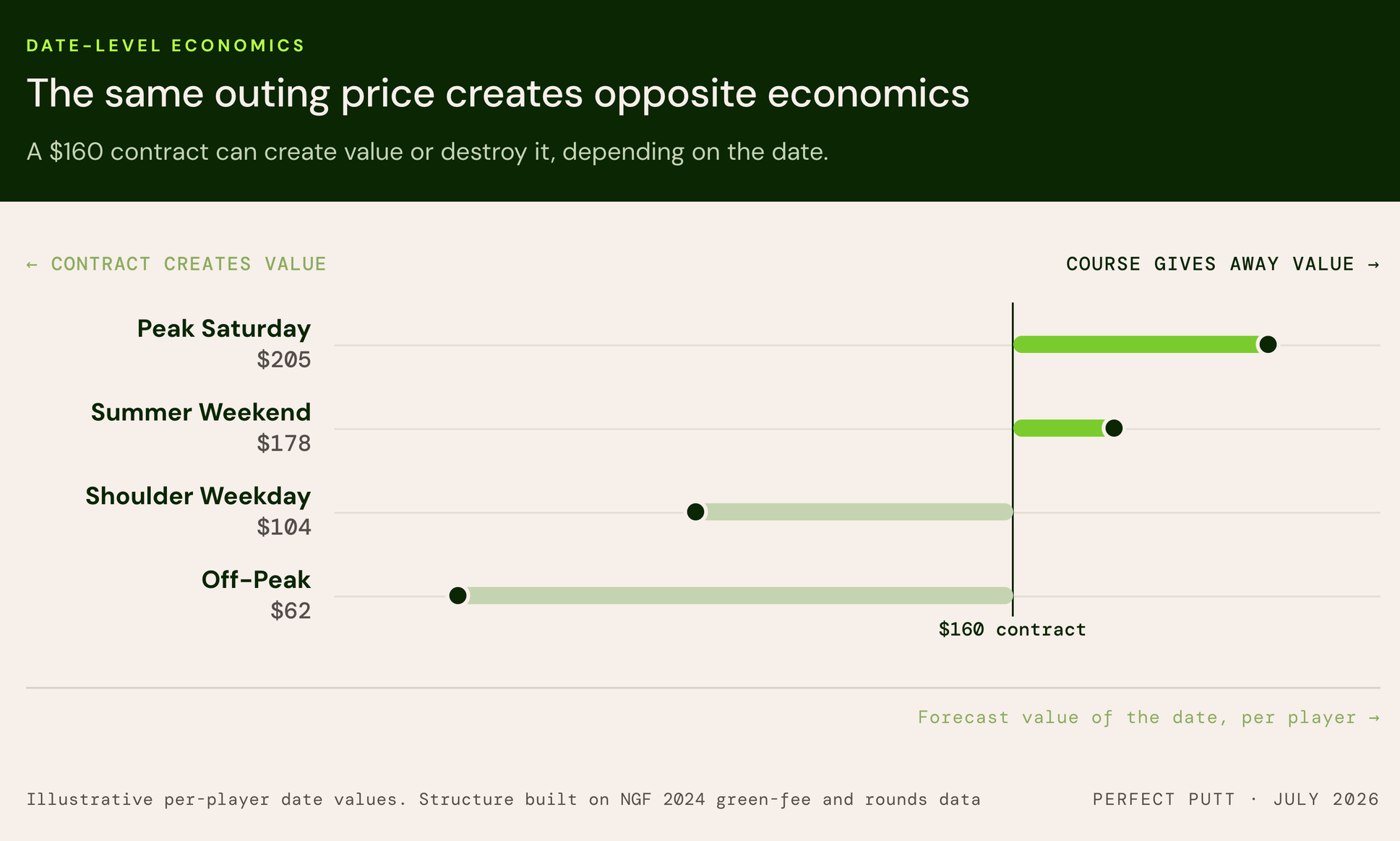
Every outing should be priced against the value of that specific date, not the course's average day.
A 100-player outing at $150 to $170 per player looks like a strong result when compared with the NGF's estimate of roughly $59 in blended revenue per occupied tee time. But that average masks what actually matters.
On the course's busiest dates, the expected value of public play may already equal or exceed the outing rate. In that case, the course is discounting revenue it was likely to earn anyway. On its slowest dates, the same outing can create substantial value by guaranteeing revenue that might never have materialized.
The same principle applies to food and beverage minimums. Many courses assume those minimums offset any discount on the golf side. But Club Benchmarking data shows food and beverage labor alone consumes roughly 62% of F&B revenue before food costs and other operating expenses. A $5,000 minimum does not generate $5,000 of incremental profit. Unless the contribution margin exceeds the revenue discounted on golf, the minimum may recover far less value than it appears to.
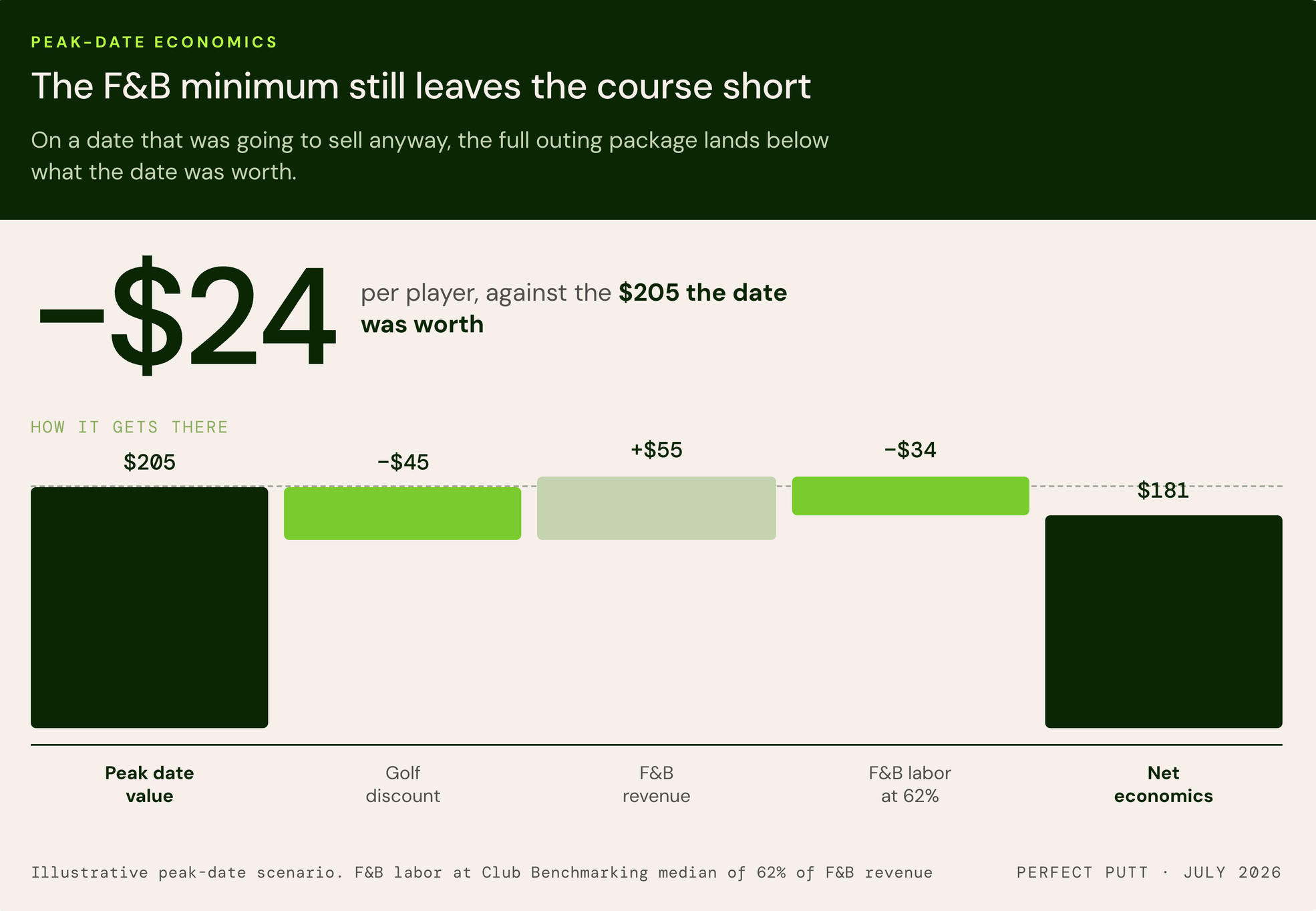
The economics of an outing are determined by the total contribution of the event relative to what the course would have earned on that date without it—not by the contract price in isolation.
The Value Of A Renewal
The longest-running outing accounts are often treated as a course's most valuable relationships. But longevity alone says little about whether the pricing still reflects what the date is worth.
A recurring outing is essentially a contract that renews year after year, often on terms negotiated years earlier. If a ten-year-old account is still priced against demand from a decade ago, that is not evidence of a well-managed relationship. It is evidence the account has not been repriced.
The better question is not How long has this outing been with us? It is When was its rate last tested against today's demand? Two outings can each have a ten-year history, yet be worth very different amounts. One has been repriced as demand evolved. The other has simply renewed while the market moved around it.
The value of a renewal is not that it comes back every year. The value is that it returns with pricing that still reflects the economics of the date.
The Underwriting Advantage
Most golf courses do not lack pricing software. They lack a consistent and repeatable underwriting function.
Repricing an outing book requires someone to continually estimate what each date is worth, compare that value to the contracted rate, and adjust pricing as demand changes. At most courses, that responsibility is spread across the general manager, golf professional, or sales team, leaving little time or data to treat it as a disciplined underwriting exercise.
Hotels solved this problem decades ago. Large operators built revenue management systems that forecast demand, measure displacement, and price group business against what transient guests were expected to pay. Those systems work because they are supported by thousands of rooms, millions of historical bookings, and centralized ownership.
Golf remains the opposite. Ownership is fragmented across thousands of independently operated courses, each with a relatively small set of outing dates to learn from. Most operators simply do not have enough observations to build sophisticated pricing models on their own.
That fragmentation creates an opportunity. An owner or investor with a large enough portfolio could aggregate years of outing data across dozens of properties, estimate the true value of each date, and continuously reprice contracts as demand evolves. The advantage would not come from selling booking software. It would come from underwriting demand more accurately than the market.
Looking Beyond Revenue
The question is not how much outing revenue a course generates. It is whether that revenue has been properly underwritten.
An outing on a slow Tuesday and an outing on a peak Saturday may produce the same revenue, yet have very different economics. One fills demand the course might never have captured. The other may simply replace higher-value public play with discounted business.
A well-underwritten outing book shows more than contracts and annual revenue. It shows what each date was expected to earn without the outing, why the contracted rate was appropriate, and when that pricing was last tested against current demand. Without that discipline, today's revenue may simply reflect yesterday's assumptions.
That distinction creates opportunity. Two courses can report identical outing revenue, yet one may have substantial embedded pricing upside because its contracts have never been repriced as demand evolved.
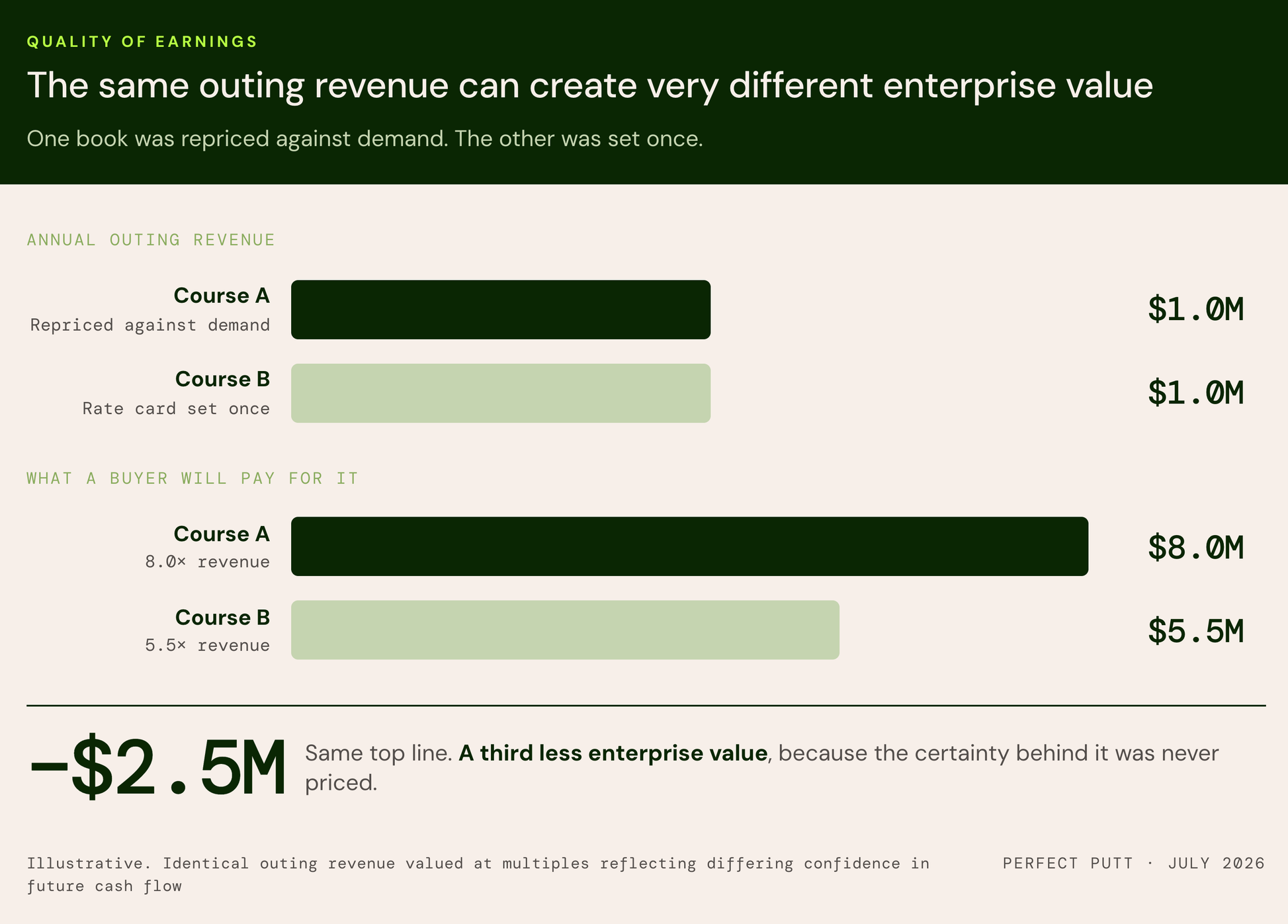
The opportunity isn't booking more outings. It's understanding which dates deserve certainty, what that certainty is worth, and having the discipline to reprice it as demand evolves. The biggest pricing opportunity for many courses may already be on next year's calendar.
The best way to support Perfect Putt is to share it with a friend.