
Golf's Apparel Land-Grab

The economics of golf apparel have quietly changed. Product still matters, but increasingly the most valuable asset is the direct relationship between a brand and the golfer.
Welcome to Perfect Putt, a newsletter covering the business and economics of the golf industry. If this was forwarded to you, subscribe to join 12,000+ readers who follow how capital flows through golf.
Read Time: 9 Minutes
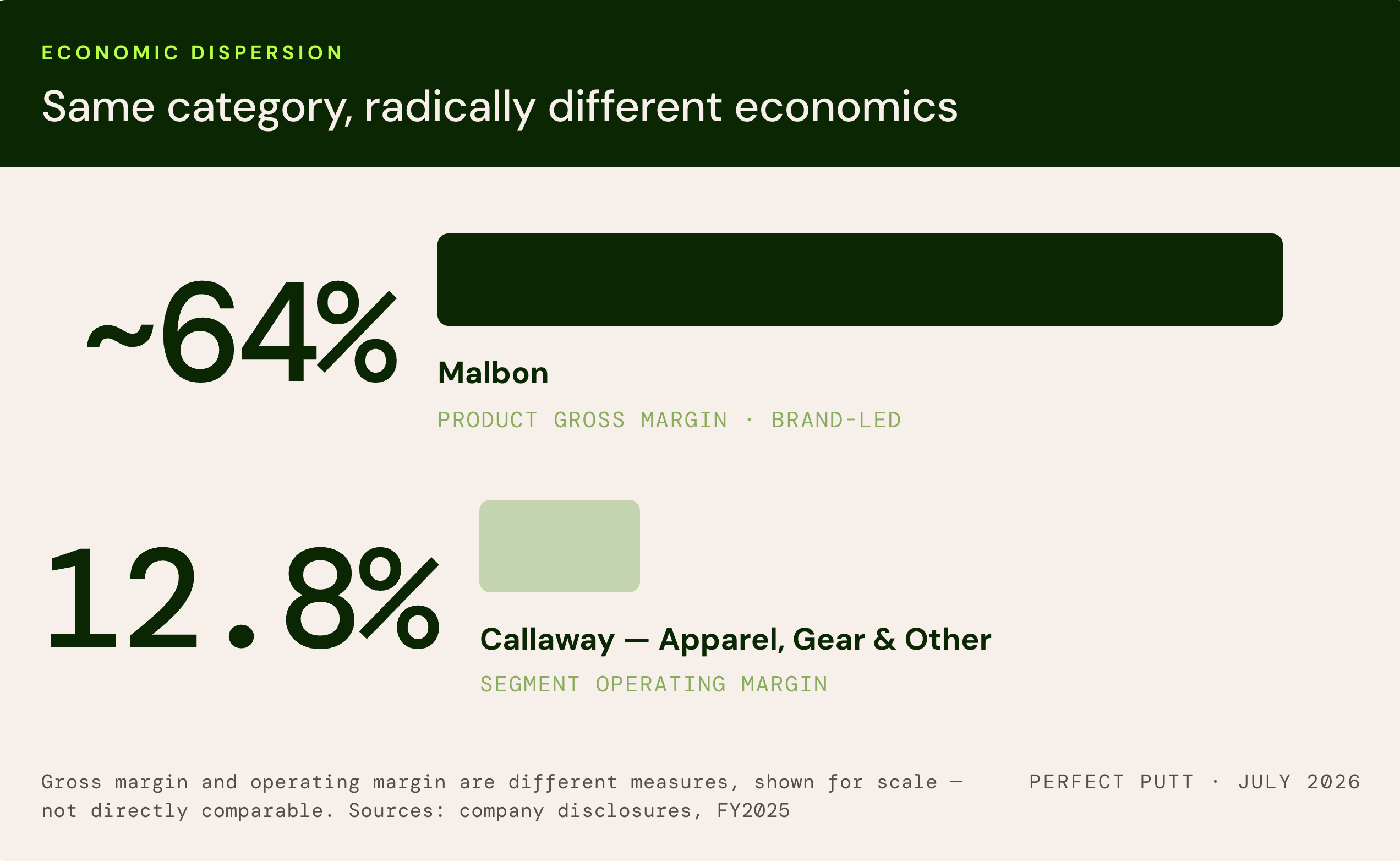
Golf apparel is attracting more capital than at any point in the sport's recent history. Malbon Golf, a Los Angeles brand that has built its identity through fashion-forward apparel, high-profile collaborations, and golf culture, closed part of a $43 million funding round in 2025 while reporting product gross margins near 64 percent. At the other end of the industry, Callaway Golf's apparel business generated a 12.8 percent operating margin in fiscal 2025, only modestly ahead of its golf equipment segment, while Acushnet's FootJoy business has reported declining sales for two consecutive years.
These companies all sell apparel, yet investors increasingly value them for entirely different reasons.
The old golf apparel business was built around selling shirts. The new one is built around owning relationships. Apparel has become the first purchase in a much larger customer journey, giving brands recurring touchpoints that can later expand into media, memberships, travel, events, equipment, and experiences. The companies winning today are not necessarily designing better products. They are building stronger communities.
That distinction is becoming more valuable precisely because golf's most successful apparel brands no longer need the traditional industry to reach golfers in the first place.
Today's Sponsor
This edition is brought to you by The Club, a private investment community from Old Tom Capital, built for golfers who are also serious investors. Hundreds of vetted members: operators, founders, and accredited investors who know the game from the inside.
Last year the team reviewed 600 investments and brought only the best into the room. Members have had a look at proprietary deals in companies like TGL (TMRW Sports), Grass League, Birdie Houses, TerraRad, and TRUE Linkswear.
Membership is $500 a year, with no obligation to invest in anything. They send the deals, you decide where to lean in.
The Economic Divide
The instinct is to explain the gap as wholesale versus direct-to-consumer. Legacy companies sell through pro shops and retailers. Independent brands sell directly, keep more of the margin, and control pricing.
There is some truth to that. It just isn't the whole story.
Callaway's Apparel, Gear and Other division, home to TravisMathew, Callaway-branded apparel, and Cuater, posted a 12.8 percent operating margin in fiscal 2025, down from 14.3 percent the year before and only slightly ahead of the company's Golf Equipment segment. Yet TravisMathew itself still generates a meaningful portion of its business through wholesale and green-grass accounts, and Callaway continues to describe it as one of its strongest-performing brands.
If wholesale distribution were the primary constraint on profitability, TravisMathew should struggle alongside the rest of the category. Instead, it has largely escaped it.
Malbon offers another version of the same story. Product gross margins approaching 64 percent are far closer to luxury apparel companies such as Ralph Lauren than to traditional golf manufacturers. While gross margin is not directly comparable to Callaway's operating margin, it illustrates something important: differentiated brands can command premium economics regardless of whether they operate entirely outside traditional distribution.
The deeper divide, then, is not simply distribution but customer ownership. The brands creating the most value increasingly control how they are discovered, how they are priced, and how they remain part of a golfer's identity long after the initial purchase. That changes the role apparel plays in the business. The first purchase becomes the beginning of a customer relationship that can drive recurring engagement and eventually extend into a much broader ecosystem.
Capital Recognizes the Pattern
The most interesting signal is not how much capital has entered golf apparel. It is who has chosen to deploy it.
Growth equity, athlete-backed investment vehicles, strategic operators, and even a PGA of America-affiliated fund are all backing a similar type of company: differentiated golf brands with the potential to scale more like premium consumer businesses than niche sporting-goods companies.
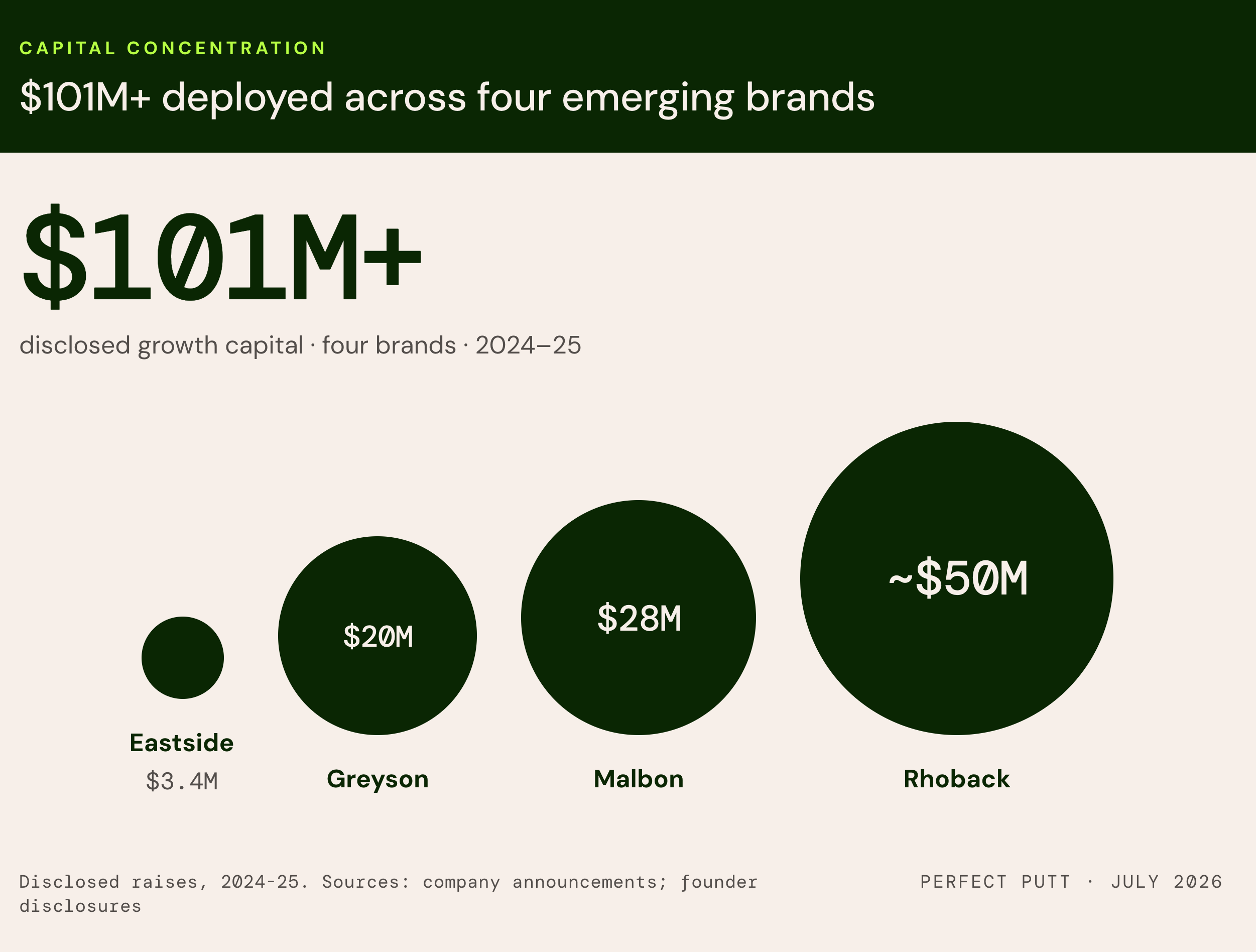
Eastside Golf raised $3.4 million in January 2024 from EP Golf Ventures, a fund backed by the PGA of America making its first investment in fashion or retail. Co-founder Earl Cooper has said annual revenue surpassed $10 million that year, up from $1 million in 2020. Greyson Clothiers closed a $20 million strategic growth round in February 2025 backed by New Era's chief executive and athlete investors including Justin Thomas, while reporting annual sales exceeding $100 million. Malbon raised $28 million as part of a planned $43 million financing later that year. Rhoback, a broader athleisure brand with a growing golf following, raised roughly $50 million from CHAMP, a fund backed by L Catterton and more than 250 professional athletes, after surpassing $150 million in annual revenue.
The investors differ in mandate, return profile, and sector expertise. The pattern, however, is consistent: capital is flowing toward brands with distinct identities, premium positioning, and the potential to grow beyond golf's traditional retail ecosystem.
That investment pattern is less a new phenomenon than the next chapter of one already written.
Callaway acquired TravisMathew in 2017 for $125.5 million, valuing the business at roughly 11.8 times projected adjusted EBITDA after it had already built an independent following. Richemont, the Swiss luxury group behind Cartier and Montblanc, acquired Peter Millar in 2012 before expanding its golf platform through G/FORE in 2018. In February 2025, Richemont elevated G/FORE into its own standalone Maison alongside fashion houses such as Alaïa and Chloé, reinforcing the strategic value of differentiated brand identity beyond apparel revenue alone.
Viewed together, the raises and acquisitions suggest a repeatable lifecycle. A brand first builds a loyal following and distinct identity. Growth capital helps scale that foundation. At sufficient scale, strategic and luxury buyers may pay a premium for the brand and the customer relationships it has built.
The result is a different way of thinking about value creation in golf apparel. The product may be the starting point, but the more durable asset is the audience and brand equity built around it.
Distribution Has Changed
The investment pattern above has been enabled by a fundamental change in how brands reach golfers. Building meaningful awareness once required access to traditional retail. Today, it increasingly does not.
For decades, golf's gatekeepers controlled distribution. A new apparel brand needed a buyer at Golf Galaxy, a green-grass account, or shelf space inside a pro shop to reach golfers at scale. Distribution was something established companies granted.
Today, attention itself has become a form of distribution.
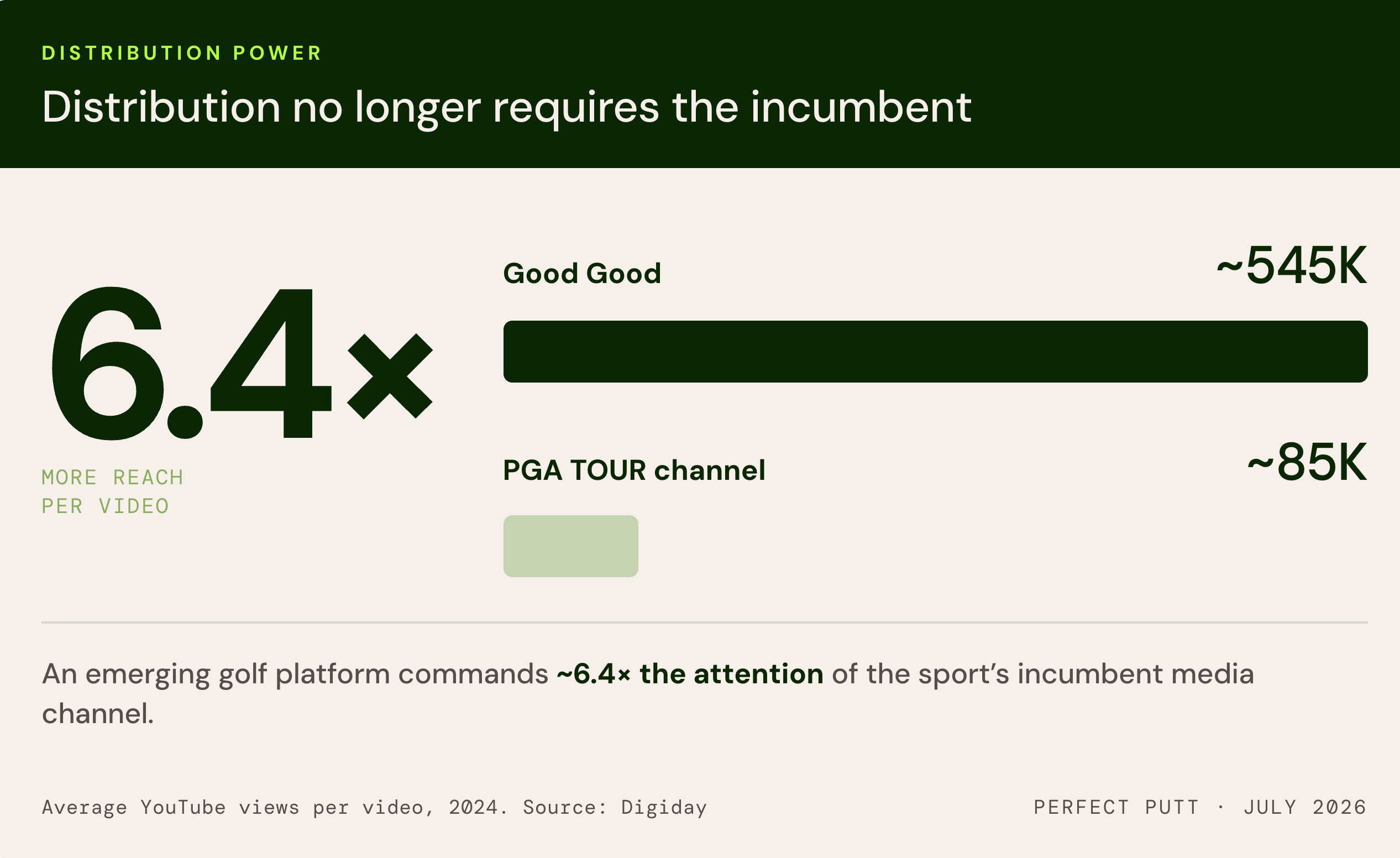
Good Good Golf illustrates the shift. The creator-led media and commerce company has built an audience of more than 1.75 million YouTube subscribers and averaged roughly 545,000 views per video in 2024, compared with approximately 85,000 for the PGA Tour's own channel, according to Digiday. That reach allows Good Good to build demand for its products through an audience it already owns rather than relying exclusively on traditional retail channels. The broader creator ecosystem is creating similar opportunities. Grant Horvat's investment in Primo Golf and the brand's subsequent partnership with Phil Mickelson's HyFlyers team grew out of creator-driven reach and relationships rather than a traditional wholesale strategy.
The same pattern extends beyond creators.
Malbon's collaborations with Undefeated, New Balance, and Gap introduced the brand to audiences that may have never consumed traditional golf media. Founder Stephen Malbon has said those partnerships were designed to reach consumers following Hypebeast rather than golf publications. Eastside Golf's collaboration with Jordan Brand followed a similar path, extending cultural relevance the company had already established into a larger platform. Even golf media is adapting. Skratch has expanded its editorial coverage of golf style, reflecting how apparel has become part of the sport's broader cultural conversation rather than simply another retail category.
The implications reach well beyond apparel distribution.
The strongest golf brands increasingly borrow from the playbook of media businesses. They build recurring audiences through creators, storytelling, collaborations, and community, then convert that attention into demand for physical products. The audience becomes an asset alongside the product itself.
That shift changes the economics of brand building. An independent company can now build a highly engaged following before securing meaningful wholesale distribution. Traditional retail becomes an accelerant rather than a prerequisite. By the time retailers want the product, much of the brand equity may already exist.
That is part of what makes these businesses attractive to investors. The value is not simply in the inventory being sold, but in the direct access to an audience that already knows and trusts the brand.
The Remaining Whitespace
If the scarce asset in golf apparel is not product but customer relationships, one of the industry's largest remaining opportunities is hiding in plain sight.
Women's golf.
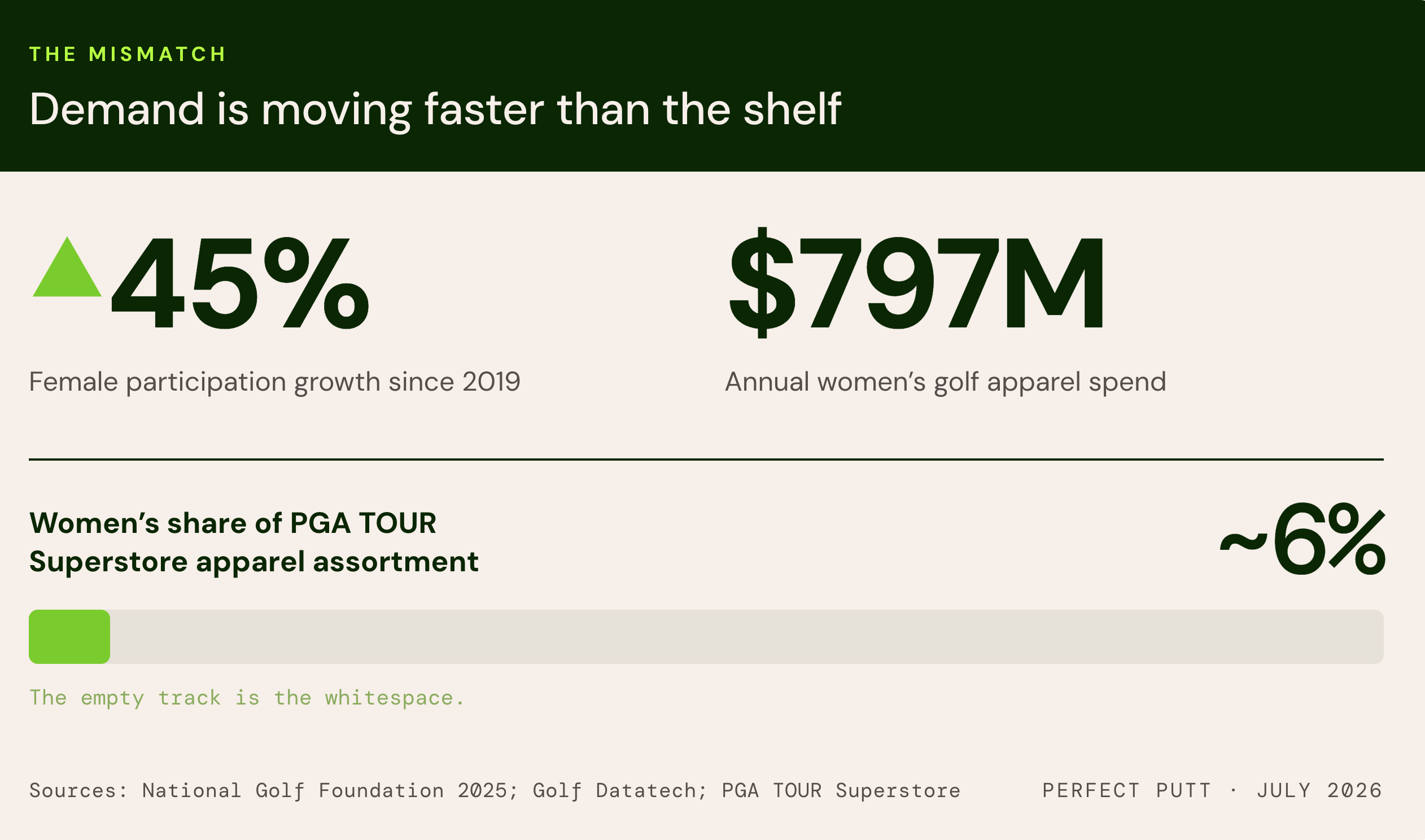
According to the National Golf Foundation, on-course female participation reached a record 8.1 million golfers in 2025, growing roughly 45 percent since 2019, compared with approximately 12 percent growth among men. Yet Golf Datatech continues to describe women's golf apparel as an "underserved and underdeveloped market," estimating roughly $797 million in annual spending. Even PGA TOUR Superstore's own merchandising team has noted that women's apparel represents only about 6 percent of its assortment, versus roughly 16 percent for men's.
The disconnect is striking. Participation has expanded dramatically. Spending power already exists. Yet no brand has clearly emerged as the category's defining cultural platform.
No company has yet achieved the combination of scale, identity, and community in women's golf that brands such as Malbon, Eastside Golf, and TravisMathew have built with their respective audiences. The opportunity is not simply to sell more apparel to women. It is to build the brand that becomes the entry point to golf for one of the fastest-growing segments in the game.
That does not mean nobody is trying. Fore All is building a community-first brand around a more approachable vision of the game. Renwick is reimagining classic golf apparel through a premium lifestyle lens. Midspring is applying a modern, venture-backed consumer brand playbook to women's golf, reflecting the growing belief that this audience can support a category-defining business.
It is still too early to know which model, if any, becomes a category leader. History suggests, however, that the winner will not simply be the company that sells the most apparel. It will be the one that builds the strongest relationship with this growing audience and compounds it into pricing power, recurring engagement, new categories, and ultimately greater enterprise value.
Who Owns the Golfer
The defining competition in golf apparel is no longer simply about market share.
It is about who owns the golfer.
Malbon, Rhoback, Greyson, Eastside Golf, TravisMathew, Peter Millar, and an emerging generation of women's brands are all competing to become the defining brand for a specific type of golfer.
That represents a fundamental shift from the industry's historical model. For decades, apparel largely complemented equipment portfolios and moved through the same wholesale channels as clubs and golf balls. Increasingly, apparel has become the front door to a much larger customer relationship.
The brands creating the most value are building more than product businesses. Apparel introduces the customer. Content, collaborations, and community keep them engaged. Over time, that relationship creates opportunities to expand into new products, categories, and experiences. The shirt is the first transaction, not necessarily the last.
That helps explain why strategic acquirers increasingly pay for differentiated brands rather than undifferentiated apparel businesses. Richemont's decision to operate Peter Millar and G/FORE as separate Maisons reflects the value of preserving distinct brand identities and the customer relationships built around them, rather than simply expanding an apparel portfolio.
Viewed through that lens, women's golf is not a separate story. It is perhaps the clearest remaining example of the same structural shift: a rapidly growing audience without a single brand that has clearly emerged to define it.
The long-term winners in golf apparel may not be the companies that manufacture the best polo or quarter-zip. They will be the ones that become the first purchase, the trusted voice, and ultimately the defining brand for the golfer they serve.
The most valuable asset in golf apparel is no longer just the shirt. It is the relationship the shirt can create. And once a brand owns that relationship, apparel becomes only the beginning.
The best way to support Perfect Putt is to share it with a friend.