
How Younger Members Are Reshaping Country Club Economics
Private golf is undergoing a generational transition, and clubs are beginning to reallocate capital in ways that could reshape where investment opportunities emerge across the industry.
The median age of visitors at National Golf Links of America on Long Island fell from 40.5 to 33.6 between 2019 and 2022. At the Country Club of the South outside Atlanta, it declined from 38.0 to 31.8. At Hazeltine National outside Minneapolis, from 38.7 to 30.9.
Those figures reflect more than a demographic shift. They mark the beginning of a broader reallocation of capital, one that is changing how clubs compete, where they invest, and which businesses stand to benefit.
Welcome to Perfect Putt, a newsletter covering the business and economics of the golf industry. If this was forwarded to you, subscribe to join 12,000+ readers who follow how capital flows through golf.
Read Time: 8 Minutes
The Data
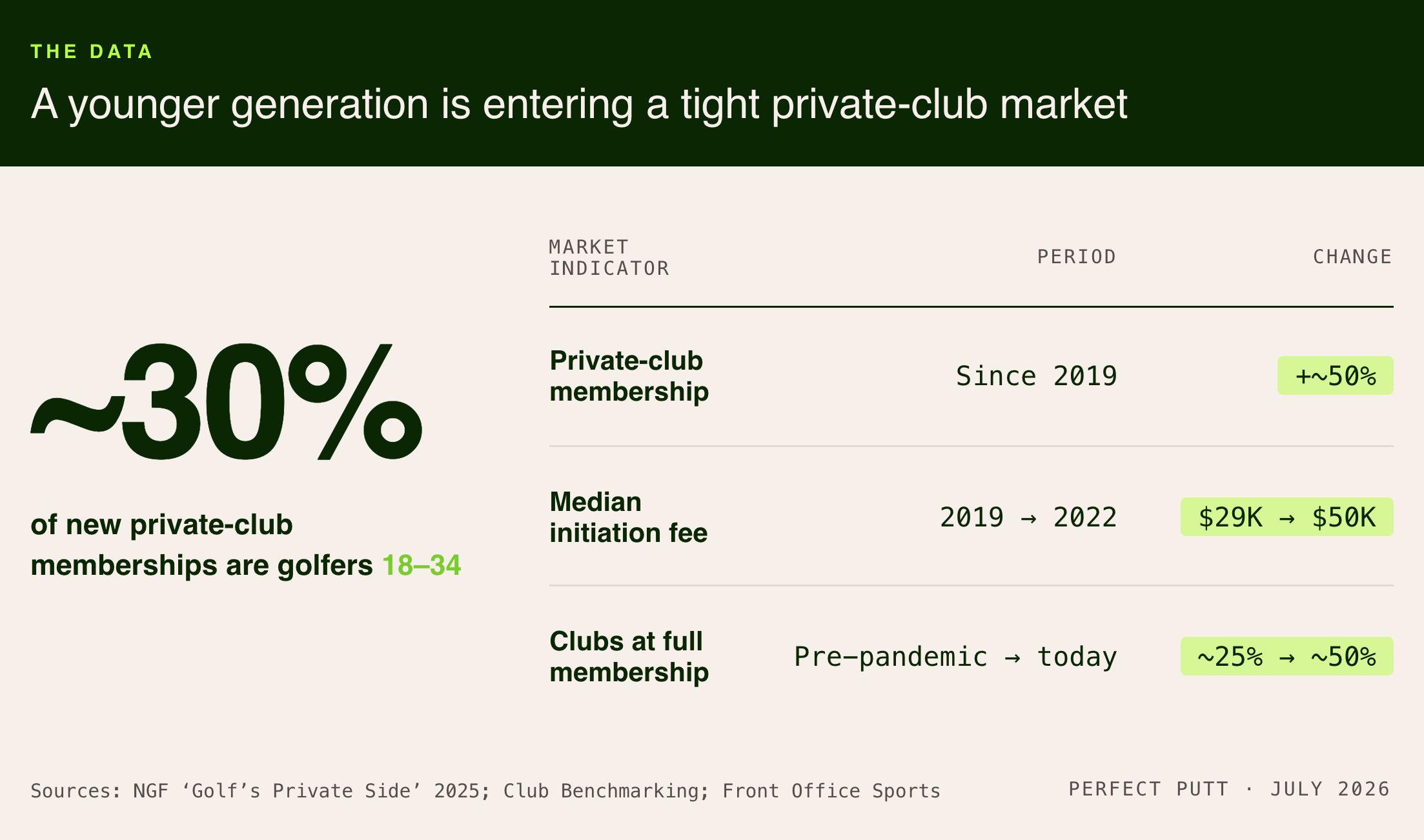
Golfers aged 18 to 34 now number roughly 6.8 million on-course players, making them the largest age segment in the sport, and they account for nearly 30 percent of new private club memberships. Junior participation has reached its highest level since 2004, while Lightspeed's 2025 Golf Industry Report found that 74 percent of golfers in this age group plan to purchase a membership or season pass, with more than a third considering a shift from paying by the round to paying for access outright. The demand is already showing up in club economics. Private club membership has increased nearly 50 percent since 2019, the share of clubs reporting full membership rolls has roughly doubled, initiation fees have climbed from a median of $29,000 in 2019 to $50,000 by 2022, and GGA Partners reports average initiation fees and operating dues continuing to rise. Supply has struggled to keep pace. Despite accounting for a relatively small share of the industry's facilities, private clubs represent more than half of new course development, with most new projects concentrated in just three Sunbelt states. The numbers leave little doubt that demand has shifted. The more interesting question is how clubs are choosing to respond.
Designing for the Next Generation
The renovation projects appearing across the industry are not isolated amenity upgrades. Together, they suggest clubs are investing toward a different type of member and a different pattern of use.
Lowering the barrier to membership
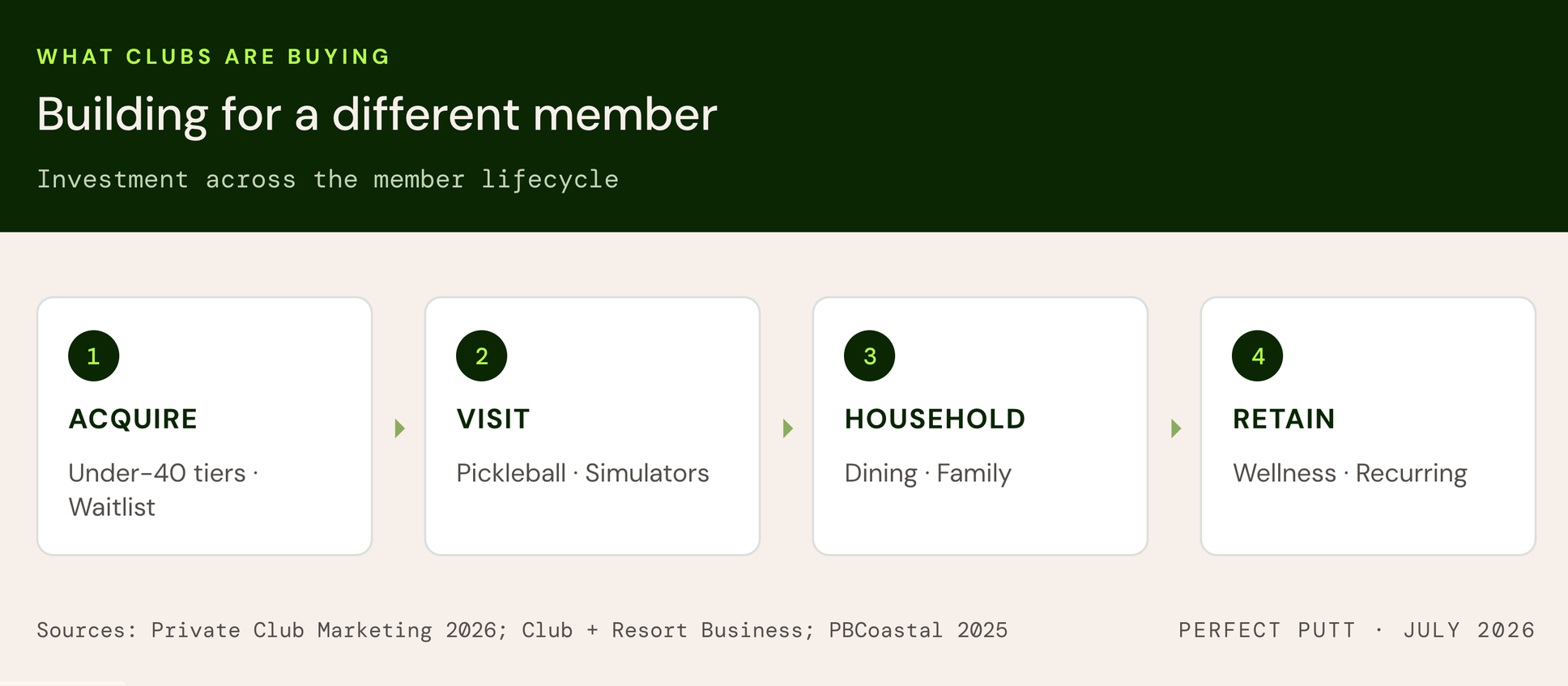
Clubs are making it easier for younger members to join without abandoning the exclusivity that defines the category. Private Club Marketing's 2026 trends report recommends "Under 40" membership categories modeled on the Soho House playbook, giving younger professionals a lower-cost entry point that grows into full membership over time. Marketing has evolved alongside pricing. Rather than quietly managing waitlists, many clubs now promote them with messaging such as "Only 10 Summer Memberships Remain," positioning scarcity as part of the value proposition while competing for attention with the visual storytelling of hospitality brands rather than traditional word of mouth.
Creating more reasons to visit
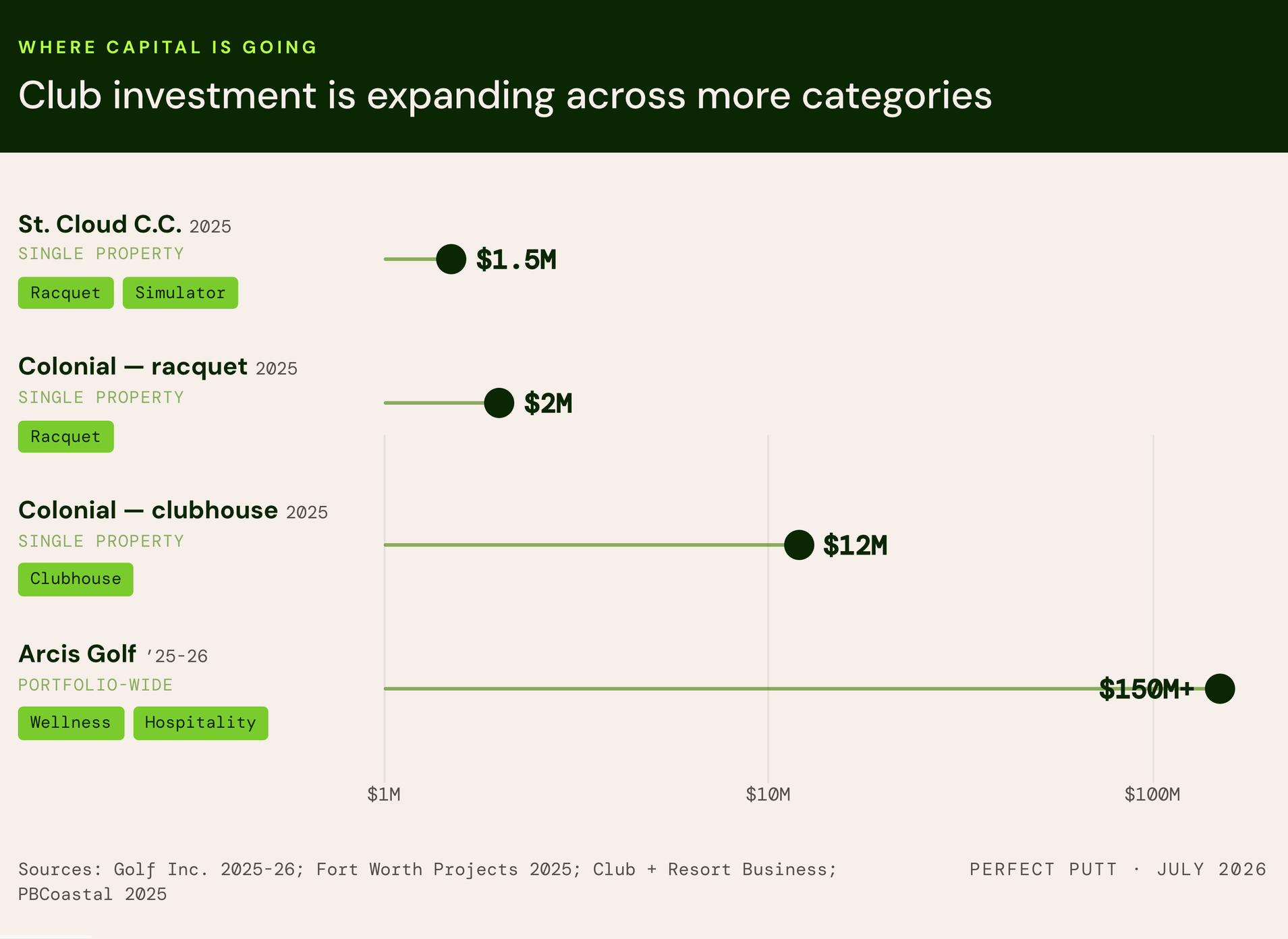
Pickleball is the clearest example because it reflects a broader shift toward amenities that encourage members to use the club throughout the week. Colonial Country Club in Fort Worth is investing $2 million in a standalone tennis and pickleball facility alongside a separate $12 million clubhouse renovation. Mirasol Country Club is expanding from four to thirteen pickleball courts, while St. Cloud Country Club added pickleball and a digital golf simulator as part of a $1.5 million renovation. The common thread is utilization. A member may play eighteen holes once a week, but racquet sports, simulators, fitness, and wellness create reasons to return several times between rounds, increasing the value generated from the same physical footprint.
Designing for households rather than golfers
Many of the newest investments extend well beyond the course itself. Elmwood Country Club paired its pickleball expansion with a new ballroom bar and an upgraded dining program in response to member requests. Family programming, pools, junior golf, and casual dining follow the same logic. The goal is to make the club relevant to spouses, children, and families, transforming a golf membership into a household membership. That distinction matters because the economics of retaining an engaged family are fundamentally different from retaining a single golfer.
Investing in retention
The long-term objective behind these investments is straightforward: keep members engaged for decades rather than years. Whether that strategy ultimately succeeds remains an open question. Trade publications have highlighted individual clubs that experienced significant membership growth after adding pickleball courts and performance centers, but those examples remain anecdotal. The industry is still early in testing whether sustained investment in wellness, racquet sports, dining, and family amenities produces measurably stronger retention than the traditional golf-first model. For now, clubs are allocating capital based on that assumption, while the long-term evidence is still being written.
Where Renovation Capital Is Actually Flowing
The significance of these projects extends beyond any single amenity. Across the industry, renovation dollars are increasingly being directed alongside traditional golf investments toward racquet sports, wellness, family amenities, dining, technology, and hospitality-style experiences. That shift is particularly notable because it is occurring within an industry growing at a measured pace. Golf course and country club revenue increased roughly 4 percent between 2020 and 2025, with forecasts calling for steady, low-single-digit growth through 2030. Clubs are not simply spending more. They are broadening where they invest, reflecting a belief that today's members expect a more comprehensive club experience than previous generations.
The same pattern is visible at institutional scale. Arcis Golf has invested more than $150 million upgrading its portfolio with resort-style amenities, premium dining, and wellness-focused programming, including a partnership with fitness platform iFIT. What makes these investments notable is not their size but their consistency with what is happening across individual clubs. Whether at a single property or across a national portfolio, operators are expanding investment beyond the golf course itself, suggesting this is not a collection of isolated renovation projects but a broader evolution in how clubs create value for members.
As clubs evolve to serve a younger membership base, golf is increasingly becoming the anchor for a broader lifestyle network that includes wellness, racquet sports, hospitality, technology, and family experiences. That expands the range of businesses with meaningful exposure to the golf industry while reinforcing golf's role as the platform connecting them. The opportunity is not simply in the clubs themselves, but in the growing network of businesses positioned to serve how the modern club is choosing to invest.
The Second-Order Opportunity
If this reallocation continues, the more interesting investment question extends beyond which country clubs will outperform. It is how a younger membership base reshapes demand across the businesses that serve them. Every renovation project described earlier creates demand that extends well beyond the club itself. St. Cloud Country Club's addition of a simulator did not simply improve the member experience. It created demand for simulator hardware, software, installation, and ongoing service. Arcis Golf's partnership with iFIT illustrates the same idea at institutional scale, with a national operator choosing to partner with an established wellness platform rather than build those capabilities internally. Even the industry's rapid adoption of pickleball has supported an expanding network of court builders, equipment suppliers, programming providers, and technology platforms designed specifically for clubs.
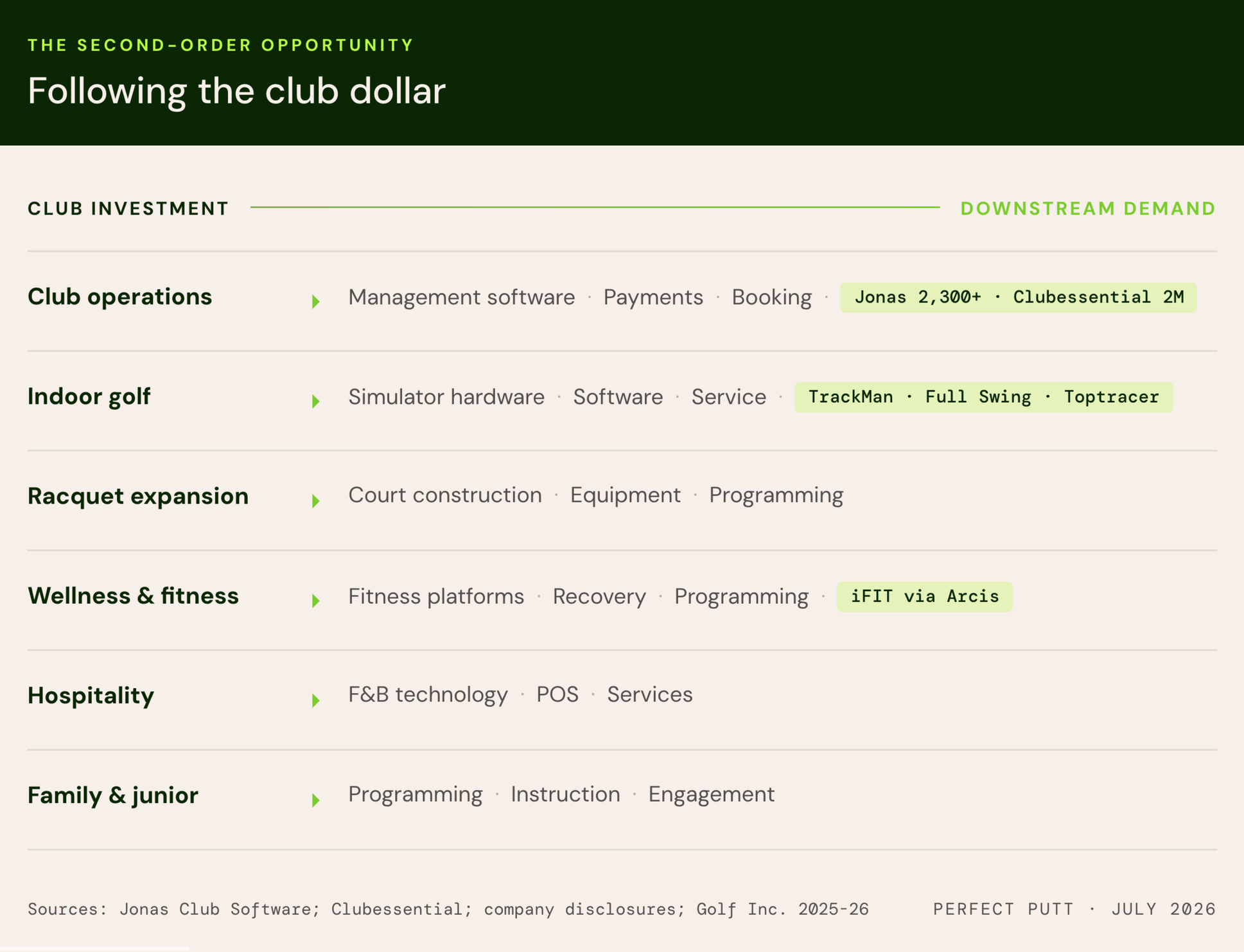
The same pattern is emerging across club operations. As private clubs evolve into broader lifestyle destinations, they increasingly rely on sophisticated software to manage reservations, member communication, dining, racquet sports, events, and payments. Companies such as Jonas Club Software and Clubessential have built large businesses serving exactly this need, reflecting the growing operational complexity of the modern club. Rather than viewing private clubs solely as golf assets, investors may increasingly need to think of them as customers purchasing a much wider range of products and services than they did a decade ago.
That broader supplier network may ultimately become one of the more overlooked consequences of the demographic shift. As clubs continue investing to meet the expectations of younger members, demand is likely to extend well beyond golf-course infrastructure into technology, hospitality, wellness, racquet sports, and family programming. The clubs getting younger may be the headline. The businesses supplying those clubs could prove to be the longer-term story.
The Underlying Shift
A younger membership base is reshaping more than the demographic profile of private clubs. It is influencing what clubs choose to build, renovate, and prioritize, expanding investment beyond the golf course into racquet sports, wellness, hospitality, technology, and family experiences. In doing so, it is broadening the network of businesses with meaningful exposure to golf.
For decades, investing in private clubs largely meant investing in golf itself. Increasingly, it also means understanding the businesses that help clubs attract, engage, and retain a new generation of members. The demographic shift inside the clubhouse may be the headline, but the longer-term story is how that shift changes where capital flows across the industry.
The best way to support Perfect Putt is to share it with a friend.