
The Field Pays the Purse
Below golf’s sponsored pathway, players fund their own prize money. Mini tours survive on discipline. They earn a return only by selling to someone other than the player.
Welcome to Perfect Putt, a newsletter covering the business and economics of the golf industry. If this was forwarded to you, subscribe to join 12,000+ readers who follow how capital flows through golf.
Read Time: 8 Minutes
Two Economies on One Ladder
A Korn Ferry Tour member pays nothing to enter a tournament with a $1 million purse. The 2026 player handbook sets member entry fees at $0 and annual dues at $100, plus small per-event charges. A few rungs down, a player on a Western mini tour pays $1,150 to $1,450 to enter a 54-hole event whose purse comes almost entirely from the other entrants. The price of competing falls as status rises.
The inversion reflects two different businesses. At the top, sponsors fund the purse and the tour sells them an audience. Below it, the field funds the purse and the tour sells players a chance to win their own money back, plus a shot at moving up. The second is a pass-through: entries return as prize money, and most of the rest goes to the host course.
Demand has held for two decades. South Florida’s Minor League Golf Tour opened in 2004 with three entrants and a $150 first prize. By January 2026 it reported 2,395 events and more than $17 million in prize money.
How a tour funds its purse decides whether it survives. What else it can sell decides whether it earns a return.
Inside One Tournament
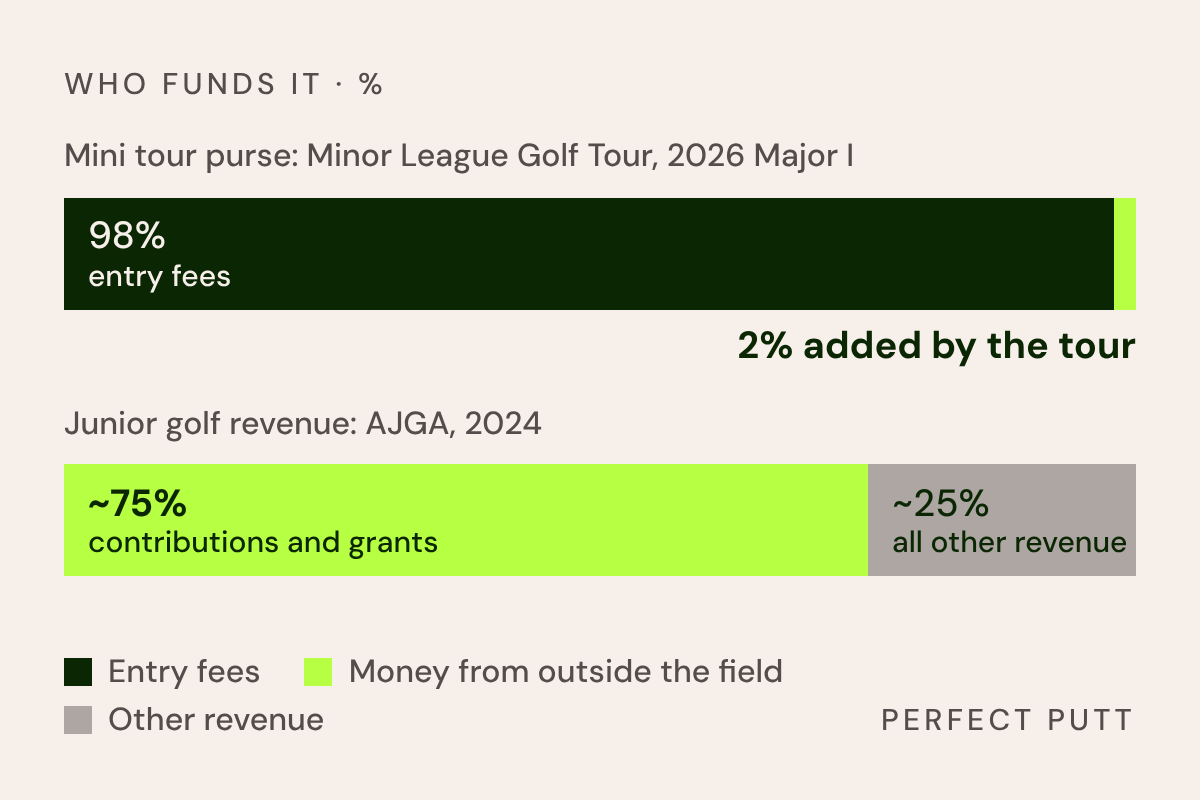
A single event shows where an entry fee goes. At the Minor League Golf Tour’s 2026 Major I, 106 players paid $695 each, a total of $73,670. The purse was $56,450: $55,450 from entries and $1,000 added by the tour. Three-quarters of the entry pool went straight back to the field.
The remaining $18,220, about $86 per player per round, covered green fees, carts, range balls and administration. The tour says its administration fee has averaged under $15 per player per round since 2010 and does not publish it by event. At $15, the operator collected about $3,180, or roughly $2,200 after the money it added to the purse. That is about 3% of entries, before staff, insurance and scoring.
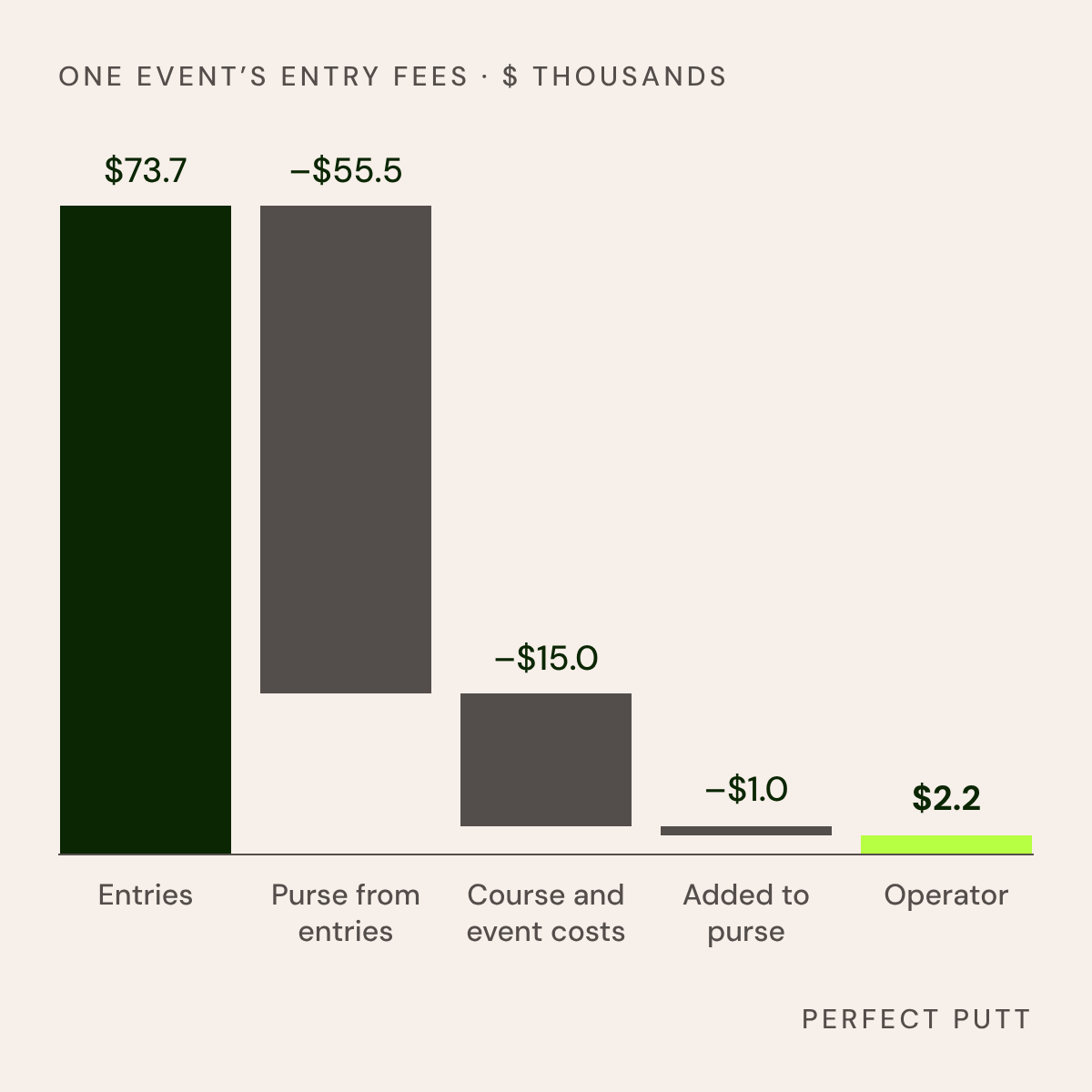
The purse is a transfer among players. It carries no operator risk while it stays inside the entry pool. Risk enters when a tour guarantees more than the field pays in. The Minor League Golf Tour sizes its first-place guarantee to the field, from twice the entry fee for small fields to five times for fields of 40 or more, and posts payouts after entries are counted. The guarantee follows the field, not the other way around.
The Spread Does Not Scale
A full season of filings shows the same pattern. One nonprofit mini tour operator in the West reported about $3 million of 2025 revenue in its federal tax filing, nearly all of it entry fees. Of each dollar, 84 cents went to tournament expenses, the line that carries purses and course fees together, 9 cents to staff and overhead, and 7 cents was retained. That was its strongest result in nine years of filings. A nonprofit surplus is not an investor’s return, and one filing does not set an industry margin. It does show how thin the spread runs for an established tour.
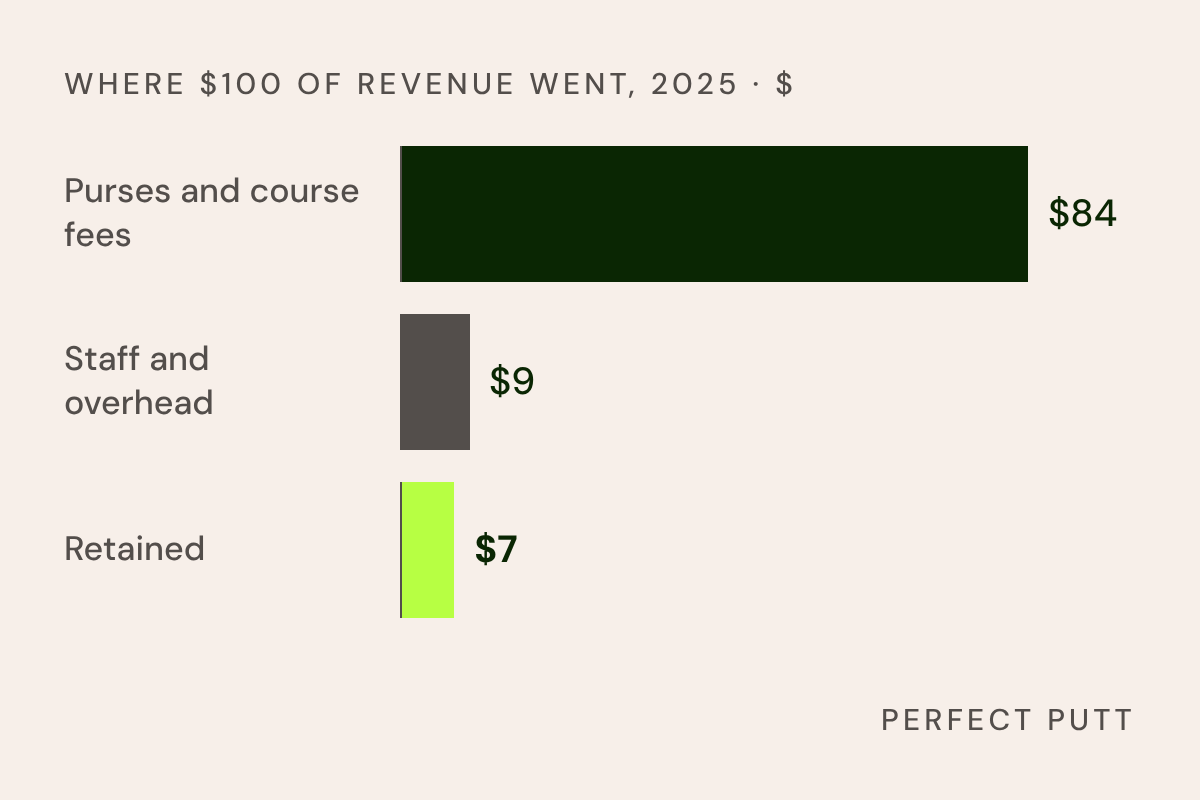
Growth has not widened it. The Minor League Golf Tour went from 25 events to about 120 a year without changing its administration fee. The nonprofit operator more than tripled revenue from 2019 to 2025, and its margin stayed in single digits.
The reason is the cost structure. Tournament poker runs on the same entry-funded model: the house keeps about 17% of a $500 buy-in at the 2025 World Series of Poker and 7% of the $10,000 Main Event, according to PokerNews and Card Player. But a casino owns its room, so each added player is mostly margin. A mini tour rents its room by the player-round, so each added entrant brings another green fee.
Scale can still help through centralized administration, larger sponsor packages and more bargaining power with host courses. That is where the operators worth studying separate themselves.
Higher Costs, Higher Bar
Two conditions outside the operator’s control have shifted at once.
The first is the venue. The National Golf Foundation counted a record 549 million rounds in 2025 and an average public 18-hole fee of $47.25, 29% above 2019. Courses price tournament play like any other tee time in a strong market. One Western operator told Monday Q that course costs, about $50 per player per round before the pandemic, now run up to three times that in peak season.
The second is the finish a player needs to move up. For 2026, the PGA Tour Policy Board cut Korn Ferry Tour graduation to the top 20 from 30, set Q-School cards at the top five, and limited fully exempt PGA Tour status to the top 100 from 125. The Tour framed the changes as giving card holders more equitable playing opportunities and schedule certainty. A non-member who plays all four stages of Q-School pays $21,000 in entry fees.
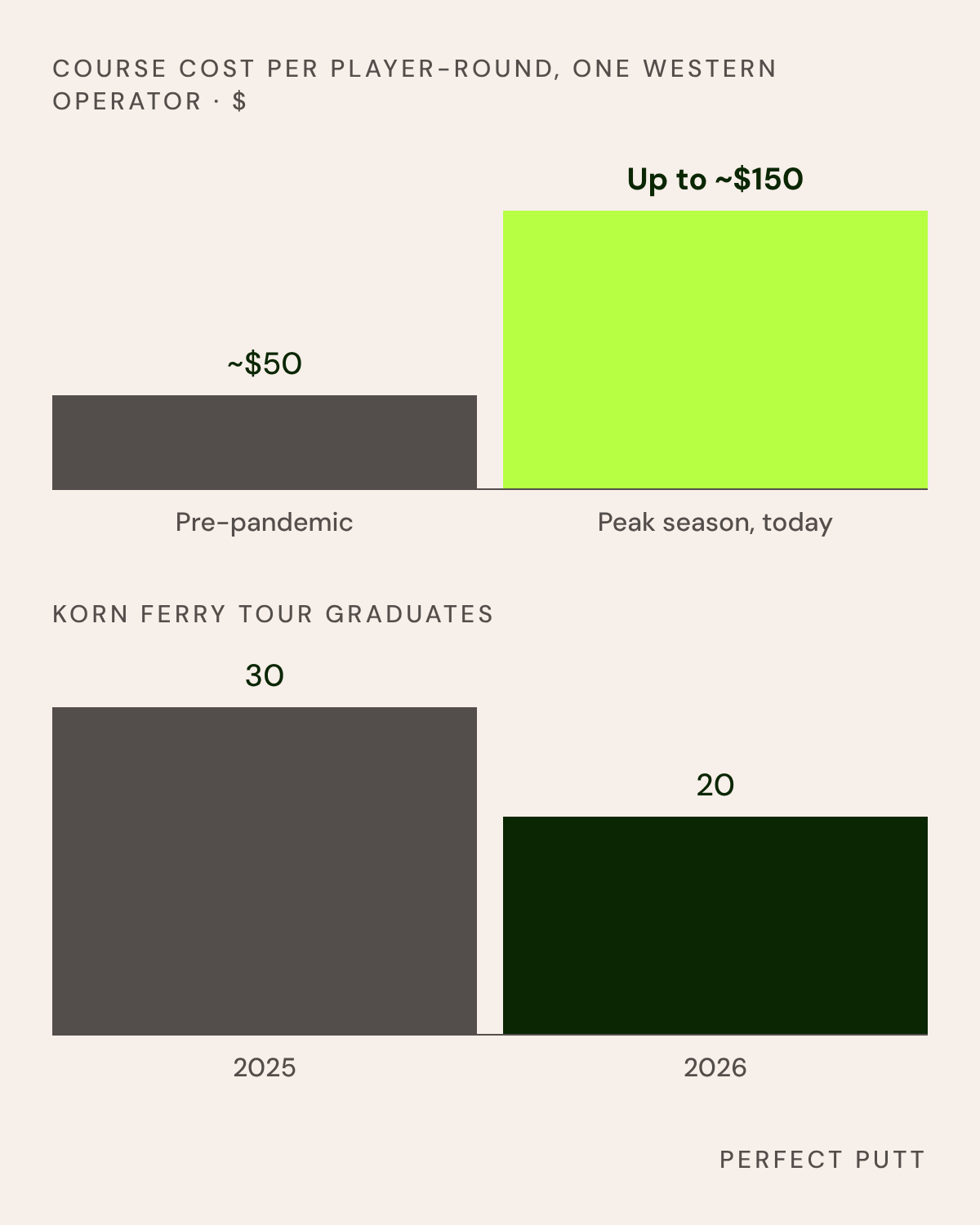
The two shifts compound. Higher venue costs push entry fees up or squeeze the operator’s spread. A narrower pathway lowers the value of each start as a route to status. Players pay more for an option worth less, and their bankrolls run out sooner.
Runway Is the Customer Lifetime
The operator and the player sit on opposite sides of the same ledger. A tour that returns 70% to 90% of entries stays solvent. By the same arithmetic, the field as a whole loses money before anyone books a hotel.
One 54-hole Western event in 2024 cost a player about $2,490 in entry, lodging, fuel and food, and breaking even required a top-seven finish in a 117-player field, according to Golf Digest. A Clutch Pro Tour player in England put the season cost at about £40,000 and break-even at 17th of 150, according to Golf Monthly. Across all 1,038 Minor League Golf Tour entrants in 2025, the purse averaged about $1,509 per player for the year.
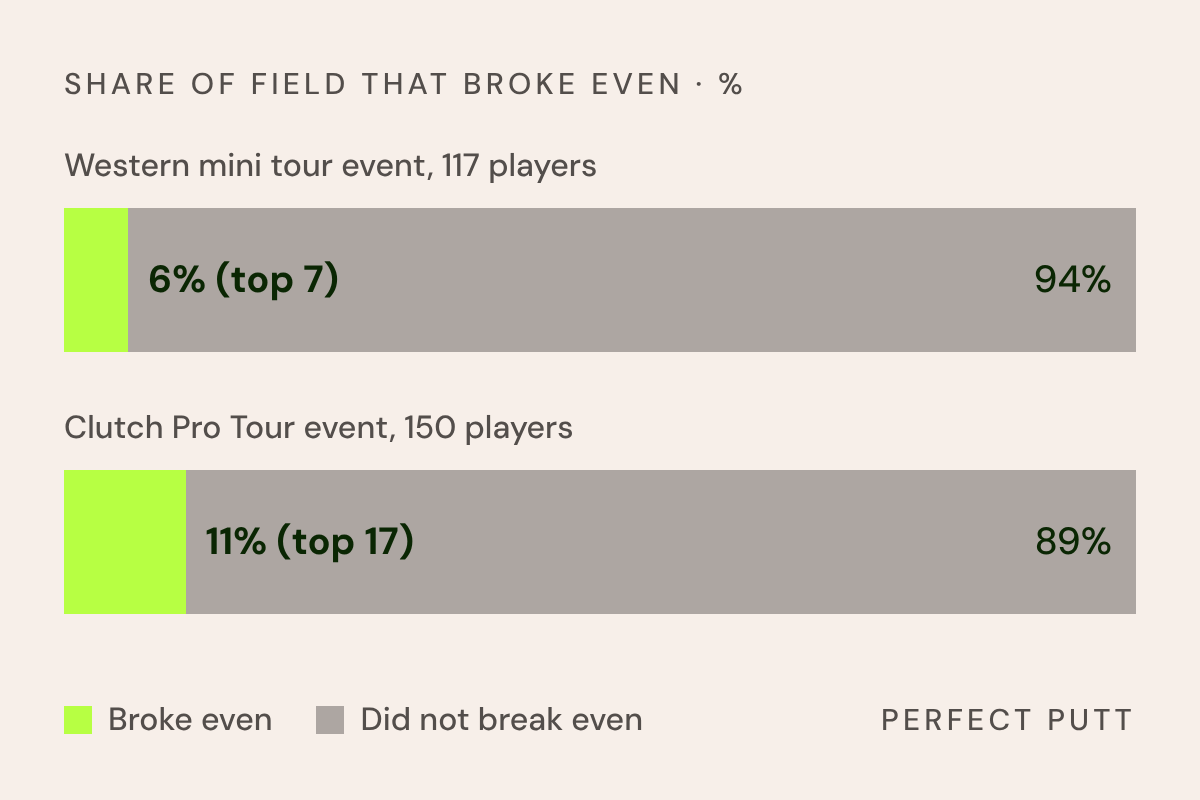
No governing body resizes the field, so the field resizes itself. Players start with a bankroll and leave when it runs out. The same Clutch Pro Tour player put the typical starting stake of those who quit at about £20,000, roughly half a season. A tour’s customer lifetime is its players’ bankroll divided by their net cost per start. Survival requires steady fields, disciplined guarantees and lean overhead. A return requires lowering that cost or raising what a start is worth.
Selling the Week More Than Once
An average tour sells entries. A stronger one sells the same week to four buyers.
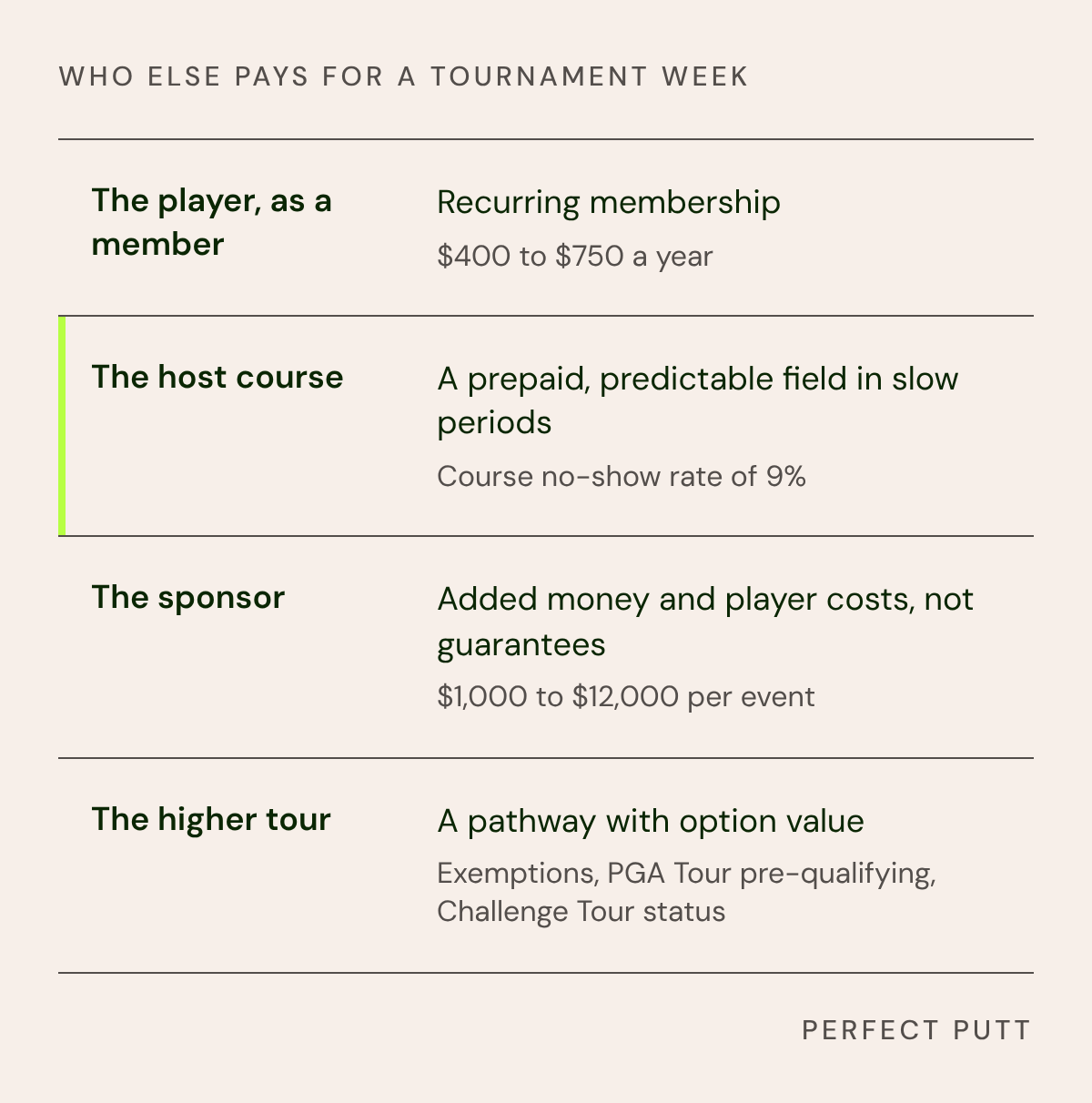
The player, as a member. Annual fees create revenue outside the purse: $400 on the Minor League Golf Tour, $750 on the ANNIKA Women’s All Pro Tour. Concentration extends runway. Most Minor League Golf Tour events sit within 90 miles of Jupiter, Florida, across 47 weeks a year, so players sleep at home and a bankroll buys more starts.
The host course. NGF measured a 9% no-show rate across more than 500 courses. A tour that brings a prepaid, predictable field into slow periods offers something a one-off outing cannot, and that is where scale earns bargaining power. Multi-year hosts can also carry player costs: Indian Wells will provide a hotel room to each Epson Tour Championship player from 2027.
The sponsor. Sponsorship works best as added money or support for player costs, not as a headline guarantee. Examples range from the Minor League Golf Tour’s $1,000 to $12,000 additions to a Callaway-sponsored points race on the women’s tour that sends its top five to the second stage of LPGA qualifying.
The higher tour. Pathways give an entry option value: a Barracuda Championship exemption for the 2025 Reno Open winner, PGA Tour pre-qualifying through the All Pro Tour and, in Europe, Challenge Tour exemptions for Order of Merit leaders on official feeder tours such as the Clutch Pro Tour.
No mini tour publishes a P&L showing which combination performs best. The operators that last sell to more than one buyer.
Capital Implications
Player-funded tours behave like small, cash-yielding local businesses with a variable cost base. Ticketing and media contribute little below the Korn Ferry Tour, so a growth case cannot rest on new audiences. It rests on four lines: revenue from sources other than entries, venue cost per player-round and the length of host agreements, the guarantee policy, and starts per player per season.
For a roll-up, the test is whether a combined schedule wins better host terms and larger sponsor packages than its parts could alone. What breaks first in a downside is the guarantee. A tour that promises purses into a softening field, or behind a departing sponsor, turns a pass-through into a liability.
The upside sits with buyers who have a budget. Tourism authorities, hospital systems and regional banks fund Korn Ferry purses. In Minot, North Dakota, a nonprofit raised about $205,000 in 2024, largely from local sponsors and amateur entries, to fund a $100,000 pro purse on the Dakotas Tour. An operator that can package a tournament week for a community, destination or sponsor stops depending on the field alone.
Remove the purse and the model changes. Junior tours run on the same courses, entry fees and administration without a prize pool. The American Junior Golf Association reported $21.6 million of 2024 revenue, about 75% from contributions and grants. The model is drawing institutional capital: in April, Bolt Ventures acquired the Hurricane and Texas junior tours and, with Arnold Palmer Enterprises and the Arnold & Winnie Palmer Foundation, launched the Arnold Palmer Junior Golf Tour, with nearly 400 events planned for 2027.
Below the sponsored pathway, the field pays the purse. The opportunity for capital lies in everything an operator can sell beyond it.
The best way to support Perfect Putt is to share it with a friend.