
The Shrinking Minimum Run
New tools haven’t moved golf’s factories. They’ve changed how few clubs it pays to make.
A factory making 100,000 identical iron heads spreads its tooling costs across every unit. A workshop making 1,000 different heads has little to spread and gains little from scale. For decades, that math favored large Asian factories and left short runs to Tour vans and boutique shops.
3D printing, five-axis milling and computer-driven design are changing it. They are not changing where clubs are made, but how few can be made profitably.
Welcome to Perfect Putt, a newsletter covering the business and economics of the golf industry. If this was forwarded to you, subscribe to join 12,000+ readers who follow how capital flows through golf.
Read Time: 8 Minutes
Two Cost Curves
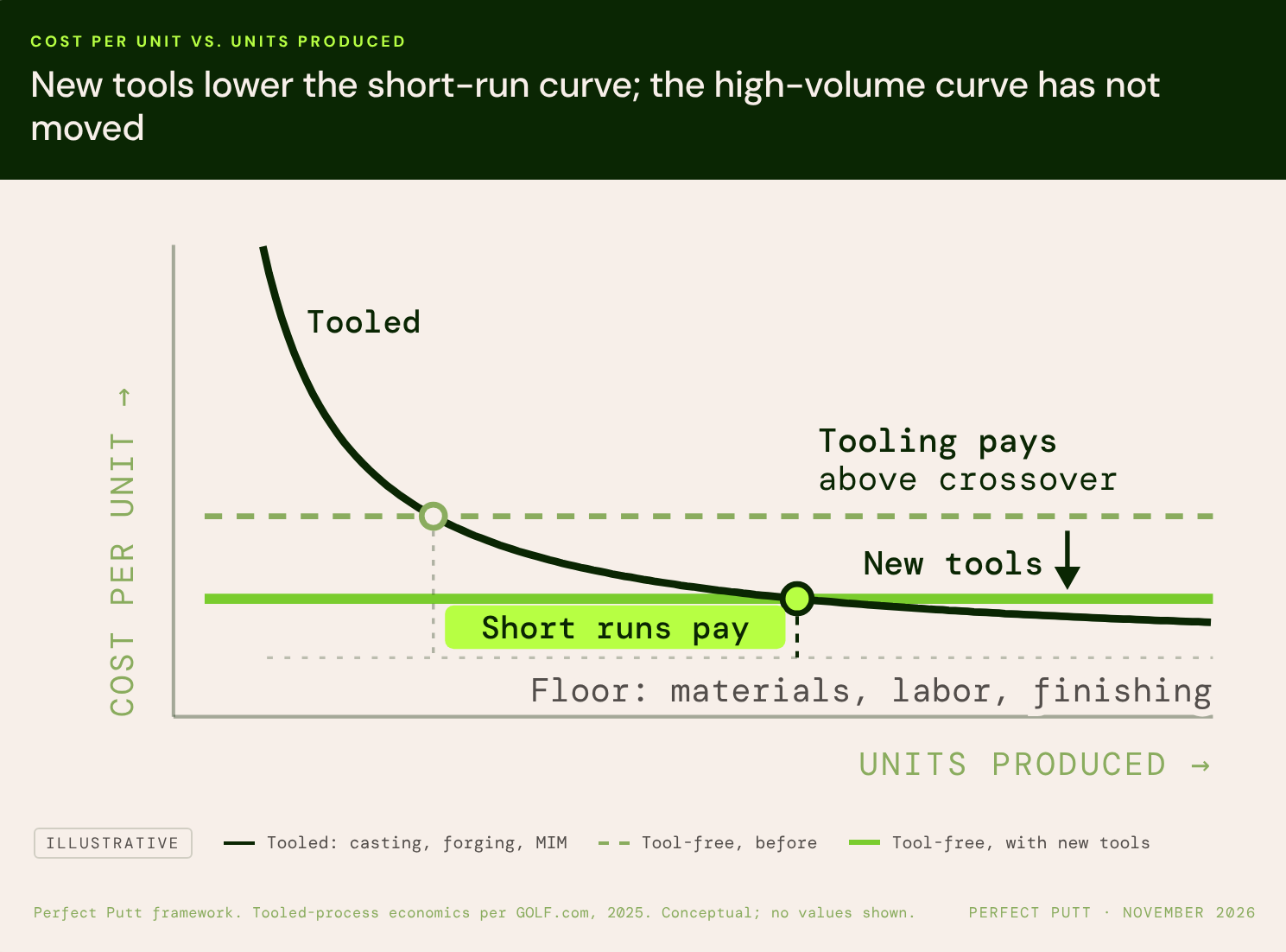
Golf equipment is made on two cost curves. Casting, forging and metal injection molding carry high fixed costs in tooling and low costs per unit, so they reward volume; every design change in a molded part requires a new mold, GOLF.com noted in a 2025 look at the process. Printing and milling carry low fixed costs and higher costs per unit, so they reward variety. Below some volume the tool-free process is cheaper; above it, the mold wins.
The high-volume curve has not moved. Fusheng Precision, the largest club-head maker, centers its manufacturing in Vietnam, which UN Comtrade data show became the largest source of U.S. golf hardgoods imports in 2025. Callaway's latest annual filing shows more than half of its club assembly and about three-quarters of its balls made outside the U.S. Bridgestone closed its Georgia ball plant in June 2026.
The change is on the other curve. New tools have pushed down the cost of producing in small batches, which lowers the minimum run at which a product, a model variant or a single golfer's build becomes commercially viable.
What the New Tools Actually Change
Each new process lowers a different part of the short-run cost.
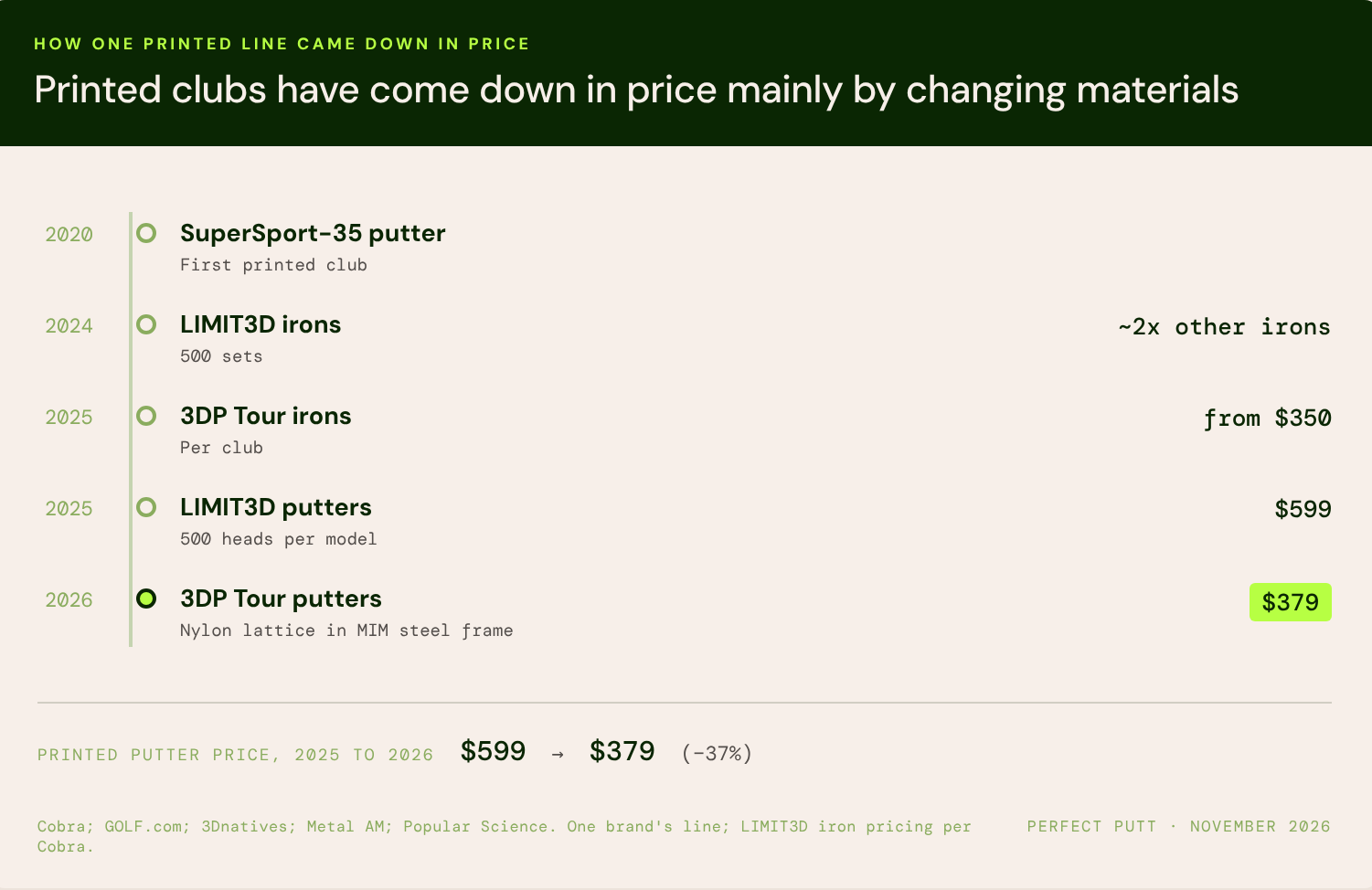
3D printing eliminates tooling costs and allows designs to change between production runs. Its main limitations are speed and finishing, with Popular Science identifying finishing as the most expensive step in producing a printed clubhead. Manufacturers have lowered costs largely by changing materials. Cobra’s first printed irons launched in 2024 as a limited run of 500 sets, priced at roughly twice its conventional irons. By 2026, its putters used a printed nylon lattice inside a molded steel frame and retailed for $379. The biggest advantage, however, is speed. According to GOLF.com, custom Tour irons can be produced in about a month, faster than traditional forging or casting. Cobra now reports that roughly 10 percent of its clubs contain a 3D-printed component.
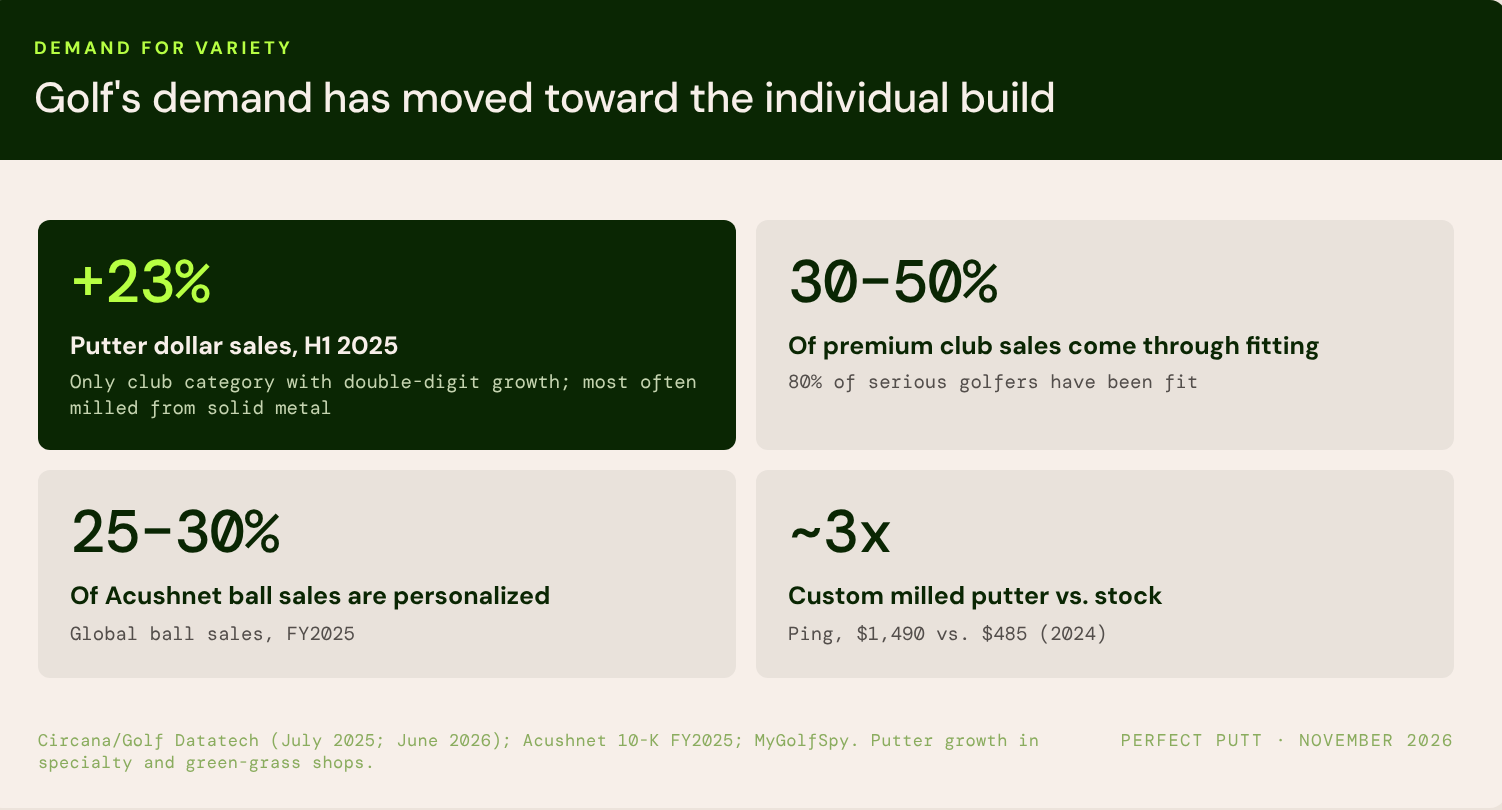
Milling lowers the cost of entry further. A five-axis machine cuts a different head from each billet with no mold, so variety adds programming time rather than tooling. That is why putters, the club most often milled from solid metal, are where short-run production has scaled. Putter dollar sales rose 23 percent in specialty and green-grass shops in the first half of 2025, according to Circana's Golf Datatech, the only club category with double-digit growth. Several brands mill putters domestically: Bettinardi says it does all of its machining in Illinois, and L.A.B. Golf builds stock and custom putters in Oregon at about 35,000 a month, its engineering head said in 2025. The premium for an individual build is visible within a single head family: Ping's custom milled program listed at $1,490 in 2024, about three times its $485 stock model, MyGolfSpy reported.
Automation and new materials work differently. They improve consistency and performance inside high-volume processes. Callaway says it has added robotic molding and 3D X-ray core inspection at its Massachusetts ball plant, and TaylorMade's carbon driver face took about 20 years of development and a dedicated plant completed in 2021, by the company's account. These investments raise the fixed cost of the process. They strengthen scale production and do not shorten the minimum run.
What Other Industries Learned
Footwear and dentistry offer two different lessons in manufacturing automation.
Adidas opened robotic Speedfactories in Ansbach, Germany, in 2016 and Atlanta in 2017, then announced their closure in November 2019. The German plant had been built for knit uppers and foam midsoles and could not make leather shoes with rubber soles. Adidas said the work made more sense in Asia, where established suppliers already had the expertise and infrastructure, and transferred the technology to two Asian suppliers. Align Technology, by contrast, produces more than one million custom aligner parts a day, according to Orthodontic Products, each specified by an individual patient's treatment plan.
The distinction is not that one company automated successfully and the other did not. Adidas demonstrated the difficulty of using automation to compete with established supply chains on standardized production. Align demonstrates how digital manufacturing can scale when each product requires a different specification. Golf sits somewhere between the two. Most equipment still benefits from centralized, high-volume manufacturing, while custom fitting, short-run machining and printed components create opportunities for more individualized production. The advantage lies not simply in owning the equipment, but in matching the manufacturing process to the economics of the product.
Where Short Runs Now Pay
Lower short-run costs matter only if demand for variety exists, and golf's demand has moved in that direction. Fitting accounts for 30 to 50 percent of premium club sales, and 80 percent of serious golfers have been fit, according to Circana's June 2026 study, which also found wedges, hybrids and putters underfit relative to irons and drivers.
Production is reorganizing around that demand at the end of the line. Callaway runs custom assembly in Tokyo, Swindon, Melbourne and Seoul alongside its primary plant in Monterrey, Mexico. Heads are still produced in volume in one place; the club is configured for one golfer in another. The categories where the whole product, head included, can be made in short runs are the ones machined from solid metal or printed: putters, wedges, limited editions and Tour builds.
What Still Favors Scale, and What Slows Adoption
Most golf equipment still sits on the high-volume curve. Driver and iron heads, standard balls and primary assembly remain concentrated in large plants. Fusheng Precision continues to invest in production capacity, announcing plans for a new factory building in Vietnam in 2026. Its expansion underscores the continued role of large-scale manufacturing, even as newer technologies make smaller production runs more viable.
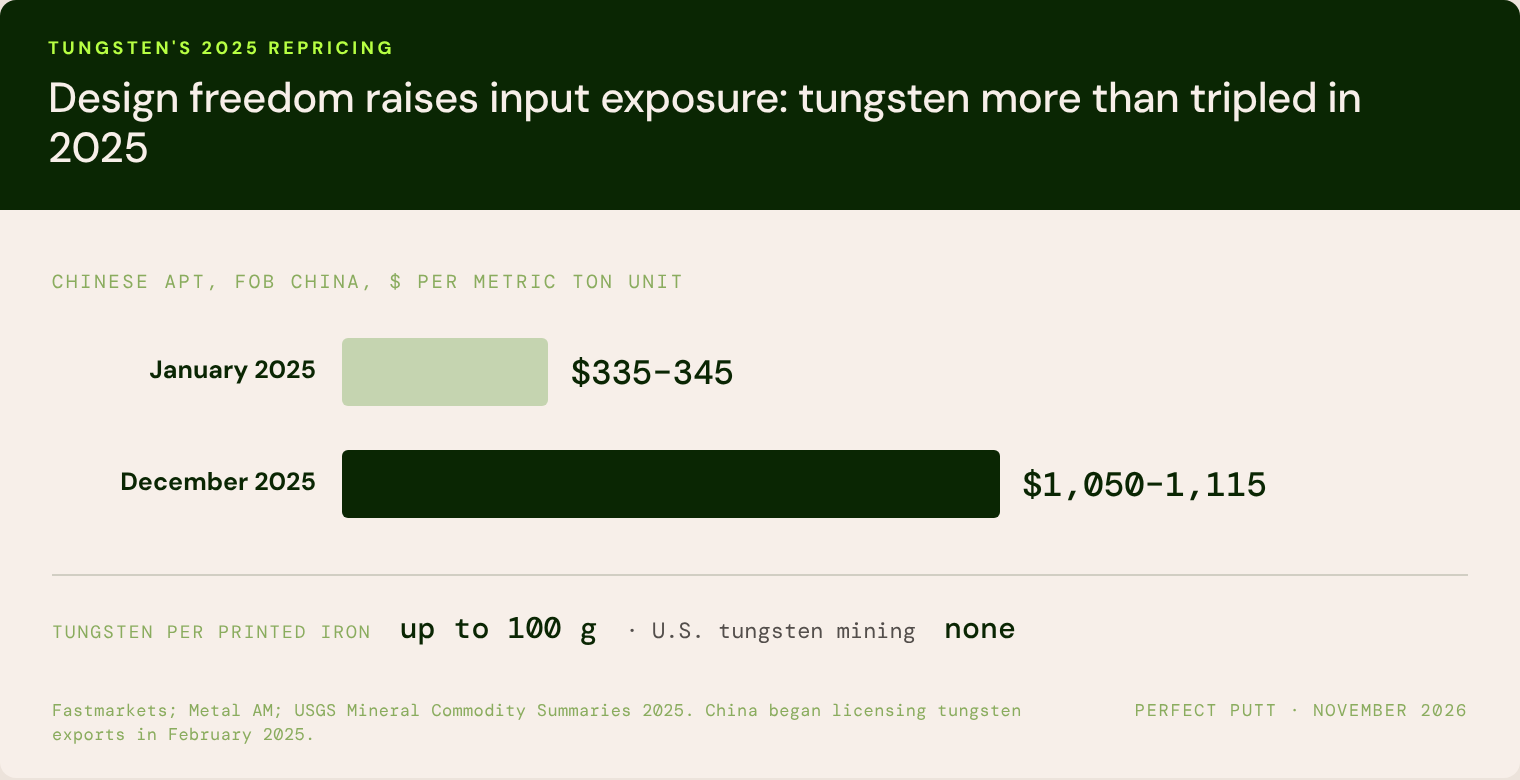
Three barriers limit how far short-run production can spread. Printing remains slow and finishing-heavy, which caps it at small batches. Molded and composite processes require tooling or dedicated plants before the first unit ships. Design freedom raises input exposure: printed lattices exist to remove steel so mass can be placed where designers want it, often as tungsten, up to 100 grams in one printed iron, according to Metal AM. China began licensing tungsten exports in February 2025, Chinese tungsten product prices rose more than 200 percent that year, Fastmarkets reported, and Callaway's finance chief, Brian Lynch, told investors in August that tungsten costs have "increased multiples over 2025 costs." The U.S. has no domestic tungsten mining, according to the U.S. Geological Survey.
Equipment standards add a planning horizon: in June 2026 the USGA and R&A, together with the PGA Tour and DP World Tour, said there would be no change to golf ball testing standards until at least January 2030, and that any change would take effect on a single date.
Capital Implications
New manufacturing tools create three economic consequences for investors, though profitability remains unproven. No major brand discloses whether printed or custom products earn higher margins than stock equipment. Premium pricing signals demand, not necessarily better economics.
Lower capital requirements. Short runs reduce tooling costs and minimum-order commitments, making it easier for emerging brands to launch products. Taiwanese manufacturers reported growing orders from smaller brands in 2026, but the four largest brands still control more than 70 percent of the U.S. club and ball market, according to Global Golf Post. Manufacturing access is improving; reaching scale remains difficult.
New working-capital models. Inventory may be the larger opportunity. Acushnet ended 2025 with $608.6 million in inventory against $2.56 billion in sales. Build-to-order production can reduce finished-goods exposure but shifts constraints to components and assembly capacity. Flexible manufacturing offers greater inventory control, though measurable industry-wide benefits remain unproven.
Changing sources of advantage. As manufacturing becomes more accessible, differentiation shifts toward proprietary design, fitting relationships and distribution. L.A.B. Golf illustrates this opportunity: L Catterton invested in 2025 at a reported valuation above $200 million, backing a business built around differentiated design and fit-to-order production.
The central implication is that lower barriers to manufacturing do not eliminate barriers to scale. Emerging brands can launch with less capital, while established players gain flexibility in inventory and customization. Value increasingly accrues to those that can differentiate products and reach customers, rather than simply manufacture them.
Four indicators will help measure the shift: inventory-to-sales ratios, emerging-brand market share, adoption of printed components and input costs, particularly tungsten.
Mass manufacturing will continue to dominate golf equipment. What changes is the minimum viable production run, and with it, the economics of launching products, managing inventory and competing.
The best way to support Perfect Putt is to share it with a friend.