
The Second Owner Sets the Price
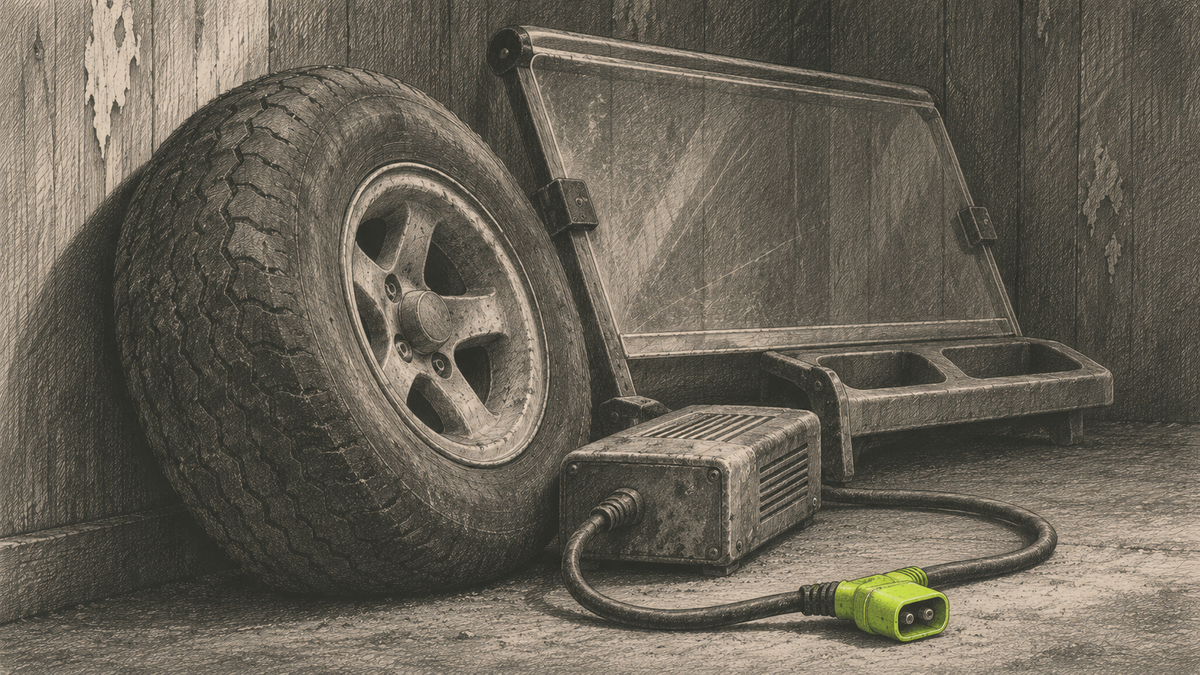
Courses earn from carts on the first tee. What those carts actually cost depends on what they fetch three or four years later.
Welcome to Perfect Putt, a newsletter covering the business and economics of the golf industry. If this was forwarded to you, subscribe to join 12,000+ readers who follow how capital flows through golf.
Read Time: 9 Minutes
Every golf cart has two lives. In the first, it earns rental fees on a course. In the second, it is sold to a new owner: another course, a resort, a beach-town rental shop or a homeowner. What the cart is worth in that second life decides much of what it cost in the first, and almost no one in golf is tracking it.
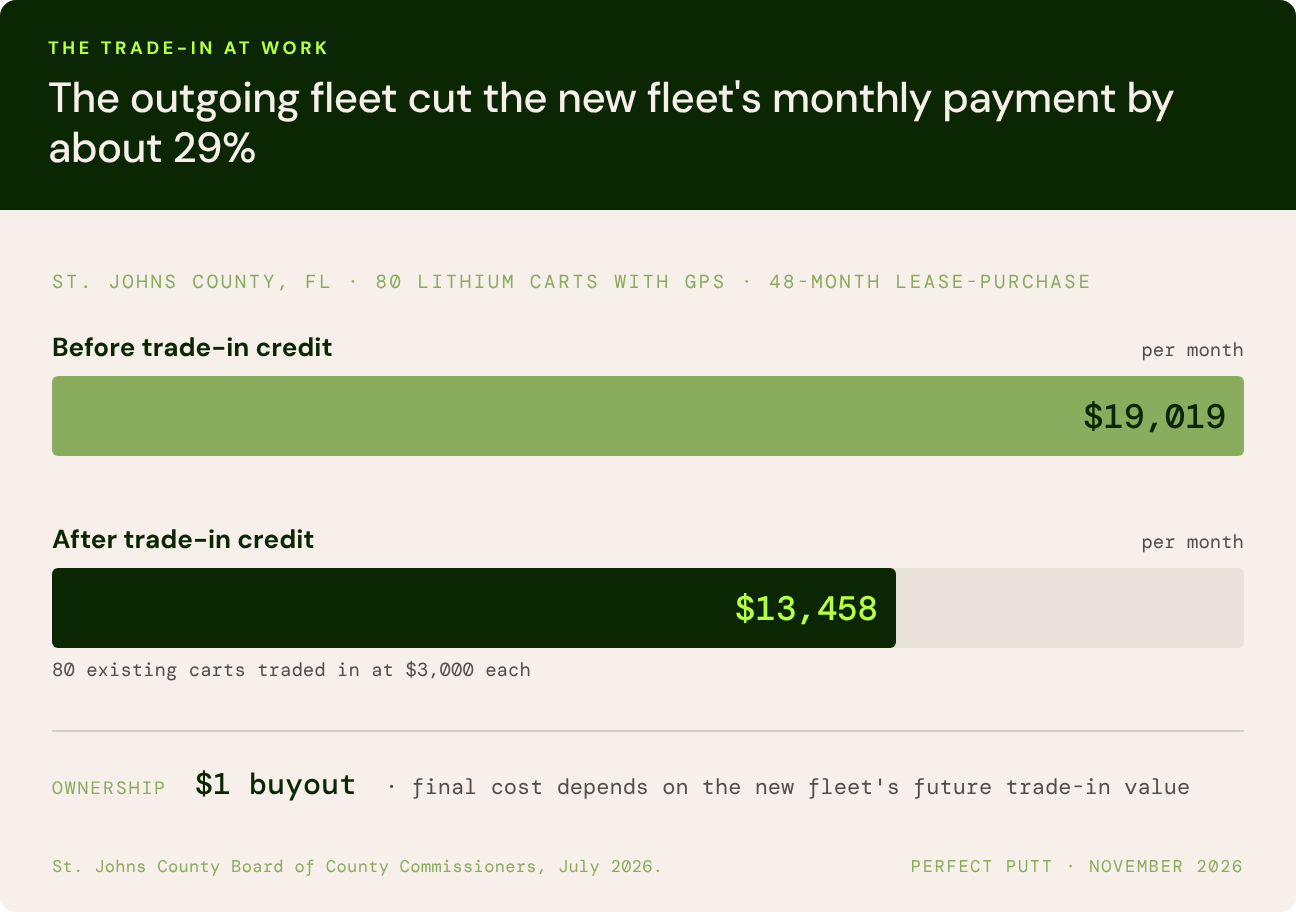
The math is simple. A course’s real cost for a cart is the purchase price minus what the cart sells for when it leaves. When St. Johns County, Florida traded in its old fleet this year, the trade-in covered about 29 percent of the payments on the new one.
Yet no index tracks what a used fleet cart is worth. Each trade-in is negotiated privately between a course and its dealer, one fleet at a time. The businesses that can price a used cart well keep the difference between what they pay for it and what they sell it for. Most courses cannot.
The Second-Largest Revenue Line
In fiscal 2024, Grapevine Golf Course in Texas collected $939,646 in cart rentals against $2.15 million in green fees, according to the city’s budget. Carts brought in about 44 cents for every dollar of green fees. That October, the city approved $835,200 for 96 new carts, roughly $8,700 apiece, and traded in a fleet that was three years old.
Grapevine is not unusual. Allentown, Pennsylvania budgeted $660,000 in cart rentals for 2025 against $1.44 million in green fees. The National Golf Foundation estimates that roughly two-thirds of American rounds are played from a cart, which makes the fleet the asset most rounds physically touch.
The cost side is just as visible. At the Riverbend complex in Kent, Washington, an $83,319 annual lease for 75 carts and utility vehicles supported roughly $200,000 in reported cart revenue in 2022. Burleson, Texas weighed an $87,061 annual lease against $258,342 in prior-year cart revenue, then bought its fleet outright in March 2024.
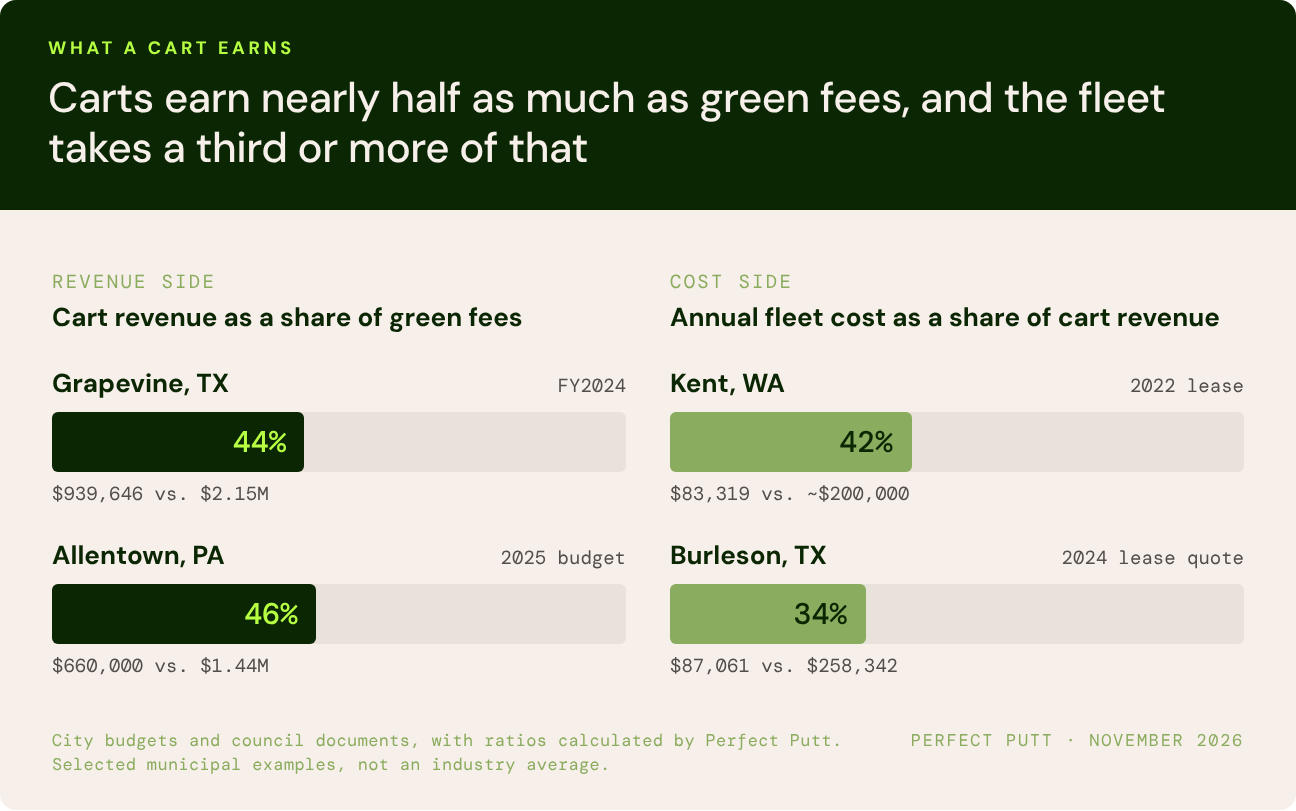
These are municipal examples because cities publish fleet contracts and cart revenue line by line. Ratios vary with region, walking rates and pricing. Private clubs, resorts and management companies sign similar contracts but do not disclose terms.
The pattern still holds. Cart revenue runs at roughly 40 to 50 percent of green fees at these courses, and a third or more of it can go straight to whoever finances the fleet. Small changes in fleet cost move course margins.
Two Contracts, One Question
Courses pay for fleets in two basic ways. The difference that matters is who carries the resale risk.
Under an outright purchase or a lease-purchase, usually with a $1 buyout, the course owns the carts. The old fleet’s trade-in lowers the upfront cost, and the new fleet’s eventual resale value determines what ownership really cost. Under a fair-market-value lease, the lessor estimates that future value and prices it into the monthly payment. The course hands off the resale risk and pays for the privilege.
St. Johns County shows how much the old fleet carries. In July 2026 the county signed a 48-month lease-purchase for 80 lithium carts with GPS screens and a $1 buyout. The initial monthly payment of $19,019 dropped to $13,458 after the county traded in 80 existing carts at $3,000 each. The county now owns a fleet whose net cost depends on what it fetches around 2030.
Palm Coast, Florida faced the same choice in August 2025. Leasing looked slightly cheaper on paper, but city staff recommended buying once resale value, ownership and the absence of end-of-lease wear charges were counted.
Some cities write the depreciation curve down. Eaglewood Golf Course in Utah projected what a $6,700 cart would be worth at three, four and five years.
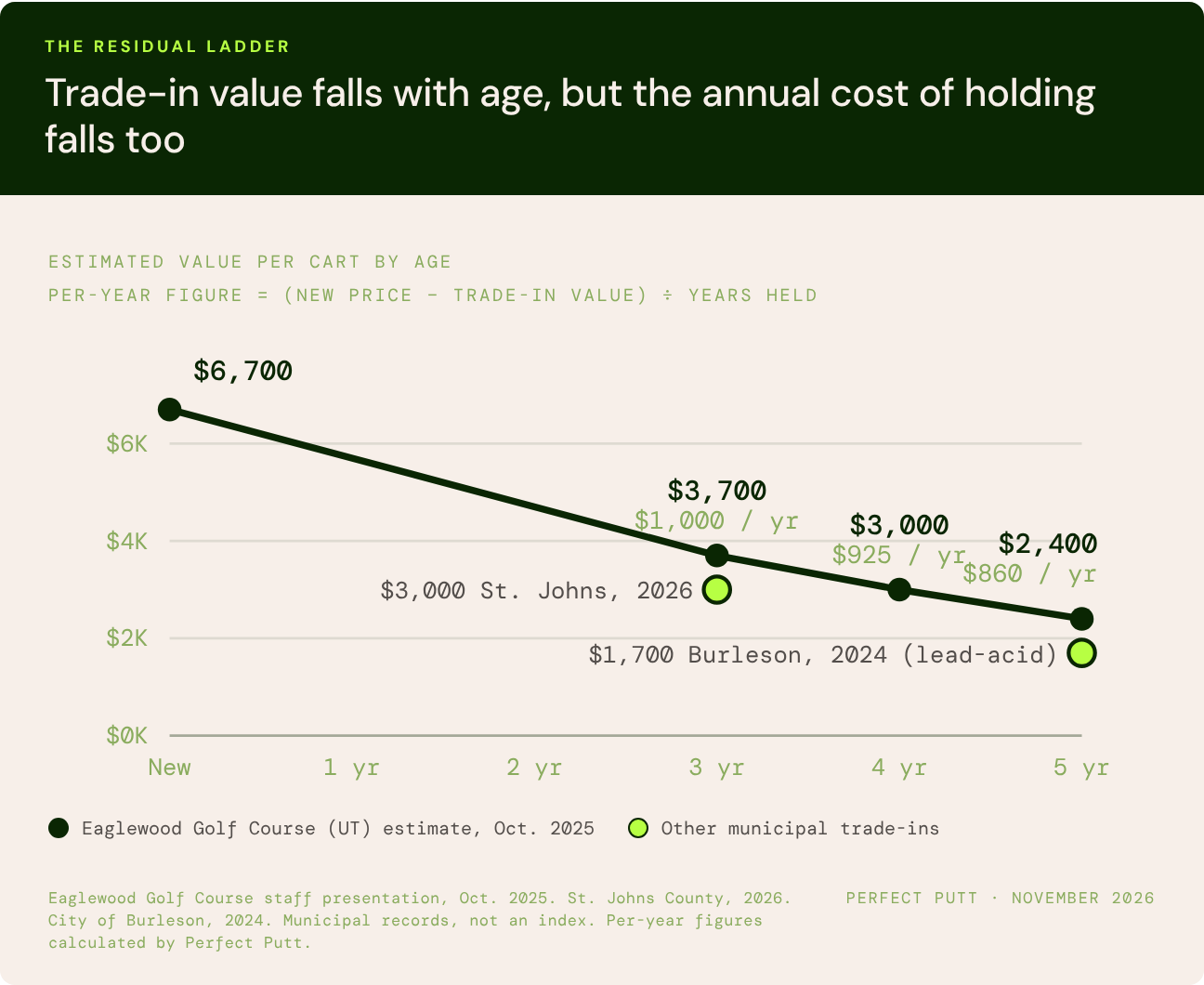
The obvious reading is that early trade-ins pay, since a three-year-old cart fetches about 54 percent more than a five-year-old one. The capital math says otherwise. Annual depreciation falls the longer a course holds, because a bigger check every three years also means buying a new fleet more often. The case for a short cycle has to come from somewhere else: battery fade, maintenance, GPS refresh and whatever premium a newer fleet commands on the first tee. Operators should model the decision per round, not per trade-in.
Resale demand also shows up in lease pricing. In 2019, Marysville, Michigan leased 60 new carts for only $223 more than three-year-old carts would have cost, according to Government Fleet, a gap the publication tied to strong demand for used carts from personal buyers.
The Second Owner
The value of a used fleet cart depends on a market golf does not run. Most courses never sell to the cart’s next owner. They trade the fleet in to the dealer selling the new one, or return it to the lessor. The dealer reconditions the carts and resells them to other courses, resorts, rental shops, communities and households. What that whole pool will pay sets the trade-in price the course is offered.
Households are a growing part of that pool. In golf communities and warm-weather towns, carts handle errands, school runs and trips to the beach. During the pandemic, Power Systems Research noted that golf car demand accelerated as a lifestyle vehicle rather than for course use. Buyers who may never play a round now help set what a course pays for its next fleet.
Trade policy has reshaped how those personal buyers are supplied. In August 2025, the Commerce Department issued antidumping and countervailing duty orders on low-speed personal transportation vehicles from China, with a countrywide countervailing duty rate of 41.14 percent. The petitioners included Club Car and Textron Specialized Vehicles, the incumbents that also sell new fleets to courses.
The second-order effect runs back to the first tee. Duties raise the price of the cheapest new option for personal buyers, which should push some of them toward reconditioned fleet carts. Stronger used demand supports trade-in values, which lowers the net cost of a course fleet. The effect is directional and not yet visible in public data, but the incumbent manufacturers sit on both sides of it.
New entrants are building for the personal driver from the start. Miami-based Chip Motors has opened preorders for a four-seat electric vehicle starting at $15,000, with first Florida deliveries planned for 2027. A purpose-built vehicle and a reconditioned fleet cart serve different budgets for the same short trips. Both point to a personal-use market large enough to design for.
What this market lacks is a price. No index tracks used fleet cart values. Trade-ins are negotiated one fleet at a time and surface one council agenda at a time. When cities test the market, the numbers move. A Minnesota city expected in 2022 to clear about $40,000 more by selling its old fleet through a broker than by taking the trade-in offer. Next to purchase price and financing, resale value is one of the largest inputs to fleet cost and by far the least transparent.
What Hertz Figured Out
Rental car companies run the same economics at far larger scale. For Hertz, the purchase price of a car matters less than the gap between what the company pays and what it recovers when the car leaves the fleet. Hertz tracks that gap as depreciation per unit per month. The figure fell from $595 in the second quarter of 2024 to $251 a year later, according to the company’s second-quarter 2025 results.
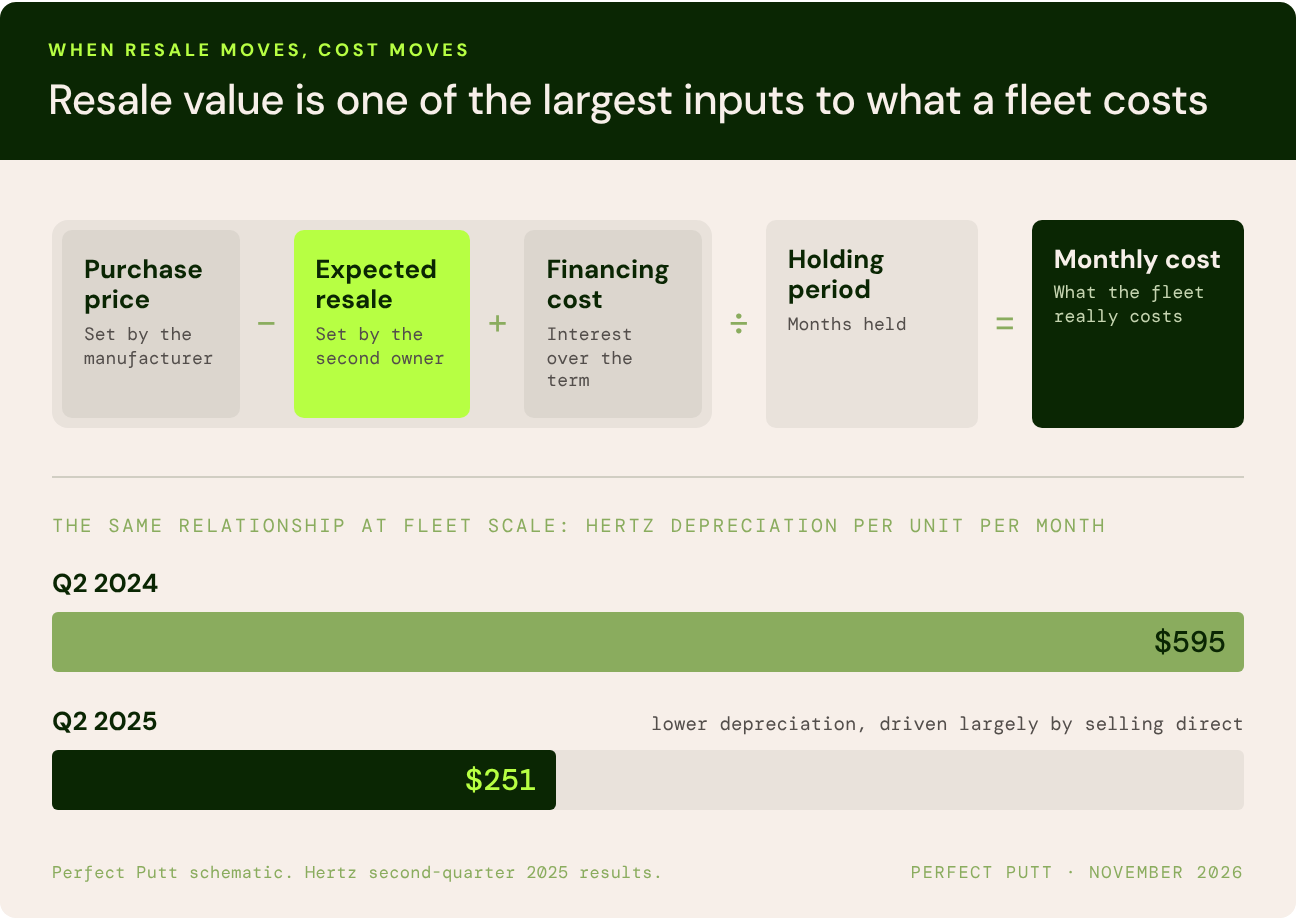
Hertz credited a “Buy Right, Hold Right, Sell Right” strategy, and the selling side did real work. The company posted its highest second-quarter retail vehicle sales in five years, much of it through its own direct-to-consumer channel. Hertz did not cut depreciation by more than half by negotiating harder with automakers. It cut it largely by controlling where its cars went next.
The golf parallel is direct. A course that hands its old fleet to the dealer selling the new one is selling wholesale into a retail market. The Minnesota broker bid is what that discount looks like on one agenda.
Who Keeps the Spread
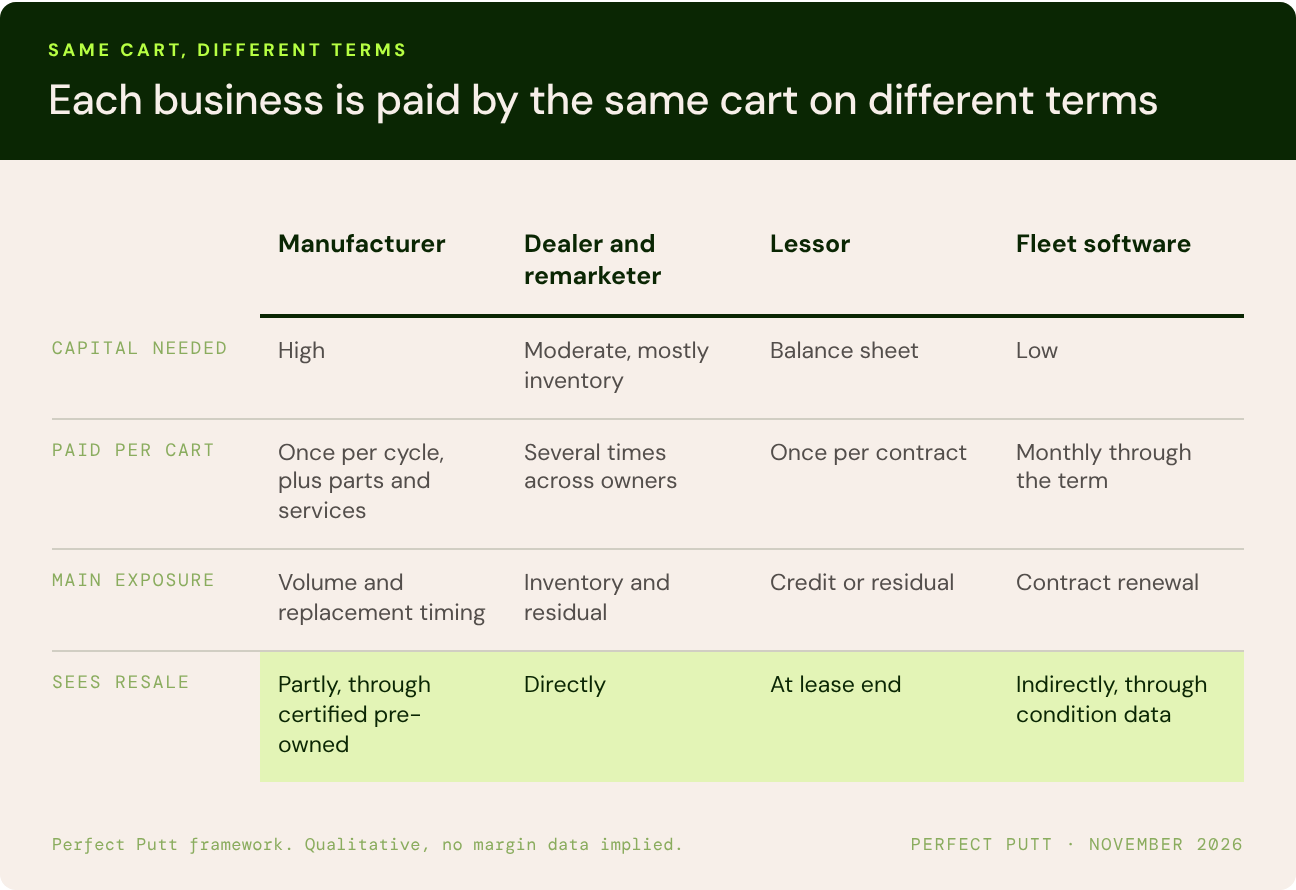
Each stage of a cart’s life pays a different party, on different terms.
The operator’s strongest lever is price, not the trade-in. Burleson charged $14 for an 18-hole cart while nearby courses charged $17 to $18. After buying its fleet and signing a four-year, $180,000 GPS contract, the city raised the fee to $18. At flat volume, a 29 percent increase on $258,342 is roughly $74,000 a year, close to the entire annual lease the city turned down. That is a directional estimate, but it shows where course economics are made.
Manufacturers are investing for the replacement cycle. Club Car opened a facility in Appling, Georgia in 2024, and Yamaha is focusing its Newnan, Georgia plant on golf cars. Textron Specialized Vehicles, which includes E-Z-GO, grew revenue 9 percent in the third quarter of 2026 as Textron moves ahead with separating its Industrial segment. Lithium batteries have tied fleet contracts more closely to battery warranties, which extends the manufacturer’s relationship past the sale.
Dealers and remarketers earn on the next transaction. Public trade-in values run from about $1,700 for an older lead-acid cart in Burleson to $3,700 for a three-year-old cart in Eaglewood’s estimate, against new prices of $6,700 to $8,700. Club Car’s certified pre-owned program shows a manufacturer reaching into that market, though resale margins are not disclosed.
Software is the least capital-intensive seat and the most underrated. Club Car Connect is installed at more than 2,300 courses by the company’s count, alongside E-Z-GO’s Pace and Yamaha’s YamaTrack, while independents such as Tagmarshal, which reports more than 600 partners, compete through retrofits. Those systems log usage, battery health and condition. That is exactly the information a resale price requires.
Capital Implications
The fleet business rewards whoever can answer one question: what is a three-year-old cart worth, and to whom?
For investors, the attractive position combines condition data with an exit channel. A remarketer with telematics access, or a manufacturer pairing a connected fleet with a certified pre-owned program, can underwrite resale values the rest of the market guesses at. A lessor carrying fair-market-value risk without that data is pricing someone else’s information. Public margin data does not yet prove the case, so diligence should test it directly through trade-in histories, resale spreads and how often resale estimates miss.
For course owners, three changes cost little. Treat the trade-in as an auction rather than a credit on the next invoice, and get a broker bid. Model holding periods per round, since the Eaglewood curve favors longer holds on capital cost alone. Price the cart like the core revenue line it is.
The open question is how long the information gap lasts. Fleet software is already collecting the data that a used-cart price index would need. If that data ever reaches courses as a benchmark, the spread compresses toward the operator. Until it does, the edge belongs to whoever can price the cart after it leaves the first tee.
The best way to support Perfect Putt is to share it with a friend.