
The Economics of Hosting a Major
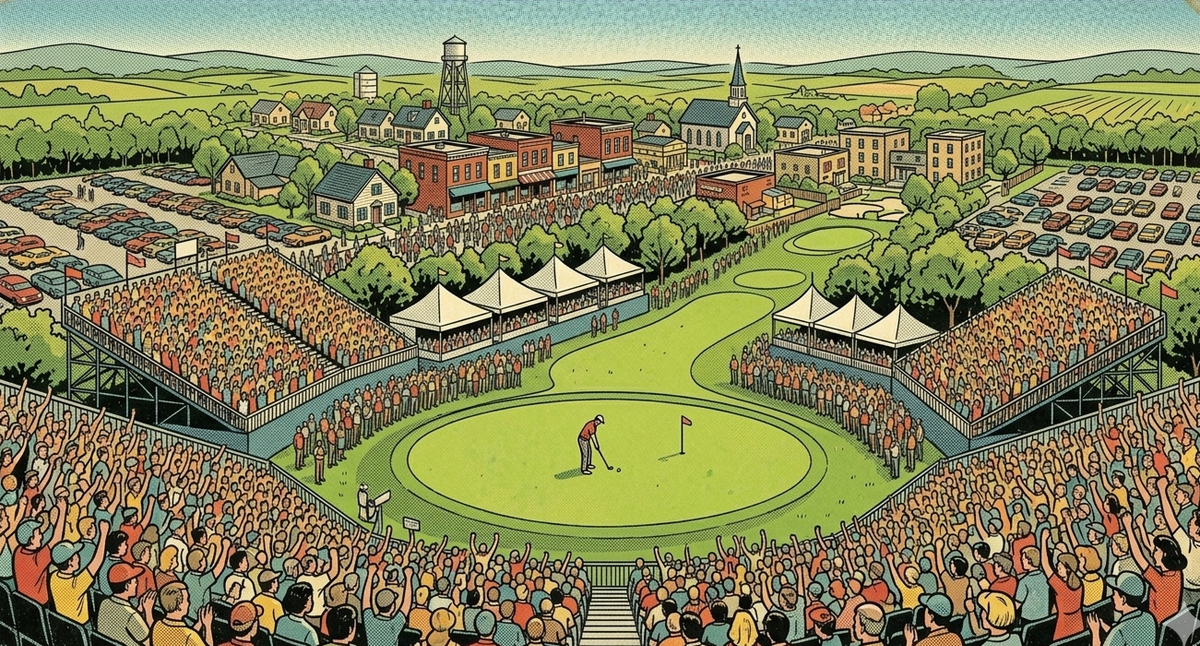
The PGA Championship delivered an estimated $80 million in economic impact to Louisville — a metro of 1.36 million with no major professional sports team. Golf's majors do something no other sport does: they bring nine-figure economic events to mid-market communities with no permanent pro sports infrastructure. Here is how the economics work.
Golf is a $140B+ industry. Every week, Perfect Putt breaks down what's actually driving it. Welcome to the new members who've joined since our last send — you're now part of a growing community of 11,000+ golfers who follow the business of the game.
Read Time: 5 minutes
The Mid-Market Pattern
Since 1990, the PGA Championship has repeatedly visited communities that do not have a major professional sports team. The four most frequently visited cities in that span are all mid-market metros.
Louisville, Kentucky (population 1.36 million): four PGA Championships. Rochester, New York (1.06 million): three. Tulsa, Oklahoma (1.03 million): three. Kohler, Wisconsin (118,000): three.
Louisville and Kohler also hosted the Ryder Cup during the same period. Kentucky — a state of 4.5 million people — has hosted four major championships and a Ryder Cup since 1990. Texas, with 30 million residents, has hosted six majors and has not hosted one since the 1969 U.S. Open. That disparity will begin to correct in 2027 when the PGA Championship visits PGA Frisco.
The pattern reflects a structural feature of golf's championship model. Major championships follow the courses, not the markets. The PGA Championship goes to Valhalla because Valhalla is a championship-caliber venue — not because Louisville is a large media market. That geographic logic means mid-market communities receive economic events that, in every other sport, flow exclusively to cities with professional franchise infrastructure.
The Economic Impact
The $80 million estimate for Louisville is the lowest of the last three PGA Championships — but it is consistent with the historical range.
The 2007 PGA Championship at Southern Hills in Tulsa generated an estimated $70 million in economic impact. Adjusted for inflation, that figure is approximately $105 million today. The 2013 PGA Championship at Oak Hill in Rochester reported a final impact of $102.1 million. Charleston estimated nearly $200 million for the 2021 PGA Championship at Kiawah Island, though pandemic attendance restrictions likely reduced the actual figure.
The baseline for a PGA Championship is approximately $80 to $120 million in local economic impact — generated through hotel bookings, restaurant and retail spend, transportation, and the downstream economic activity that 200,000-plus visitors produce over a tournament week. The 2014 PGA Championship at Valhalla alone generated an estimated $12 million in new direct spending and the equivalent of 16,000 hotel room nights.
For comparison, all professional sports teams in Cincinnati — the closest city to Louisville with a major sports presence — contribute an estimated $550 million to the local economy annually. FC Cincinnati alone accounts for approximately $37 million. A single PGA Championship week delivers economic impact in the range of two to three times what a mid-tier professional franchise generates over an entire season.
The Geographic Shift
The PGA Championship's near-term schedule moves away from mid-market communities and toward major metropolitan areas.
Charlotte in 2025. Philadelphia in 2026. Dallas in 2027. San Francisco in 2028. Newark in 2029. Washington, D.C., in 2030. The championship returns to the Charleston area in 2031.
The shift reflects the PGA of America's anchor site strategy — PGA Frisco in Dallas will host multiple future championships — and a commercial logic that favors larger media markets for sponsorship activation, corporate hospitality, and broadcast production. Larger metros offer deeper corporate bases, more hotel inventory, and greater sponsor engagement opportunities.
The tradeoff is the outsized relative impact that a major delivers to a smaller community. An $80 million event in Louisville represents a fundamentally different economic shock than the same event in Philadelphia. The absolute dollars may be comparable, but the proportional impact on the local economy — hotels at capacity, restaurants filled, service industry employment surging — is materially higher in a mid-market metro.
The Broader Value Proposition
The economic impact of golf's major championships extends beyond the direct spending week. Host communities receive sustained destination marketing exposure through years of broadcast coverage, international media attention, and the prestige association with one of the sport's premier events. Louisville's four PGA Championships have established the city as a golf destination in a way that no marketing budget could replicate.
That brand equity compounds. Hotels, courses, and tourism infrastructure built or upgraded for a championship week serve the community for decades after the event. The economic impact studies capture the direct and near-term multiplier effects — they do not fully account for the long-tail destination marketing value that accrues over years.
The Takeaway
Golf's major championships distribute economic value to communities in a way that no other major sport replicates. The PGA Championship has delivered an estimated $80 to $200 million in economic impact per event to cities that, in most cases, have no professional sports franchise. Louisville, Rochester, Tulsa, and Kohler have each hosted multiple majors — not because of their market size, but because the courses that meet championship standards happen to be located there.
The schedule is shifting toward larger metros, and the PGA of America's anchor site strategy will concentrate future championships in fewer locations. The commercial logic is sound. But the mid-market communities that have hosted majors for decades — and that receive disproportionate economic value from doing so — will feel the absence. An $80 million week in Louisville is not easily replaced by any other event on the calendar.
The best way to support Perfect Putt is to subscribe and share with a friend.