
The Connection Premium

Golf's discovery layer is shaped long before a booking is made. New research from Gather identifies the specific mechanism – and it challenges the assumptions behind how the industry currently values creator partnerships in relation to golf travel.
Welcome to Perfect Putt, a newsletter covering the business and economics of the golf industry. If this was forwarded to you, subscribe to join 12,000+ readers who follow how capital flows through golf.
Read Time: 8 Minutes
A golfer who books a trip to Lahinch, or Bandon Dunes, or Cabot Cliffs, did not arrive at that decision in the moment of searching for availability. The intent formed over a longer period, through accumulated exposure to content about those places. The booking was execution. The consideration happened upstream – in a discovery layer that every operator downstream benefits from but none of them controls.
New research from Gather, conducted in partnership with YouGov Sport across 504 UK and 507 US golf consumers, identifies what shapes intent in that layer. It changes how operators should value creator partnerships and how capital should evaluate the platforms sitting between discovery and booking.

Gather provides strategic intelligence and advisory expertise to golf businesses, unlocking growth and white space opportunities. The Gather Collective is an exclusive community for leaders in the global golf industry. Members receive ongoing access to premium industry intelligence, collaboration opportunities, industry discussions, and priority access to the Gather Golfer Panel. The data cited throughout this piece draws from Gather’s 2026 research program on parasocial relationships in golf travel. Additional reports are available on parasocial relationships in the entertainment sector, the equipment sector, and why the golf industry should care about parasocial relationships. The full research is available exclusively to Gather Collective members.
Learn more about GatherConnection Wins. Relatability Doesn't.
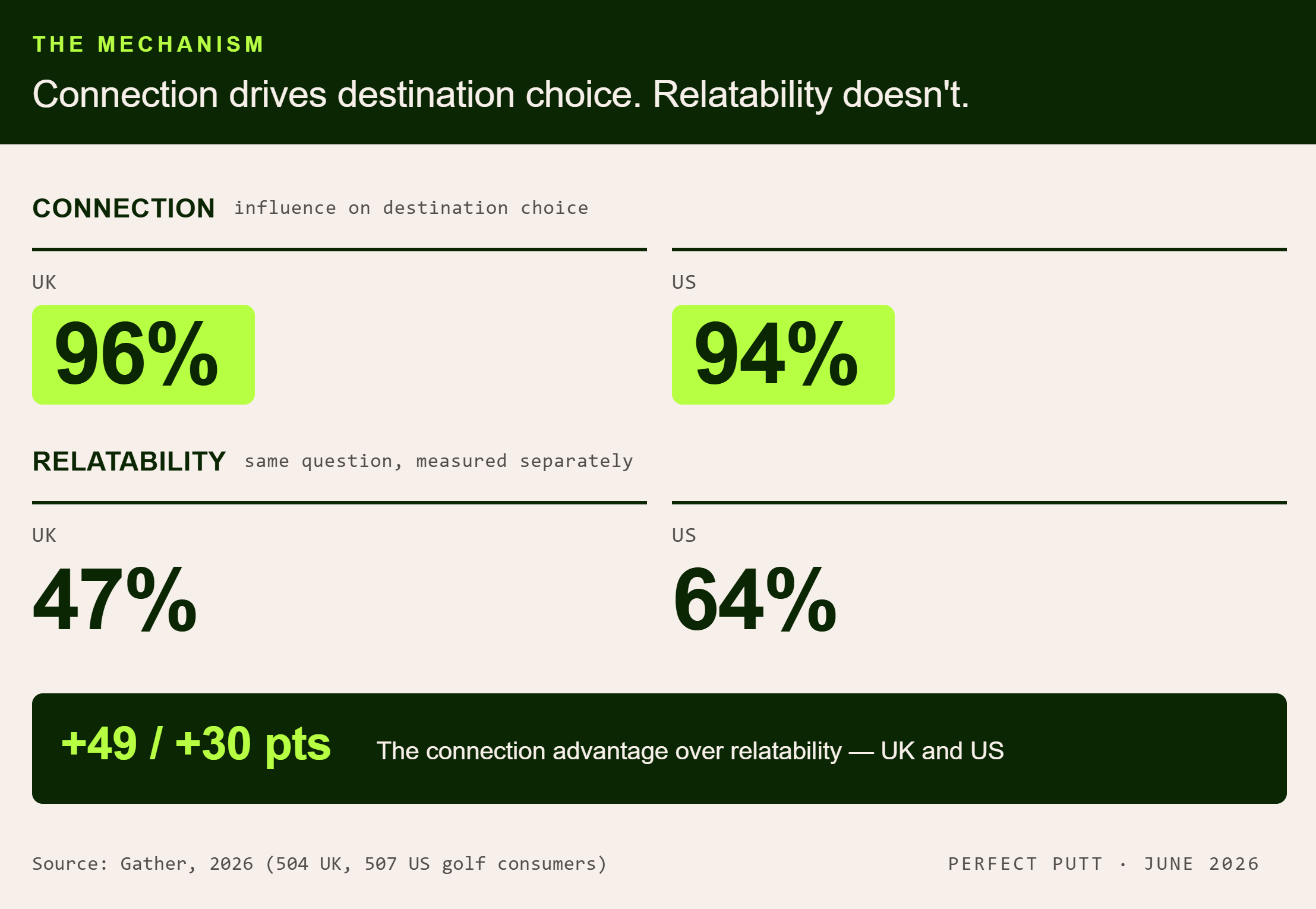
The finding is not that creator content influences golf travel decisions. That was assumed. The finding is the specific variable driving the behavioral outcomes operators care about: connection, not relatability.
Connection's influence on destination choice: 96% UK, 94% US -- near-universal. Relatability, measured separately, produces 47% UK and 64% US on the same question, a gap of 49 and 30 percentage points respectively. The pattern holds across trust and referral behavior. The mechanism runs through disclosure: when a creator shares personal information, the majority of consumers report heightened emotional engagement, and that emotional state drives destination preference and referral at rates that relatability does not approach.
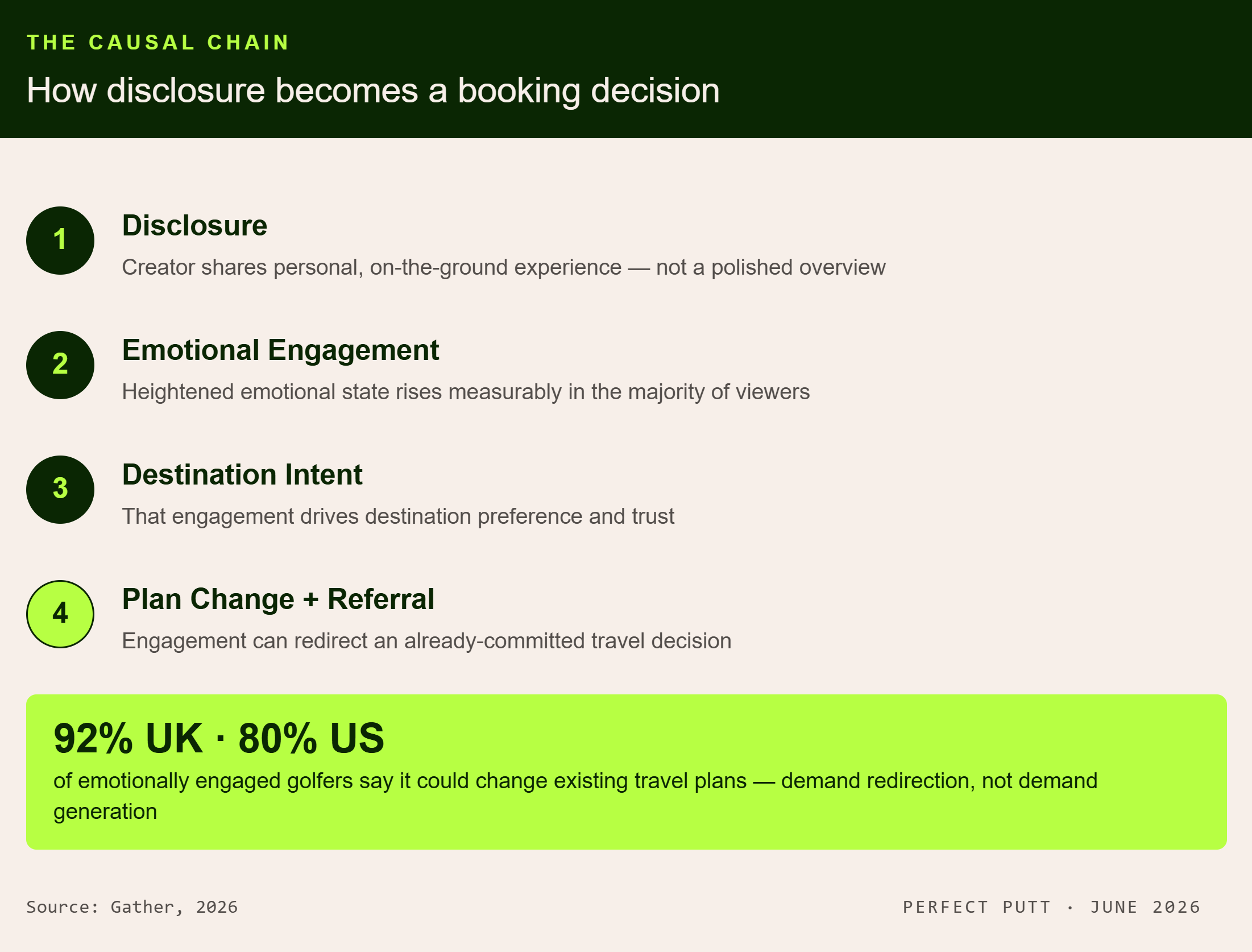
The most consequential number in the dataset is one that reads as secondary: 92% of UK and 80% of US golf consumers with elevated emotional engagement said that state could cause them to change existing travel plans. This is not a demand-generation metric. It is a demand-redirection metric, and the distinction changes the economic logic of creator partnerships entirely.
Traditional destination marketing is designed to reach undecided travelers, competing for attention before the consideration set forms. The plan-change finding describes something structurally different: a creator with genuine audience connection can disrupt a committed purchase decision. Converting a committed customer requires multiples of the spend needed to acquire an undecided one. A creator relationship that produces this outcome is not a promotional vehicle. It is a competitive weapon against specific destinations.
To frame the lower bound of that value: if the average domestic golf trip costs approximately $2,200 per participant – a figure consistent with National Golf Foundation destination travel estimates – and a creator with 100,000 connected followers redirects existing travel decisions for even 0.1% of their audience in a given year, that is 100 trips and roughly $220,000 in redirected destination spend. Most operators are currently pricing single-visit creator partnerships at $25,000 to $50,000. The gap between that pricing and the demonstrated economic effect of genuine connection is the most visible mispricing in golf travel marketing today.
The Mechanism Is Disclosure
Connection and relatability are not different degrees of the same response. Relatability is a matching function: it forms when a creator's circumstances feel recognizable, when a destination seems attainable. It is a cognitive judgment that produces consideration but not conviction. Connection is a different category. It develops through sustained familiarity and the gradual accumulation of trust – and the survey identifies the specific driver: disclosure. When a creator shares personal information, not a polished destination overview but a genuine window into their experience on the ground, emotional engagement rises measurably. That engagement is the bridge between content consumption and destination intent.
The creators who have built the deepest connection in the golf travel space are recognizable by this pattern. No Laying Up's Tourist Sauce documents an annual pilgrimage with specificity that feels like following trusted friends. Breaking Eighty documents a real golfer's actual progression, including the failures, generating identification that polished sponsored content cannot replicate. The golfer who follows these properties has not accumulated travel ideas. They have formed a trusting relationship with the person doing the recommending – and that trust is the economic variable most current partnership frameworks fail to measure.
The Moat Window
The connection mechanism is not evenly distributed across the golf consumer base, and the demographic texture matters for capital allocation decisions in this category.
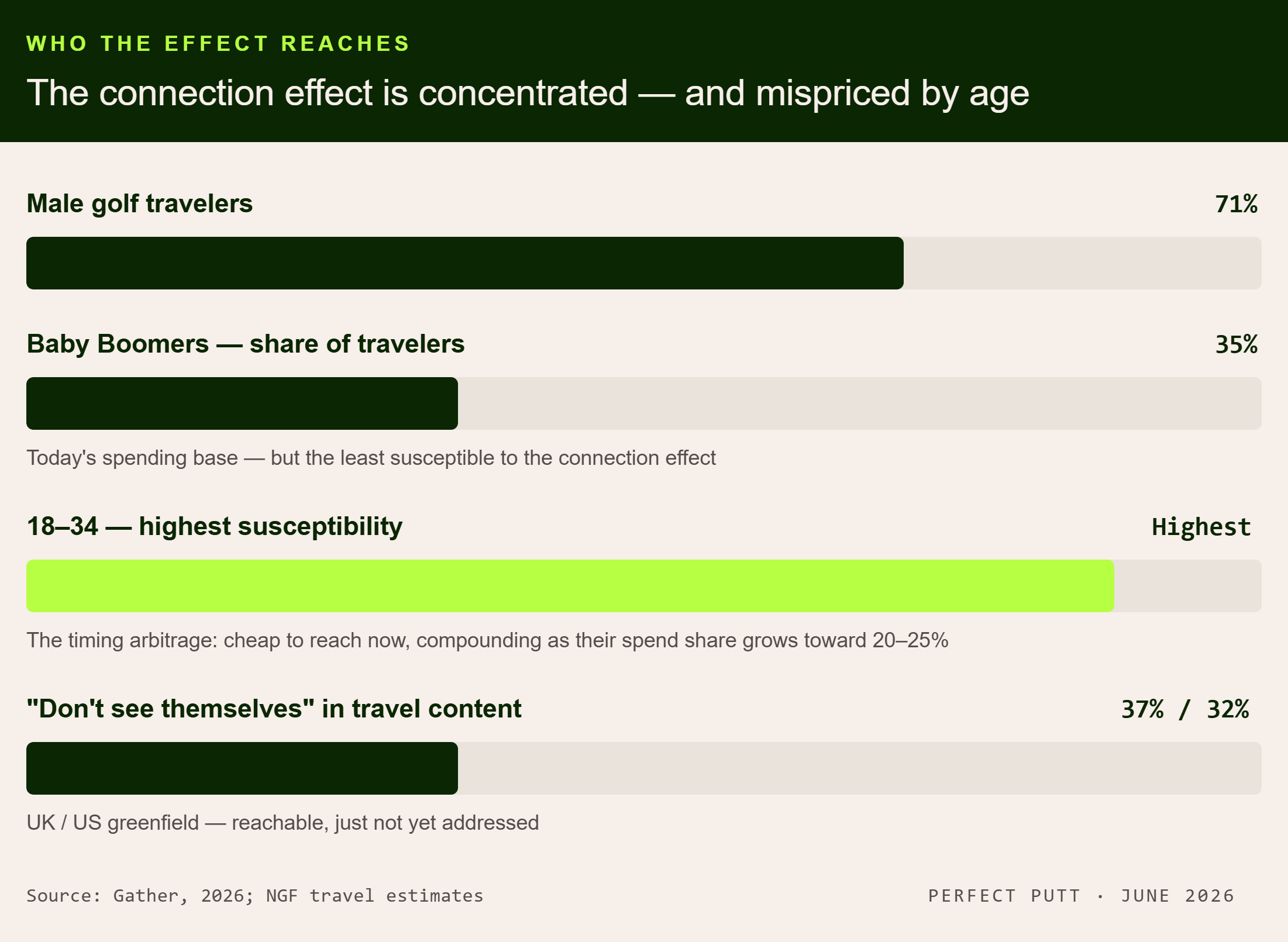
Per separate YouGov research on U.S. golf traveler demographics cited in the study, golf travelers skew 71% male with Baby Boomers representing 35% of the traveling golfer population. Younger golfers (18 to 34) respond more strongly to the connection effect. UK women golfers register stronger responsiveness to creator influence than their male counterparts.
The timing arbitrage here is explicit – and the failure to act carries a specific cost. Creator partnerships targeting the 18-to-34 cohort are priced against their present economic weight, which is modest. They are not priced against their future weight, and they are not priced against the structural risk of waiting. Baby Boomers are 35% of the golf travel market today and are actively aging out of discretionary travel. Operators who fail to establish genuine connection with younger cohorts now face a demand cliff in the early 2030s, when Boomer travel activity contracts and replacement demand simply is not there. The moat is cheap to build before the demand matures. It is very expensive to build after the demand has already moved.
A further 37% of UK and 32% of US golf consumers say they do not relate to golf travel content – not because they cannot be reached, but because current content is not designed for them. The dominant aesthetic is optimized for the 65% who already self-identify as destination travelers. The segment that plays but does not see itself in the travel narrative is a greenfield demand opportunity. At $2,200 to $3,800 per trip, a third of the domestic golf consumer base is material expansion, not redistribution.
Reach Is the Wrong Denominator
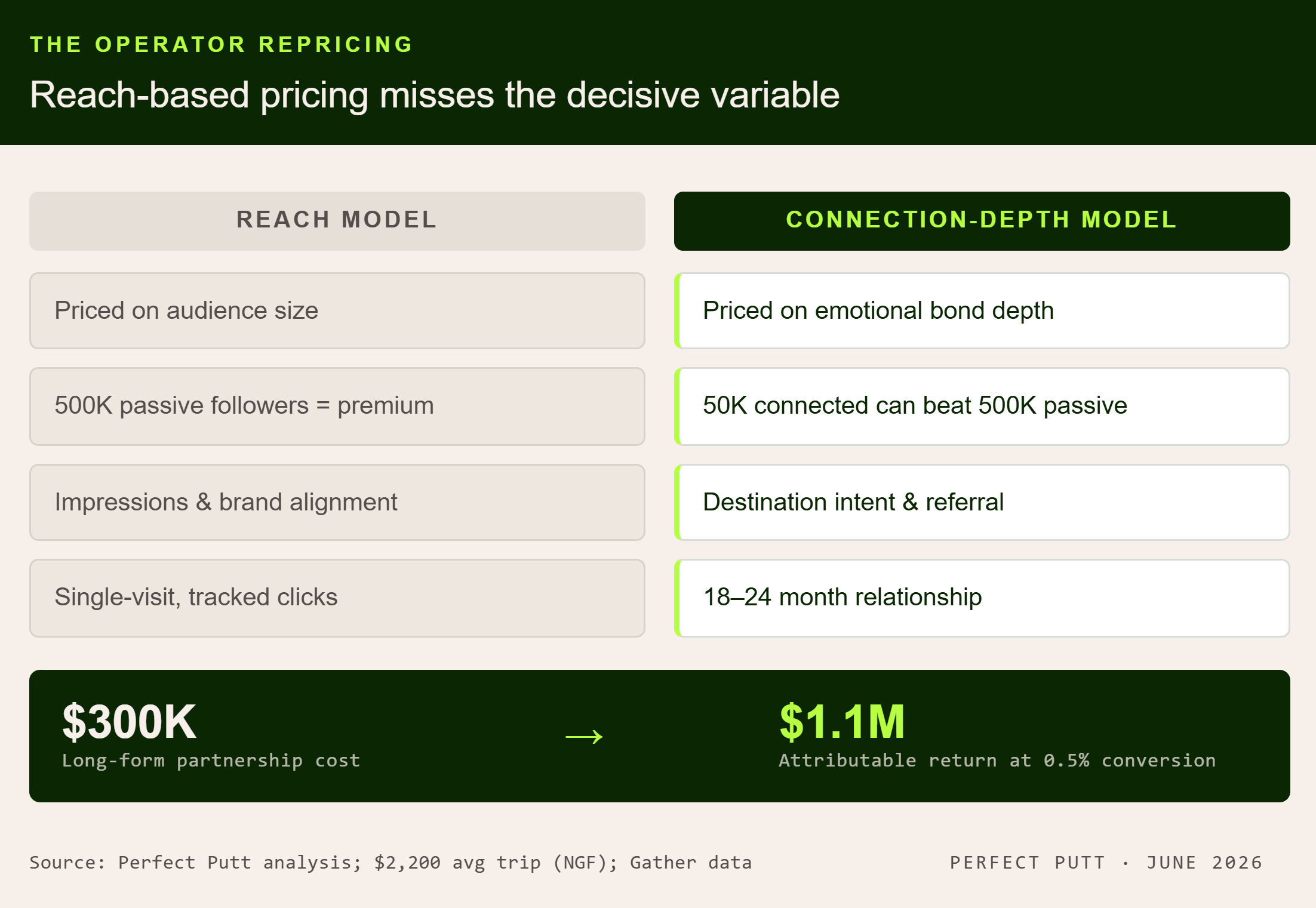
Destination operators currently evaluate creator partnerships through two lenses: reach and brand alignment. Both are reasonable first filters. Neither captures the variable that the data identifies as economically decisive.
The relevant variable is connection depth: the degree to which an audience has formed an emotional bond that converts to destination intent and referral. A creator with 50,000 deeply connected followers may generate more bookings than one with 500,000 followers who watch for entertainment but never act. The economics of those two partnerships are not proportional to audience size. Pricing them as if they were is the dominant inefficiency in how the category allocates creator marketing capital.
The return differential is quantifiable. A single-visit hosted creator arrangement – round of golf, accommodation, content deliverables – typically runs $25,000 to $75,000. A structured 18-to-24-month relationship runs an estimated $150,000 to $300,000. Apply the data conservatively: a creator with 100,000 connected followers who generates plan-change behavior in 5% of that audience over 18 months, at $2,200 average on-property revenue per redirected visit, produces $11 million in attributable return against a $300,000 investment. At 0.5% conversion the math is still $1.1 million against $300,000 invested. Neither figure captures the NPS compounding effect. The research shows connection correlates with content recommendation to friends and family at 94% in the UK and 90% in the US. Those 100,000 connected followers are not just 100,000 potential plan changes – they are 100,000 referral nodes, each reaching additional golfers outside the original audience count.
The economics above are a floor. The economics are not marginal. The constraint on adoption is attribution: current destination marketing infrastructure cannot assign revenue credit to a creator relationship built over 18 months rather than a single tracked click.
The Platform Gap
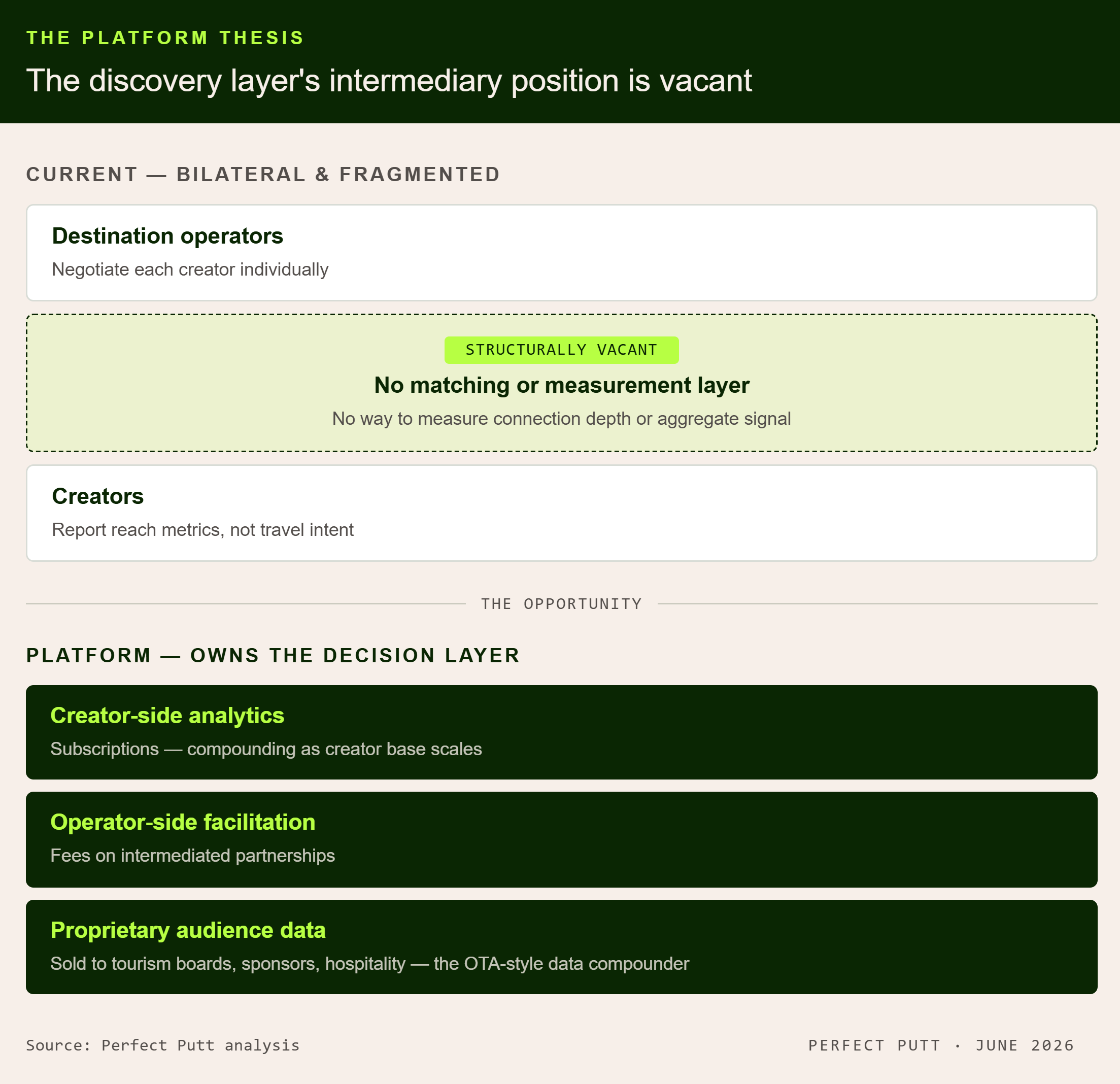
Golf creator partnerships currently operate on a bilateral, relationship-based model. Operators identify creators they admire, negotiate individually, produce content, and report reach metrics. No mechanism exists for measuring whether a creator's audience has the connection depth that produces travel intent. No platform aggregates this signal. This is not incidental to why the category is mispriced. It is the reason. Creator partnerships trade at reach-based valuations because reach is the only thing currently measurable. The platform that builds the measurement layer captures the spread between current pricing and demonstrated economic value – the same arbitrage that exists for operators today, but at platform scale and with compounding data advantages over time.
In travel broadly, the platforms that built a systematic matching layer between intent and inventory produced durable, asset-light economics at significant scale. Online travel agencies did not own the hotels. They owned the decision layer: the interval between intent formation and booking execution. Golf travel has not produced an equivalent in the discovery layer. The intermediary position is structurally vacant.
The revenue model for the business that fills this gap runs on three layers: creator-side analytics subscriptions, compounding in value as the creator base scales; operator-side facilitation fees on the partnerships the platform intermediates; and at scale, proprietary audience data sold to tourism boards, equipment sponsors, and hospitality businesses reaching high-intent golf travelers at the moment of destination formation. That architecture transforms a matching service into a data business. The same structural evolution made early OTA platforms durable, asset-light compounders.
What Has to Hold
One structural risk frames any capital thesis built on this analysis: authenticity degradation at commercial scale. Connection is durable only if the creator relationship remains genuine in the audience's perception. Creators who over-commercialize erode the disclosure-and-trust dynamic that the research identifies as the mechanism of connection. An operator funding that arrangement is not buying what the data says they are paying for. As the category professionalizes, distinguishing creators who have maintained genuine connection from those who have monetized its surface becomes the central diligence variable in this layer.
The Allocation Case
For destination operators, the underwriting case runs as follows. A creator with 100,000 genuinely connected followers, whose audience demonstrates the plan-change behavior the data measures, is not a marketing expense to be evaluated against impressions. It is an acquisition channel with a calculable return. At 0.5% behavioral conversion annually – a deeply conservative assumption against an 80% to 92% stated susceptibility rate – and average on-property revenue per redirected visit of $2,200, the attributable return on a $300,000 long-form partnership is roughly $1.1 million. At 1% conversion it is $2.2 million. Operators who build these relationships now, while the category still prices them as promotional spend, acquire that economic benefit before attribution infrastructure closes the pricing gap.
For capital targeting the golf travel infrastructure layer, the platform question is the most consequential open position in the ecosystem. The diligence questions are specific: who controls the creator relationship data on both sides, what are the switching costs that prevent creator-operator disintermediation once relationships are established, and at what scale does the proprietary audience data product become more valuable than the matching business itself?
A platform that answers those questions correctly – creator-side analytics, operator-side facilitation fees, audience data at scale – has the architecture of a durable, asset-light compounder in a market where the mechanism is now empirically grounded and the intermediary position is structurally vacant.
The course creates the reason to travel. The creator builds the connection that converts interest into intent. The platform that intermediates between connection and inventory is the business the category needs and has not yet built – and the data now exists to build it on.
The best way to support Perfect Putt is to share it with a friend.