
Before the Community Arrives

Private club waitlists may be one of the most overlooked indicators of where affluent Americans are heading next.
A standard club application captures a rare combination of information: income, family structure, future residence plans, professional networks, and long-term intentions. More importantly, it captures those details voluntarily and often years before a household buys a home, changes residency, or appears in traditional migration data.
Most datasets tell us what people have already done. A private club application can reveal what they plan to do next. Almost no one outside the membership office treats it that way.
Welcome to Perfect Putt, a twice-weekly newsletter covering the business and economics of the golf industry. If this was forwarded to you, subscribe below to join 12,000+ readers who follow how capital flows through golf.
Read Time: 8 Minutes
The Anomaly of Voluntary Disclosure
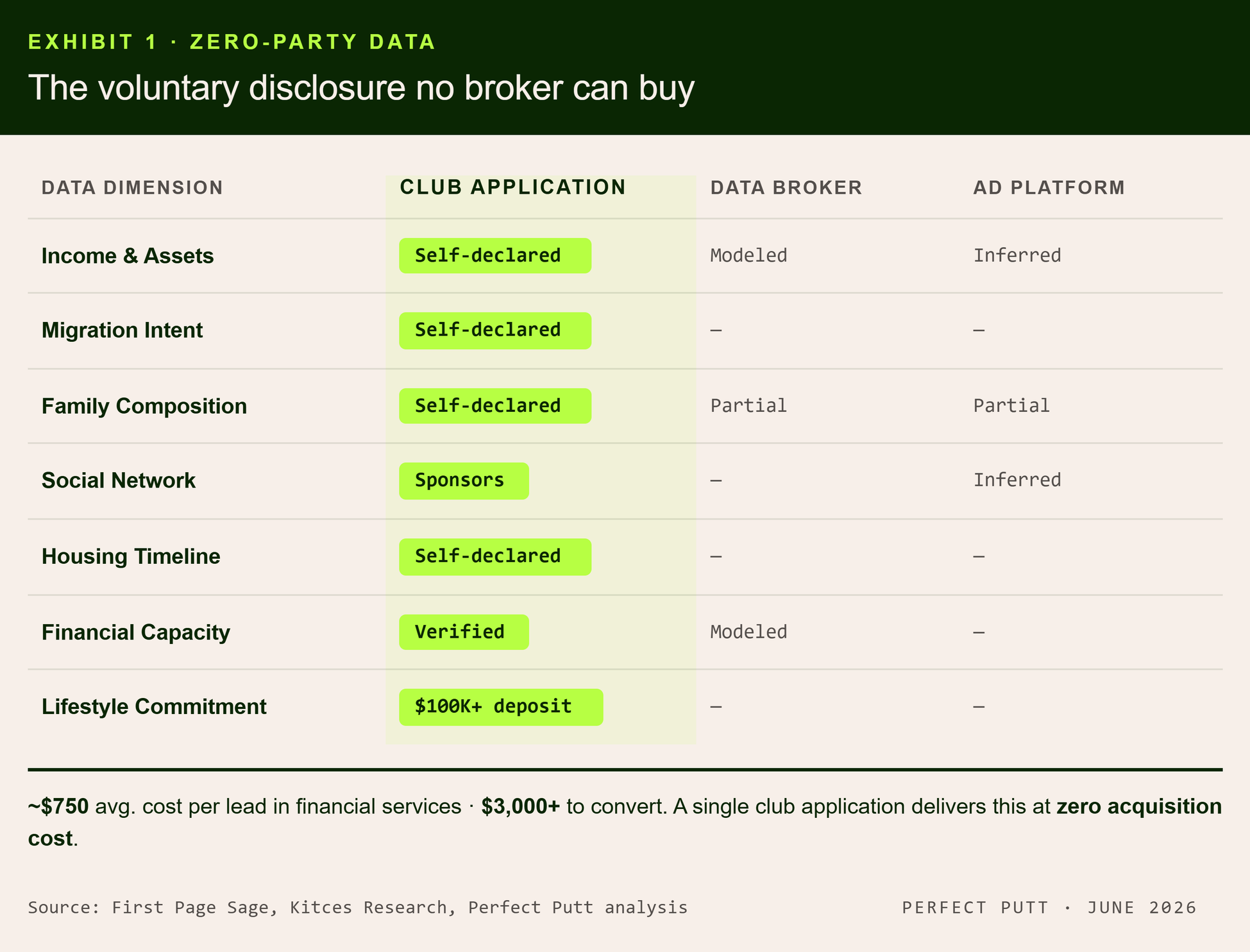
Consider what a standard application actually asks for. Current employer and title. Household income. Home address and intended future residence. Spouse's name and occupation. Number and ages of children. Existing club memberships. Personal references from current members who will vouch for character. At many clubs, a letter from a bank or financial advisor confirming the applicant can comfortably afford what comes next. Some ask for tax returns. A meaningful number ask where the applicant plans to live in five years.
Set against the modern economy of data extraction, this is an anachronism. The same consumer who installs ad blockers and declines cookie consent will disclose all of this voluntarily. In the data industry's terms, this is zero-party data: information proactively shared, not inferred or surveilled. The average cost per lead in financial services runs above $750. A club application delivers richer information at zero acquisition cost. Private clubs have been collecting it for a century.
The reason is not carelessness. It is desire. The applicant wants something badly enough to submit to a process they would refuse in any other context: admission to a community they have decided to organize the next decade around. The application is not extracted. It is offered. That distinction matters because the data carries something no inferred or scraped dataset does: declared intent.
Years, Not Months
The individual application is remarkable. The waitlist is where the signal becomes predictive at scale.
Seventy-one percent of U.S. private clubs with initiation fees above $90,000 have reached capacity with active waitlists, per Club Benchmarking. The average depth at high-demand clubs is roughly 70 prospective members, up approximately 25% since May 2020. Initiation fees at those clubs range from $100,000 to over $400,000.
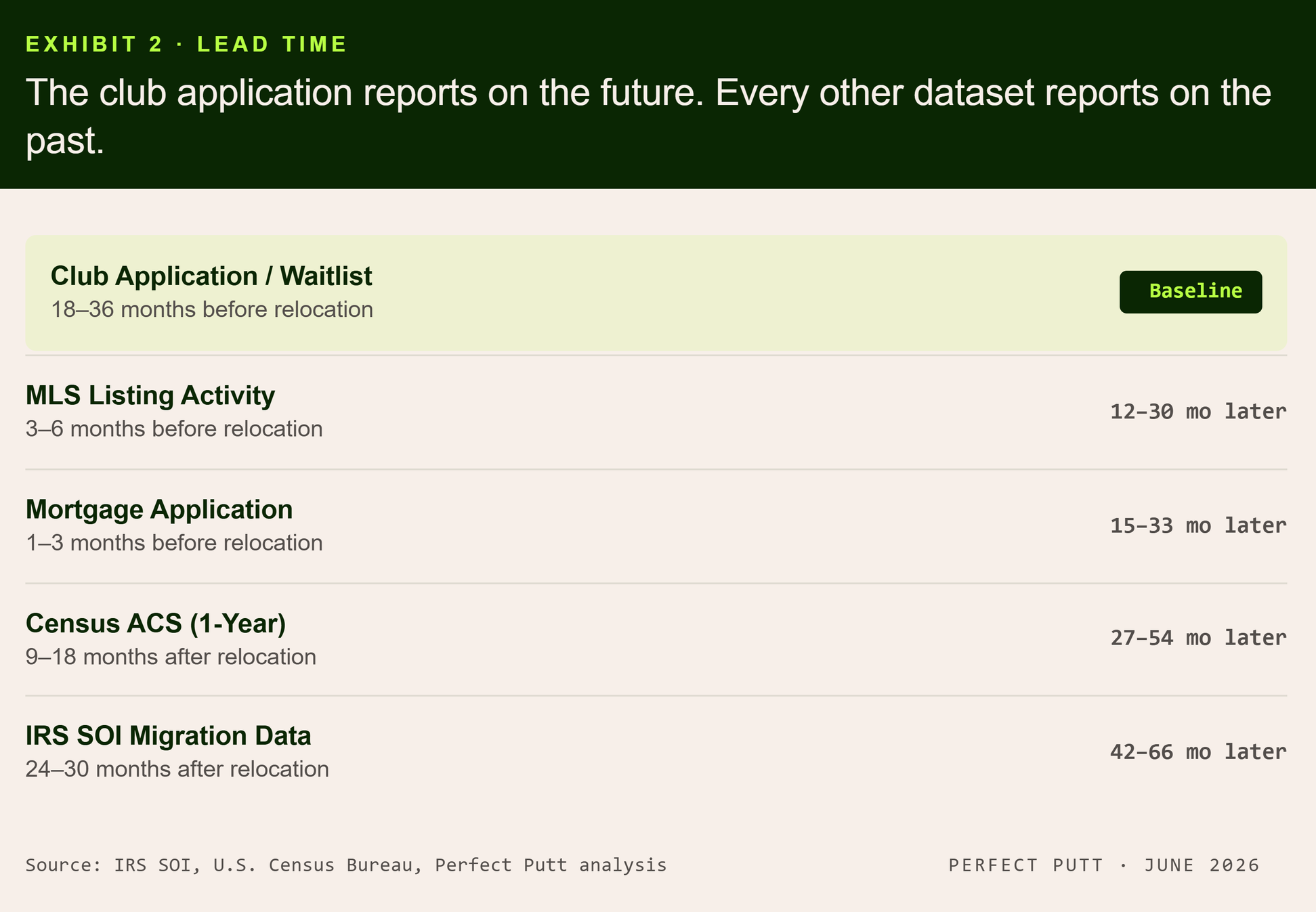
A club with a two-year queue means the membership director holds detailed files on households that have declared their intention to relocate, purchase a home, and integrate into a new community 24 to 36 months from now. Compare that to the datasets the economy relies on to track affluent migration.
IRS Statistics of Income migration data publishes with a lag of roughly two and a half years. The American Community Survey follows roughly nine months after collection. These are the best available instruments for tracking affluent migration, and they report on the past. A club application reports on the future. The informational advantage is measured in years.
The Reservation
The fascinating question is not what a club application predicts. It is why anyone fills one out years before they plan to arrive.
Nobody joins a grocery store two years before relocating. Nobody signs up for a gym in a city they have not moved to. Yet thousands of affluent Americans willingly submit detailed personal profiles to private clubs in communities they do not yet live in, join waitlists that may not clear for two years, and pay non-refundable deposits for the privilege of waiting. Roughly 80% of prospective members search for a club at the same time they search for a home, per Golf Life Navigators. The club search and the home search are parallel, not sequential.
The reason is not golf. The reason is certainty. A private club waitlist is, functionally, a reservation in a future community. The applicant is not buying access to a course. They are securing a position in a social network that will organize the next decade of their life: the families they will know, the professionals they will hire, the schools their children will attend, the charities they will support, the friendships that will define their experience of a new place. The house is the container. The club is the community. The application is the first act.
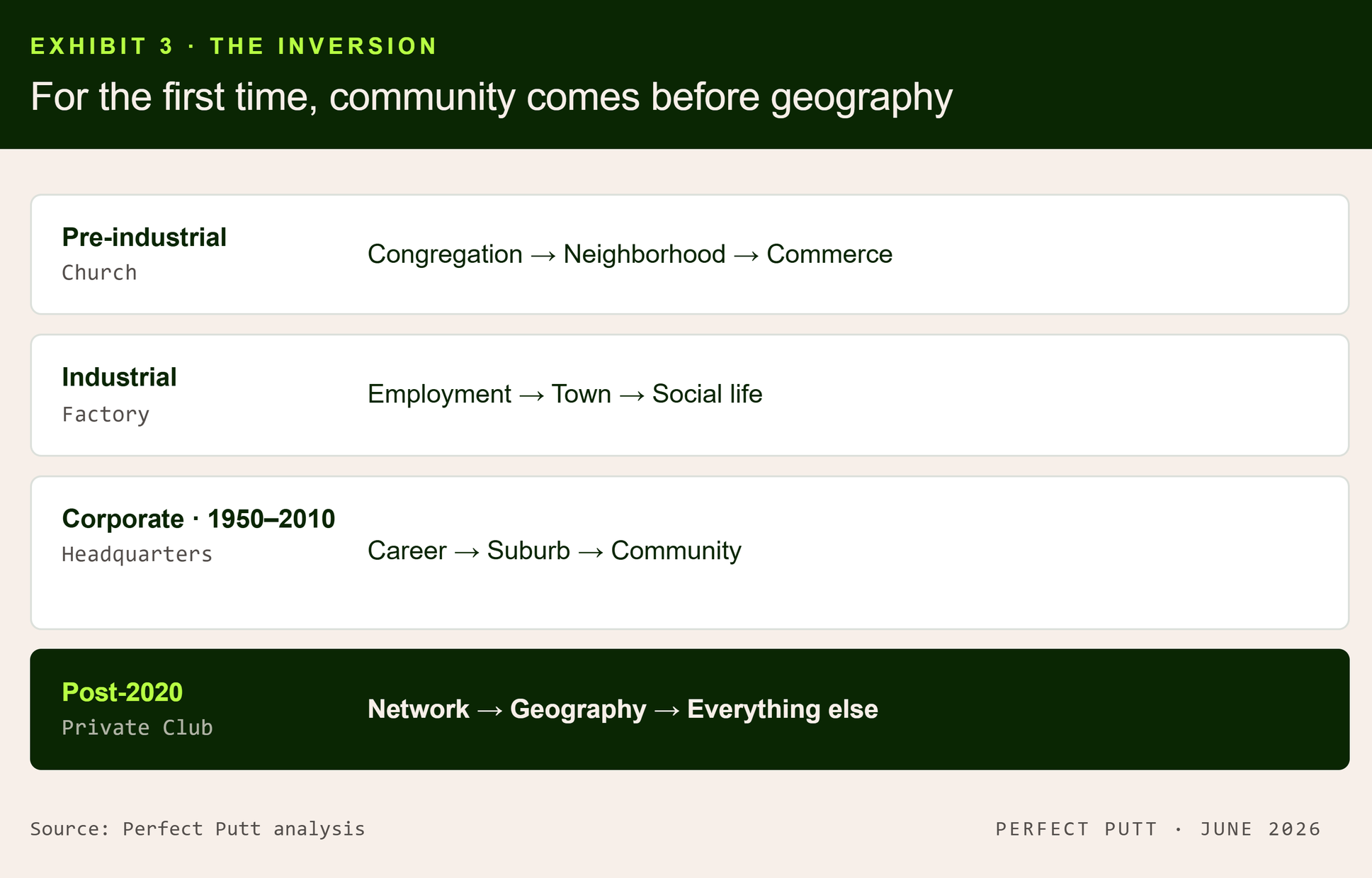
This represents an inversion of how American communities have historically formed. The church drew the congregation that built the neighborhood. The factory drew the workers that built the town. The corporate headquarters drew the executives that built the suburb. In each case, geography was determined by economic necessity. Community was a consequence of proximity.
What is happening at private club waitlists across the Sunbelt and mountain West suggests a different sequence. The community comes first. The geography follows. A household in Chicago or New York decides it wants to belong to a specific social network in Naples or Scottsdale or Austin. It applies to the club. It joins the waitlist. Months or years later, it purchases the home, enrolls the children, hires the advisors. The club application is not one decision in a sequence. It is the organizing decision from which all subsequent decisions flow.
That this pattern surfaces most clearly in golf is not incidental. Golf sits at a rare intersection of wealth, geography, social networks, lifestyle commitment, and long duration. A round takes four hours. Those hours, repeated weekly over years, build relationships with a depth and consistency that no other recreational activity matches. Membership is measured in decades. The initiation fee functions as a credible economic signal of long-term intent. And the course itself is an immovable asset anchored to a specific place, which means the community that forms around it is geographically fixed in a way that most social institutions are not.
This is why waitlist data is more predictive than real estate data, mortgage data, or migration data. Those datasets capture downstream effects. The club application captures the decision itself: the moment a household commits to a community before the community has fully accepted them, before they own a home in the area, before they appear in any conventional dataset. It is not a record of demand. It is an act of self-selection into a future social structure.
Where Social Capital Concentrates First
Private clubs are more than recreational amenities. They are institutions around which affluent communities organize.
The sponsor requirement means membership often leads to more membership. Relationships deepen over years. Professional networks expand. Families become connected through shared routines, events, and introductions. Over time, the club becomes more than a place to play golf. It becomes part of the social infrastructure of a community.
This is why the signal appears so clearly in golf. A round takes four hours. Those hours, repeated week after week for years, create relationships that few other activities can replicate. Membership is measured in decades, not seasons. The course is tied to a specific geography. As a result, golf communities tend to be durable, local, and deeply interconnected.
A growing waitlist, then, is not simply a measure of demand for golf. It is evidence that households are choosing a community before they choose a permanent address. By the time those households appear in Census or IRS migration data, many of the important decisions have already been made. Relationships have been established. Professional networks have begun to form. The foundations of community are already in place.
The pattern repeats across markets. In Naples, where the majority of private clubs report waitlists of 12 months or longer, households from the Northeast and Midwest are effectively deciding where they want to build the next chapter of their lives. In Charlotte, sponsor-gated clubs reveal a similar process. New residents are not arriving as strangers. They are joining communities they have already begun integrating into. The home purchase, account transfer, and residency change often follow. The community decision comes first.
The Information Nobody Reads
The natural question is why nobody uses this data as a signal. Three forces explain the gap.
The first is cultural. Private clubs exist to be private. Membership data is treated as confidential, often governed by bylaws that prohibit disclosure. The exclusivity is the point. It is also the barrier. The second is structural. There are roughly 4,000 private golf clubs in the United States, per the National Golf Foundation. The data sits in membership software and filing cabinets across thousands of independent organizations. No single entity holds enough to make the signal legible at market level.
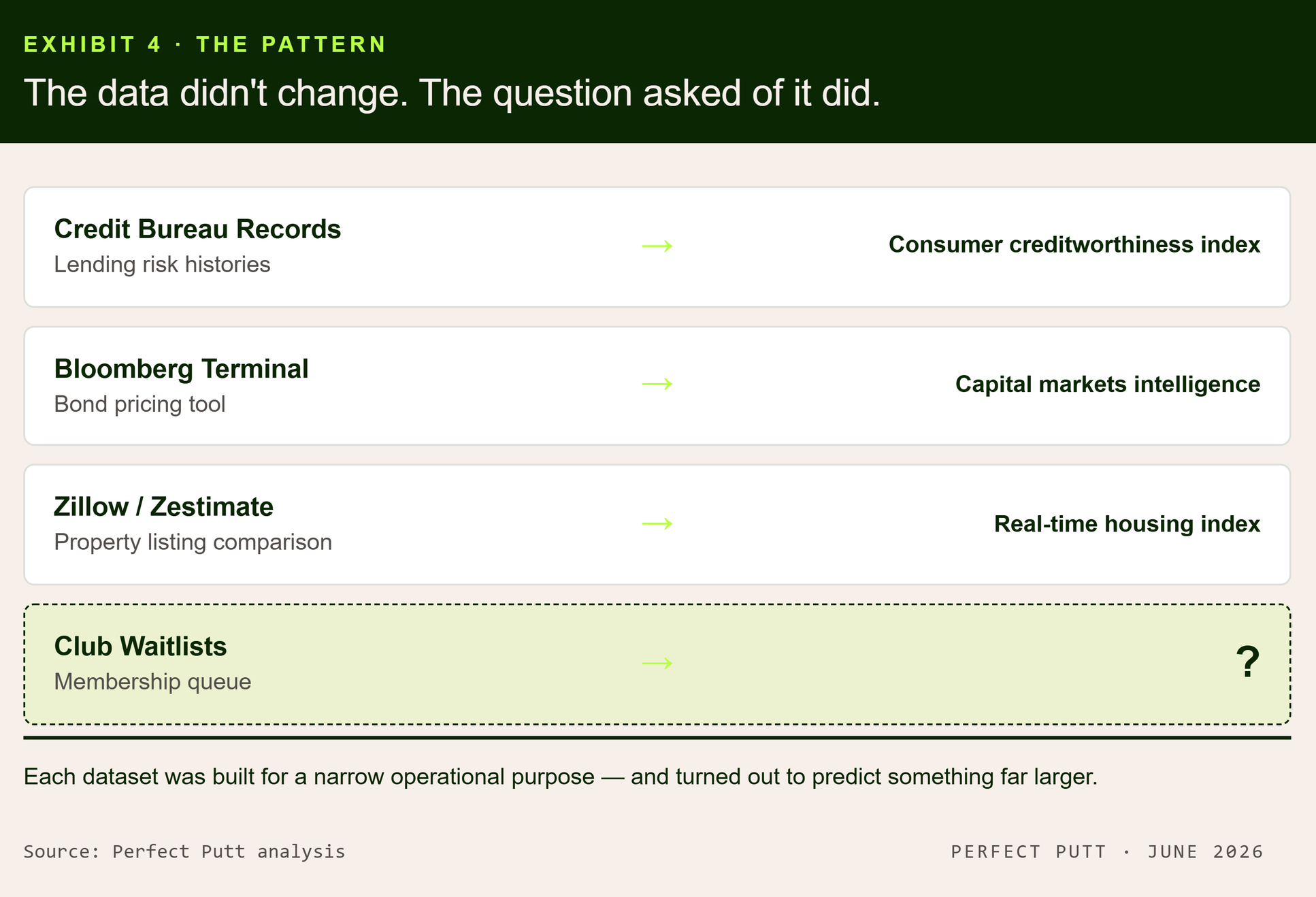
The third is conceptual. The membership director and the board see the waitlist as an operational metric: a capacity measure, a pricing trigger, a queue to manage. The idea that a waitlist predicts future wealth advisory demand, real estate activity, school enrollment, or charitable giving in a geography does not surface because the people closest to the data are solving a different problem entirely.
It is a pattern with precedent. Fair Isaac did not introduce the FICO score until 1989, nearly four decades after the first credit records were compiled. The data had been sitting in filing cabinets the entire time. What changed was not the information. It was the question asked of it.
The Last Voluntary Census
For a century, private clubs believed they were collecting applications for membership. The more interesting possibility is that they have been collecting declarations of future behavior all along.
Every application represents a household explaining where it intends to live, who it intends to know, and how it intends to spend. By the time migration appears in a Census estimate or an IRS filing, the decision has already been made. The advisory relationships are active. The spending pattern is underway. The waitlist captured all of it first, because the waitlist is where the household declared what it intended to become.
The golf industry sees a prospective member.
The broader economy may be looking at one of the earliest observable records of future affluent consumer demand in America.
The best way to support Perfect Putt is to share it with a friend.