
Rory McIlroy, Empire Builder
A look at Rory McIlroy's Symphony Ventures.
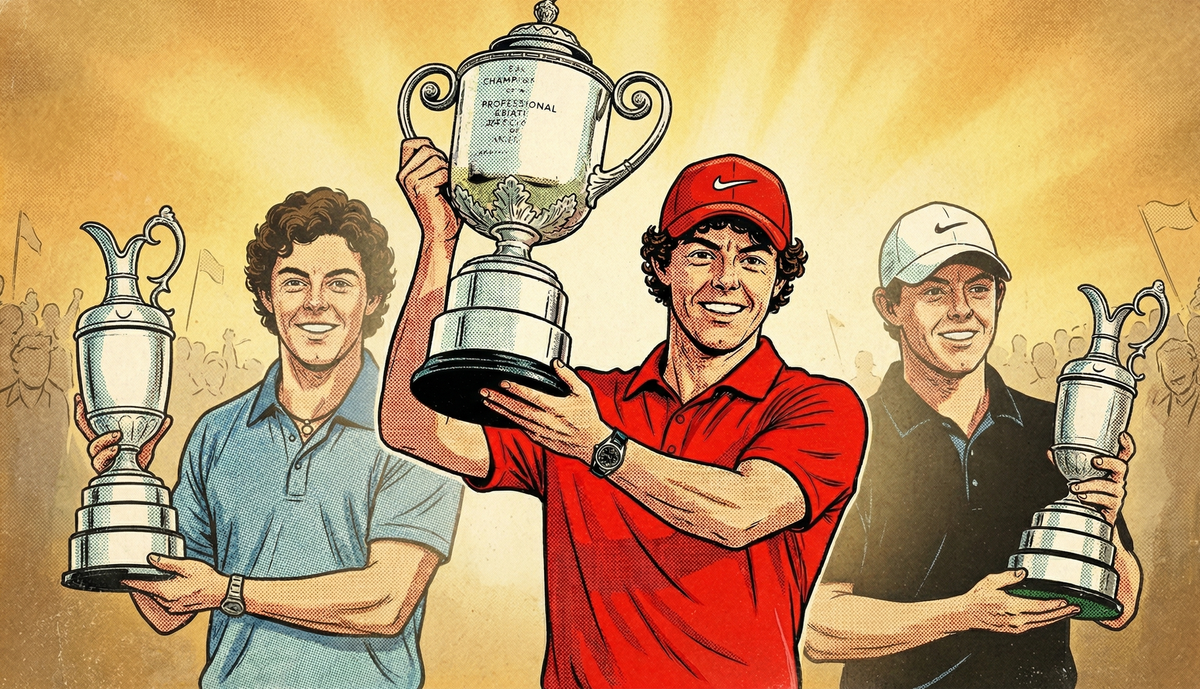
Rory McIlroy has earned over $90 million in PGA Tour prize money across his career. Add an estimated $40 million-plus in FedEx Cup bonuses since 2016, DP World Tour earnings, and off-course income — and the on-course financial picture alone is substantial.
But the more interesting story is what McIlroy is doing with those earnings. He is building an investment portfolio that, if the trajectory holds, could position him to become the wealthiest golfer in history.
Golf is a $140B+ industry. Every week, Perfect Putt breaks down what's actually driving it. Welcome to the new members who've joined since our last send — you're now part of a growing community of 11,000+ golfers who follow the business of the game.
The Investment Vehicle
At the center of McIlroy's strategy is Symphony Ventures, a firm he co-founded in 2019. Symphony operates as a multi-sector investment platform, deploying capital across technology, health and wellness, sports infrastructure, and consumer businesses.
The most recent high-profile move: a $250 million investment round in TickPick, a no-fee ticket marketplace, led by Brighton Park Capital. Symphony's specific allocation was not disclosed, but the deal is representative of the firm's approach — identifying high-growth consumer technology platforms with structural tailwinds and partnering alongside institutional lead investors.
TickPick is one position in a broader portfolio. McIlroy holds equity in TMRW Sports, the parent company behind TGL, which recently raised a Series A at a $500 million valuation. He invested in Whoop when the wearable fitness company was valued at approximately $1.3 billion — a year later, the valuation reached $3.6 billion. The pattern is consistent: early-to-growth-stage positions in companies with strong consumer engagement, defensible product differentiation, and clear paths to scale.
The Golfer-as-Investor Playbook
McIlroy is following a template that golf's wealthiest figures have defined over decades — but with a modernized approach.
Three of the six highest-paid athletes in history, adjusted for inflation, are professional golfers. Tiger Woods leads at an estimated $2.66 billion in career earnings, driven overwhelmingly by endorsements and equity positions — Nike, Rolex, Monster Energy, course design, and venture stakes including PopStroke. Arnold Palmer accumulated an estimated $1.76 billion by converting personal brand equity into licensing deals, most notably the Arnold Palmer beverage line, and a course design portfolio spanning over 300 projects worldwide. Jack Nicklaus reached an estimated $1.67 billion through a similar model anchored by over 400 course designs globally.
The common thread: none of these fortunes were built on prize money. They were built by converting competitive credibility into brand equity, and brand equity into ownership stakes and operating businesses. Prize money was the seed capital. Investing and business-building were the compounding engines.
McIlroy currently ranks approximately 30th on the all-time inflation-adjusted athlete earnings list at an estimated $670 million. The gap between that figure and Woods' $2.66 billion is significant — but McIlroy is 35, competing at an elite level, and deploying capital through a purpose-built investment firm with a diversified portfolio across sectors that are growing independently of his playing career.
The Time Constraint
McIlroy played 27 events in 2024 across seven countries and three continents. He has indicated a desire to reduce his schedule to 18 to 20 events in 2025.
The reduction makes strategic sense beyond physical recovery. McIlroy is now operating as a full-time professional golfer, a co-founder and board participant at TMRW Sports, a principal at Symphony Ventures evaluating and managing a growing portfolio, and a brand partner to multiple global sponsors. The bandwidth required to execute across those commitments is substantial — and the marginal return on the 25th tournament start is almost certainly lower than the marginal return on the next high-conviction investment.
The schedule compression is not a sign of competitive disengagement. It is a capital allocation decision — reallocating the scarcest resource McIlroy has, which is time, toward the activities with the highest long-term return on equity.
The Path to the Top
The question of whether McIlroy can surpass Woods as the wealthiest golfer in history depends on two variables: the continued performance of his investment portfolio and the duration of his competitive relevance as a brand asset.
Woods' $2.66 billion was built over three decades of unparalleled competitive dominance and cultural ubiquity. McIlroy's competitive resume is elite but narrower. What McIlroy has that Woods did not at the same career stage is a formalized investment infrastructure — Symphony Ventures is a platform, not a collection of ad hoc endorsement deals — and a portfolio of equity positions in high-growth companies that could generate asymmetric returns independent of his playing career.
If TMRW Sports scales TGL into a durable media property, if Whoop continues its valuation trajectory, and if Symphony continues to source and execute at the current pace, the compounding math becomes difficult to argue against.
The Takeaway
Professional golfers do not earn guaranteed contracts. There is no salary floor, no collective bargaining agreement, no multi-year deal that pays regardless of performance. Every dollar earned on course is performance-contingent. That makes the off-course investment strategy not just a wealth-building exercise but a structural hedge against the inherent volatility of a professional golf career.
McIlroy has understood this earlier and executed it more systematically than any active player in the sport. Symphony Ventures is not a side project — it is a diversified investment platform being built in parallel with one of the most successful competitive careers in modern golf.
The empire is quiet. The portfolio is not.
The best way to support Perfect Putt is to subscribe and share with a friend.