
Callaway And Topgolf Split
A breakdown of the Topgolf spin off.
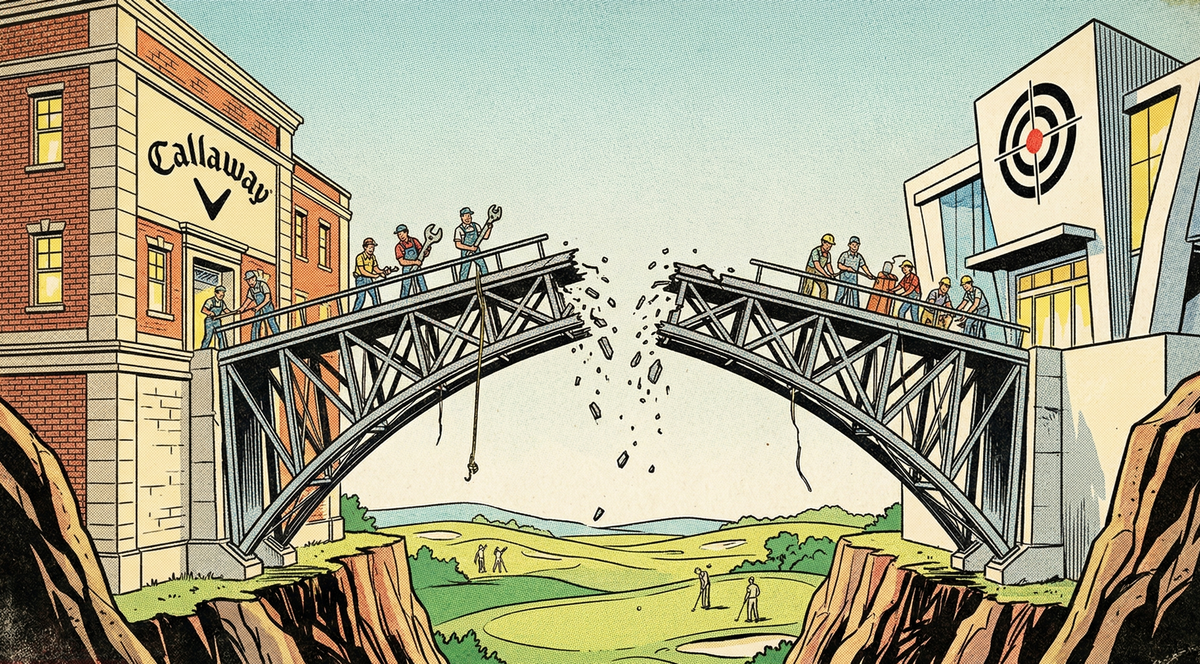
Callaway invested $2 billion to acquire Topgolf. The thesis: own the funnel from first swing to first equipment purchase. The stock has declined over 60% since. The company will spin off Topgolf in the second half of 2025. Here is why the merger failed — and what it reveals about vertical integration in golf.
Golf is a $140B+ industry. Every week, Perfect Putt breaks down what's actually driving it. Welcome to the new members who've joined since our last send — you're now part of a growing community of 11,000+ golfers who follow the business of the game.
Read Time: 6 minutes
The Original Thesis
The merger logic was straightforward and, on paper, compelling.
Topgolf serves an estimated 30 million guests annually. Approximately 50% identify as non-golfers. The venue format sits at the very top of golf's consumer funnel — the first touch point where millions of people interact with the sport in a low-barrier, social environment. Topgolf estimates that roughly 10% of green-grass golfers credit the venue experience with getting them onto a golf course.
Callaway wanted to own that distribution channel. If Topgolf was converting entertainment guests into on-course golfers, and those golfers needed equipment, why not capture both sides of that journey under one roof? It would create a competitive moat that no other equipment company could replicate — a vertically integrated path from first swing to first set of irons.
The thesis was a marketer's dream. The execution was a different story.
Where the Thesis Broke
The merger would only work if two conditions held: Topgolf needed to convert guests into green-grass golfers at a meaningful rate, and those converted golfers needed to purchase Callaway equipment at a rate that justified the acquisition cost.
On the first condition, the data is directionally positive but narrow. The estimated 10% conversion figure is not a net new golfer rate — it measures golfers who credit Topgolf as an influence, not golfers who would not have entered the game otherwise. The actual incremental conversion rate is likely meaningfully lower.
On the second condition, there is no public evidence that the merger produced material incremental revenue in Callaway's legacy equipment or apparel businesses. During Masters week, Callaway launched a fitting activation at Topgolf locations — a direct test of whether the venue could function as an equipment sales channel. Results were not disclosed, which suggests they were not compelling enough to publicize.
The fundamental challenge: Callaway invested approximately $2 billion to acquire what functioned as a marketing engine — and the marketing engine did not demonstrably move equipment sales.
The Operational Reality
Beyond the revenue thesis, the two businesses are structurally incompatible from a capital allocation standpoint.
Callaway's legacy business — equipment, golf balls, apparel — operates on product cycles, wholesale distribution, and moderate capital intensity. Topgolf operates on real estate, construction, venue management, food and beverage, and high fixed-cost infrastructure. The skill sets, capital requirements, and operating rhythms of the two businesses have almost nothing in common.
This was not analogous to a traditional golf industry acquisition. When Acushnet acquired Scotty Cameron, it was integrating a premium putter brand into an existing equipment distribution infrastructure. The manufacturing, marketing, and channel expertise already existed. The acquisition extended a capability Acushnet already had.
Callaway acquiring Topgolf was an equipment company acquiring a hospitality and entertainment business. The integration complexity was categorically different — and the organizational bandwidth required to manage both consumed resources without producing proportional returns.
The Topgolf Performance Problem
The timing compounded the structural mismatch. Topgolf's same-venue sales have deteriorated for five consecutive quarters. Indexed against 2019, same-venue performance turned negative by the third quarter of 2024. The corporate events segment — three-plus bay bookings — declined an estimated 19% in the most recent quarter.
Topgolf is not keeping pace with inflation on a same-venue basis. The growth story that underpinned the merger valuation has reversed — and the capital required to continue expanding the venue footprint creates ongoing cash demands that compete directly with Callaway's core business investment needs.
The Distribution Question
The most interesting strategic question the merger raised was never fully tested: could Topgolf locations function as brick-and-mortar retail distribution for Callaway equipment?
One hundred Topgolf venues worldwide, each with high foot traffic from golf-engaged consumers, represent a potential direct-to-consumer channel that no other equipment company possesses. Custom fittings, early access to new product, premium retail experiences inside the venue — the concept is logical.
The likely obstacle: channel conflict. An estimated 70% of golf equipment is sold through retail partners. If Callaway moved aggressively toward owned distribution inside Topgolf venues, it risked destabilizing its relationships with the big-box retailers and specialty golf shops that drive the majority of its sales volume. The strategic upside of owned distribution may not have been worth the channel disruption risk — and that tension may have limited Callaway's ability to extract the full value of the vertical integration thesis.
The Terms of the Split
Topgolf will be spun off with no financial debt and what has been described as significant cash on hand — though the specific amount has not been disclosed. New venue openings will be reduced to mid-single digits in 2025, a meaningful pullback from the aggressive expansion pace of prior years.
The structure is designed to give Topgolf operational runway as a standalone entity — clean balance sheet, reduced capital commitments, and the flexibility to optimize its business model without competing for resources inside a parent company whose core competency is golf equipment.
Wall Street's reaction to the split announcement was negative — the stock declined over 20% — suggesting investors are skeptical that the separation unlocks value at a level that compensates for the destruction of value since the original merger.
The Takeaway
The Callaway-Topgolf merger was a bold thesis on vertical integration in golf: own the funnel from first swing to first purchase. The logic was sound. The execution exposed a fundamental reality — an equipment company and an entertainment hospitality company require different capital structures, different operating expertise, and different strategic priorities. Combining them under one roof created organizational complexity without proportional revenue benefit.
Topgolf remains one of the most important brands in the golf ecosystem. It introduced tens of millions of people to the sport and built a demand basin that the entire off-course category now benefits from. Callaway remains one of the most recognized equipment companies in the world.
Separately, both businesses can optimize for their own economics. Together, neither could. The split is not a failure of either brand — it is a recognition that the integration thesis, however elegant on paper, did not produce the returns that justified a $2 billion bet.
The best way to support Perfect Putt is to subscribe and share with a friend.