
Golf’s Next Margin Is the Labor Hour

Golf has more workers than ever and, by the latest measure, less output per hour than in 2007. Price increases have covered the gap so far. The next margin comes from what operators do with the hours already on the payroll, and scale decides who captures it.
Welcome to Perfect Putt, a newsletter covering the business and economics of the golf industry. If this was forwarded to you, subscribe to join 12,000+ readers who follow how capital flows through golf.
Read Time: 8 Minutes
More Workers, Less Output
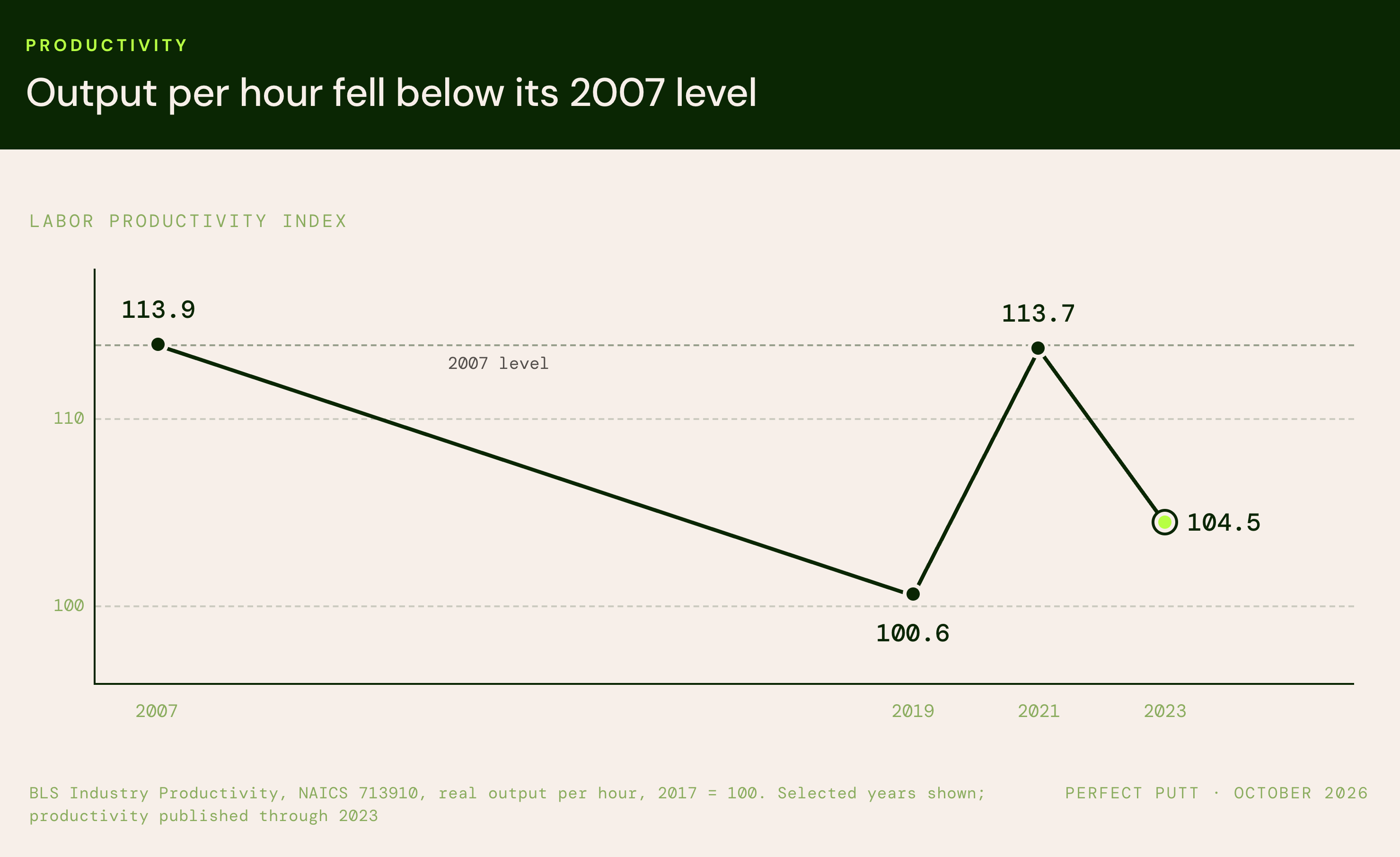
The most revealing year in golf's recent labor history is 2021. Rounds surged while facilities were still short of staff, and the Bureau of Labor Statistics (BLS) measure of output per hour at golf courses and country clubs jumped to its highest level in more than a decade. For a season, the industry ran leaner and served more golfers doing it.
It did not keep that operating model. As workers became available, facilities hired back to their prior staffing levels and beyond. Hours grew faster than output, and by 2023 productivity had fallen 8 percent from the 2021 peak, below where it stood in 2007. The productivity series ends there, but hours worked kept climbing to a record in 2025, increasingly in part-time and seasonal shifts.
Labor cost per unit of output rose about 20 percent between 2019 and 2023, driven by the two largest annual increases in the series. The industry's prices rose slightly faster, by about 24 percent, which is why margins held. Golfers and members effectively financed a workforce that grew without becoming more productive, an arrangement that depended on demand strong enough to absorb it.
The Service Model Sets the Labor Bill
Most of a facility's labor bill is set long before anyone writes a schedule, by how the course is designed, how the clubhouse serves members and how golfers book.
On the course, labor has accounted for roughly half to 60 percent of the typical maintenance budget for at least 15 years, according to GCSAA and USGA data. Budgets have risen sharply while the share has barely moved, which suggests equipment and technology have been added around the crew without reshaping it. The industry also measures that labor only in dollars per course and per acre. With no national benchmark for labor hours per hole or per round, an operator has little way to know whether its crew is productive or simply expensive.
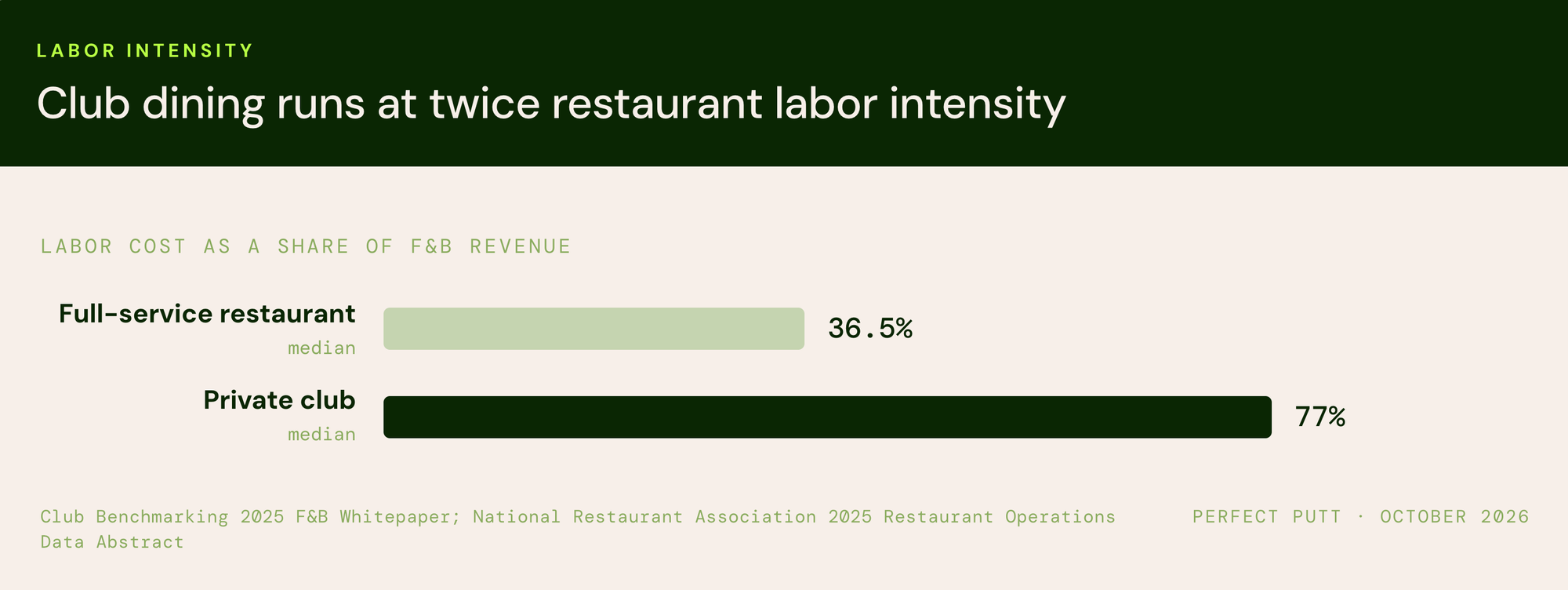
The clubhouse shows how much the service format matters. Club Benchmarking's latest food and beverage study puts the median club's F&B labor cost at 77 percent of F&B revenue, against 36.5 percent at the median full-service restaurant, per the National Restaurant Association. Fewer than one in ten clubs now earns an F&B profit. The same data point to the cause: banquet-heavy clubs run a 68 percent labor ratio, while clubs built around à la carte dining run 83 percent. A scheduled event lets a kitchen plan its staff around a known headcount; an all-day casual menu requires coverage whether or not members show up. As clubs leaned into casual dining to meet member demand, they also took on a more labor-intensive format.
Across the whole club, payroll consumes a little over half of revenue, close to where it stood a decade ago, based on Club Benchmarking, CMAA and National Club Association data. A decade of software adoption went mostly into booking and the member experience, leaving the underlying labor model intact.
Predictable Demand Is the Precondition
The clearest labor resets in other service businesses followed a common sequence: first make demand predictable, then schedule labor against it.
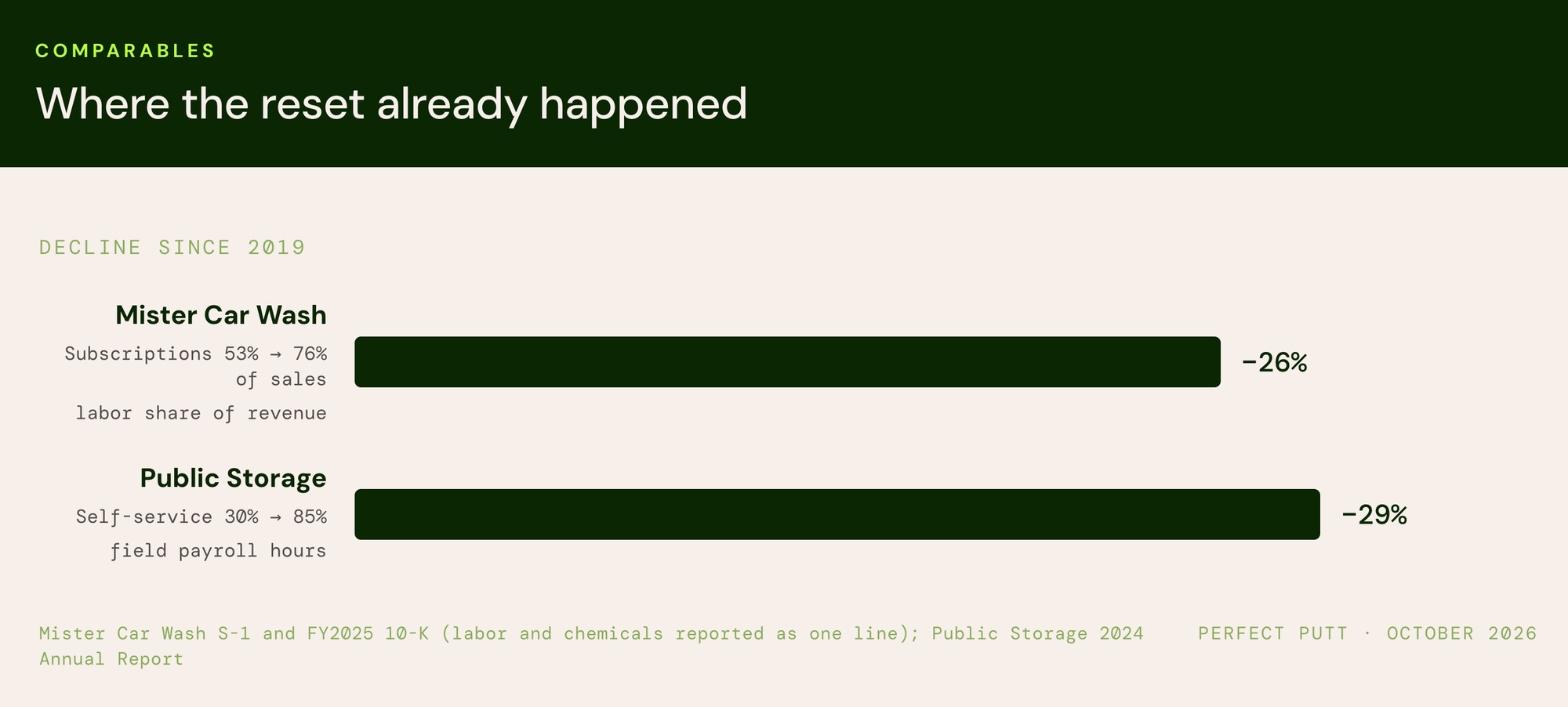
Mister Car Wash is the clearest example. As its Unlimited Wash Club grew to roughly three-quarters of wash sales, the company used member data to plan staffing, and its combined labor and chemicals line fell from 38.7 percent of revenue in 2019 to 28.7 percent in 2025. The line includes supplies as well as wages, but the direction fits a business that learned when its customers would arrive.
Vail Resorts adds a useful nuance. Its efficiency program delivered more than $100 million in annualized savings, largely from corporate roles, shared services and workforce management. When skier visits fell about 13 percent on weather in its latest fiscal year, mountain labor fell about 3 percent, a reminder that efficiency programs lower the fixed cost base while labor in weather-exposed businesses still flexes only partly with demand.
For golf, the lesson concerns information more than technology. Car washes had to build their demand data from scratch; golf already has it. A tee sheet shows who is coming and when, often days in advance, and a private club knows its members' habits and event calendar months out. Most facilities still staff with fixed crews and fixed shifts, as if demand were a surprise. The distance between what golf knows about its customers and how it schedules its people is the clearest opportunity in this story.
Pricing Alone Won’t Solve the Problem
None of this suggests golf has lost pricing power. Demand is healthy, course supply is stable, and operators can still raise prices. The issue is what those increases have been used for.
Since 2019, price has served as golf's financing mechanism for labor. Public green fees have risen roughly in line with inflation, according to the National Golf Foundation, which means public courses have kept pace with costs more than they have gained ground. Private clubs went further and drew on members' capital. The median golf club initiation fee rose from about $30,000 to about $50,000 between 2019 and 2023, according to CMAA, alongside dues increases well above their pre-pandemic pace. Initiation fees are member capital, and club governance guidance generally directs them to capital reserves. Where they have covered operations instead, clubs have funded payroll from the balance sheet, tied their most cyclical revenue line to a fixed cost, and deferred the capital work that removes labor in the first place.
That was a reasonable response to a labor shortage and is a weaker one now that it has passed. Hiring has eased considerably: the share of superintendents describing their local labor market as bad fell from 63 percent in 2022 to 34 percent in 2025, by the GCSAA's count. Wages have not followed. Pay keeps rising, and statutory floors keep moving higher in golf's largest markets, with Florida's minimum wage reaching $15 at the end of September.
The arithmetic explains why owners should care. With payroll at roughly half of revenue, a 5 percent cut in hours per unit of output adds about 2.5 points of margin. On a 12 percent EBITDA margin, that is about one-fifth more EBITDA with no change in price (Perfect Putt illustration).
For a buyer or lender, the question is earnings quality. Margin held up by price depends on demand. Margin built on fewer hours per round depends on the operation. Vail's ratio shows the asymmetry: apply it to a facility where payroll is half of revenue, and a 10 percent revenue decline takes about four points off margin from labor alone (Perfect Putt estimate).
Subtraction Before Automation
The most reliable productivity gains in golf so far have come from taking work out of the operation, ahead of the technology that gets most of the attention.
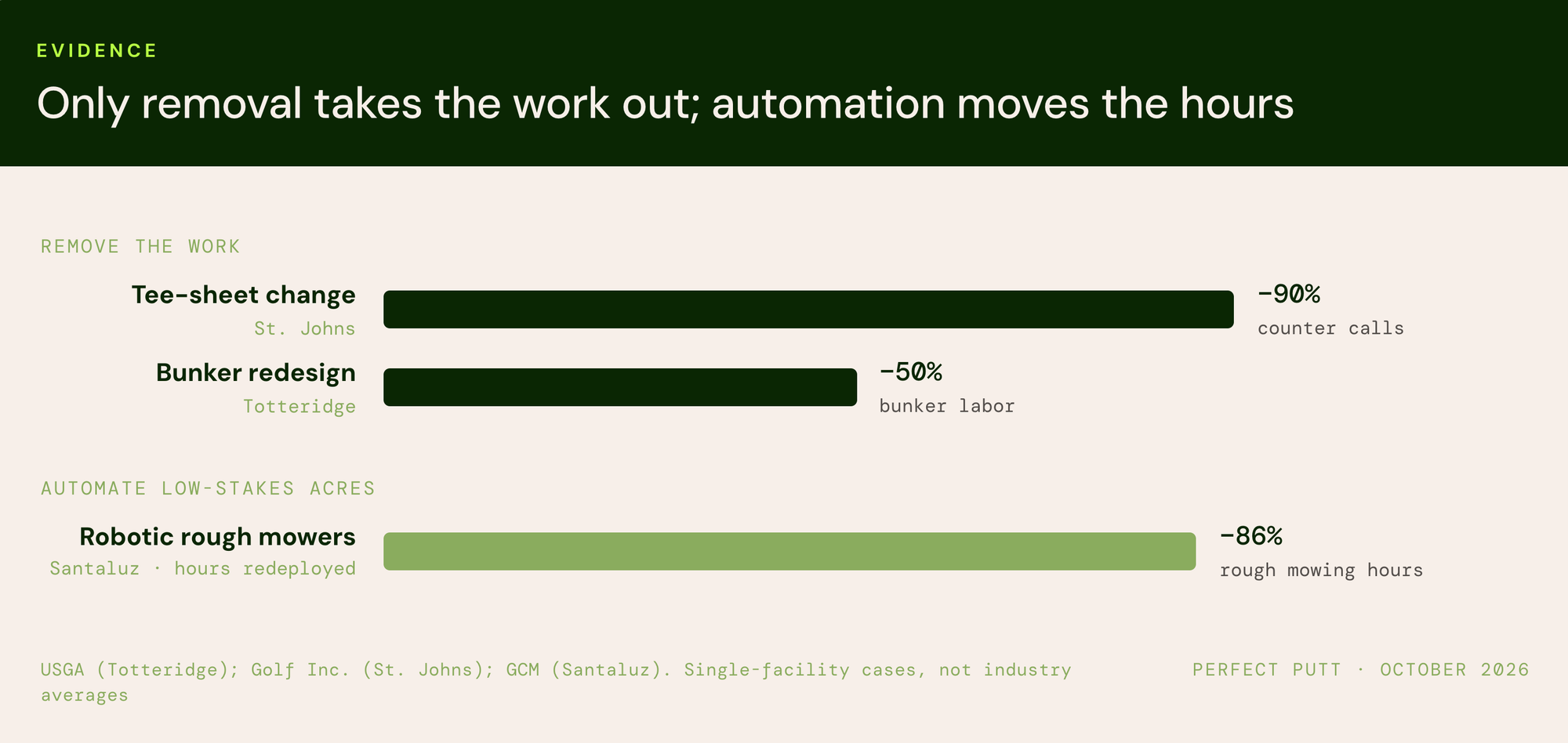
Course design offers the cleanest evidence. When Totteridge Golf Club cut its bunker sand area in half, it roughly halved the labor those bunkers required, according to the USGA. The clubhouse equivalent is the telephone. The NGF estimates that U.S. facilities spend more than 6 million staff hours a year answering calls, worth over $100 million, in a sport where only 40 percent of golfers book mostly online, against 80 to 90 percent of travelers. St. Johns Golf Club reported counter calls down 90 percent after switching tee-sheet systems, according to Golf Inc. In both cases, the hours disappeared because the work did.
Automation is producing real but narrower results. The Santaluz Club in San Diego cut manual rough mowing from about 2,200 hours a year to about 300 after deploying robotic mowers, saving roughly $50,000, its superintendent told GCM. The club did not reduce staff. Crews moved to hand mowing, bunkers and presentation. Autonomy on primary playing surfaces is earlier still. One autonomous mower maker's SEC filing shows 64 fairway mowing platforms delivered in total as of September 2025, a small installed base relative to the thousands of courses the category is aimed at.
That raises the central question for anyone underwriting golf productivity: if saved hours are redeployed rather than cut, where does the return come from? Freed hours can replace overtime and the seasonal hires a facility would otherwise add in peak months. They can go into conditioning that supports higher green fees and dues. They can expand capacity, with more tee times handled, programs coached and events served by the same staff. They can also absorb growth, so the next rise in demand does not require the next round of hiring. Robotic mowers and booking systems are capital spent to cut operating cost, and they should be underwritten that way, with payback measured in hours actually removed or hires actually avoided. Without that, the result is a better-presented course on the same cost base.
Capital Implications
Golf’s productivity problem is a management gap. The industry has the demand data, the tools and proven ways to remove work. Few operators measure labor in a way that turns saved hours into margin. That determines where value accrues.
Scale is the first filter. A platform such as Troon, with more than 900 locations, or Invited can build shared services, revenue management and labor scheduling once and apply them across many facilities, the same pillars behind Vail’s $100 million in savings. Scale also produces the internal benchmarks a single course lacks.
Ownership is the second. Troon mostly manages courses it does not own, so labor savings go first to the owner, and the manager shares in them only where its contract includes incentive fees. Owner-operators such as Invited keep the margin directly.
The market already prices these layers differently. Clubessential’s owners were reported by Reuters in 2024 to be seeking about $3 billion, near 22 times expected EBITDA, an asking level rather than a completed transaction. KSL agreed in June to buy Invited for about $3 billion including debt, under 9 times the operating earnings Reuters reported. Leonard Green’s deal for 60 percent of Topgolf valued that business at about $1.1 billion, before the lease obligations venue businesses carry. Investors pay a software multiple for owning demand data and an asset multiple for owning labor. The operator that converts data into fewer hours captures the margin at the lower multiple, which makes platform buyers the natural acquirers of productivity. The risk is paying platform prices for margin that came from price.
Capital that removes work, from bunker renovations to booking systems, is the most direct form of the opportunity, because the hours it saves do not come back.
The test for investors is simple. In diligence, ask for labor hours per round and per member, by department, across three seasons. A seller who cannot produce them is selling price, not an operation. The next BLS productivity release will show whether 2024 continued the slide.
The best way to support Perfect Putt is to share it with a friend.