
The Unfitted Club
Workouts are becoming free. The value in golf fitness sits with whoever the aging golfer trusts, and with whoever owns that golfer’s next ten years of spending.
Welcome to Perfect Putt, a newsletter covering the business and economics of the golf industry. If this was forwarded to you, subscribe to join 12,000+ readers who follow how capital flows through golf.
Read Time: 9 Minutes
A Gap Equipment Couldn't Close
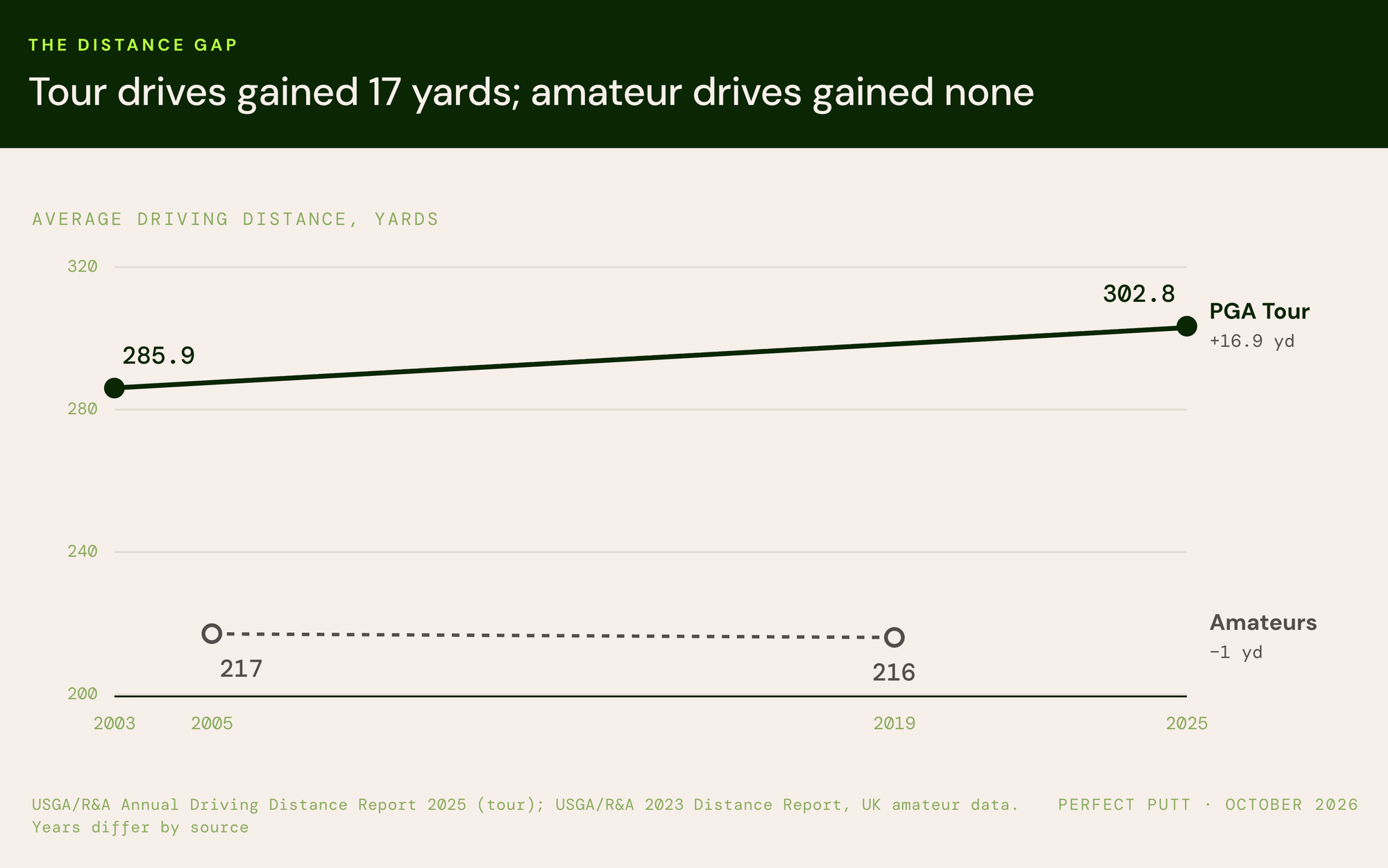
Between 2003 and 2025, average PGA Tour driving distance rose from 285.9 yards to 302.8, according to the USGA and R&A’s annual distance report. The same governing bodies measured the average amateur drive at 217 yards in 2005 and 216 in 2019. TrackMan data published by Golf Digest puts the average male amateur’s driver clubhead speed at about 93 mph, roughly 20 mph below the tour average.
Both groups play the same drivers and the same balls. The difference is what each has built around them.
The Tour put its first mobile fitness trailer on the road in 1985. Today two sets of semi-trailers travel to more than 60 events a year, staffed by physical therapists, athletic trainers and a chiropractor, and the Tour says about 80% of each week’s field uses them. In February 2026, Cleveland Clinic became the Tour’s official healthcare provider through 2032.
Fitness is not the whole story at the top. Tour distance also reflects who earns a card, launch conditions tuned on launch monitors, and how and where drives are measured. The amateur line deserves the closer read. Flat distance across an aging player base does not mean equipment failed. Better clubs and balls likely held the line against a slowing body.
Equipment has done what it can. Golf now fits every club in the bag to the player, from loft and lie to shaft profile, and rarely fits the player to the swing. The body is the last unfitted club, and at the recreational level it has received less investment than anything else in the bag.
What Travels From the Tour Trailer
The research on what closes that gap is consistent, though the samples are small. A 2020 review in the Journal of Sports Sciences covering 25 strength and conditioning studies found gains of 4% to 6.4% in clubhead speed, ball speed and distance where results were significant.
The effect holds with age. In a 2007 randomized trial published in the Journal of Strength and Conditioning Research, golfers averaging about 71 years old added roughly 5% to driver clubhead speed after eight weeks of functional training, while the control group lost speed.
The senior tour points the same way. Average driving distance on PGA Tour Champions rose from 269.0 yards in 2013 to 283.3 in 2025, according to Golf.com’s review of tour statistics, and four players over 50 averaged more than 300 yards last season. Before 2023, no more than one player had done so in any season. Part of that rise reflects longer hitters aging onto the tour, so the trend is consistent with the research rather than proof of it.
The more useful finding is what does not matter. A 2024 meta-analysis in Sports Medicine found clubhead speed most strongly associated with explosive lower-body power and upper-body strength, while flexibility and balance showed no meaningful association. Much consumer golf fitness is marketed around mobility. The evidence favors the barbell, which means a meaningful share of the category sells the benefit with the weakest support.
That evidence also shows which parts of the elite model translate. The expensive part, a full-time team of trainers, physios and recovery staff, does not. The inexpensive parts do: a physical screen that identifies limitations, a strength program, and a structured warm-up.
The recreational version of tour fitness is a short sequence of assessments and sessions, which makes it a service business from the start. The screen is the step that decides everything after it, and whoever runs the screen usually writes the program.
The Buyer Is Turning 65
Distance sells the category. Age and injury create the sustained demand. The National Golf Foundation counted 6.3 million on-course golfers aged 65 and over in 2025, up 38% since 2019, and about 45% of on-course golfers are now 50 or older. NGF also finds the 65-plus group plays almost twice as many rounds as other adult golfers.
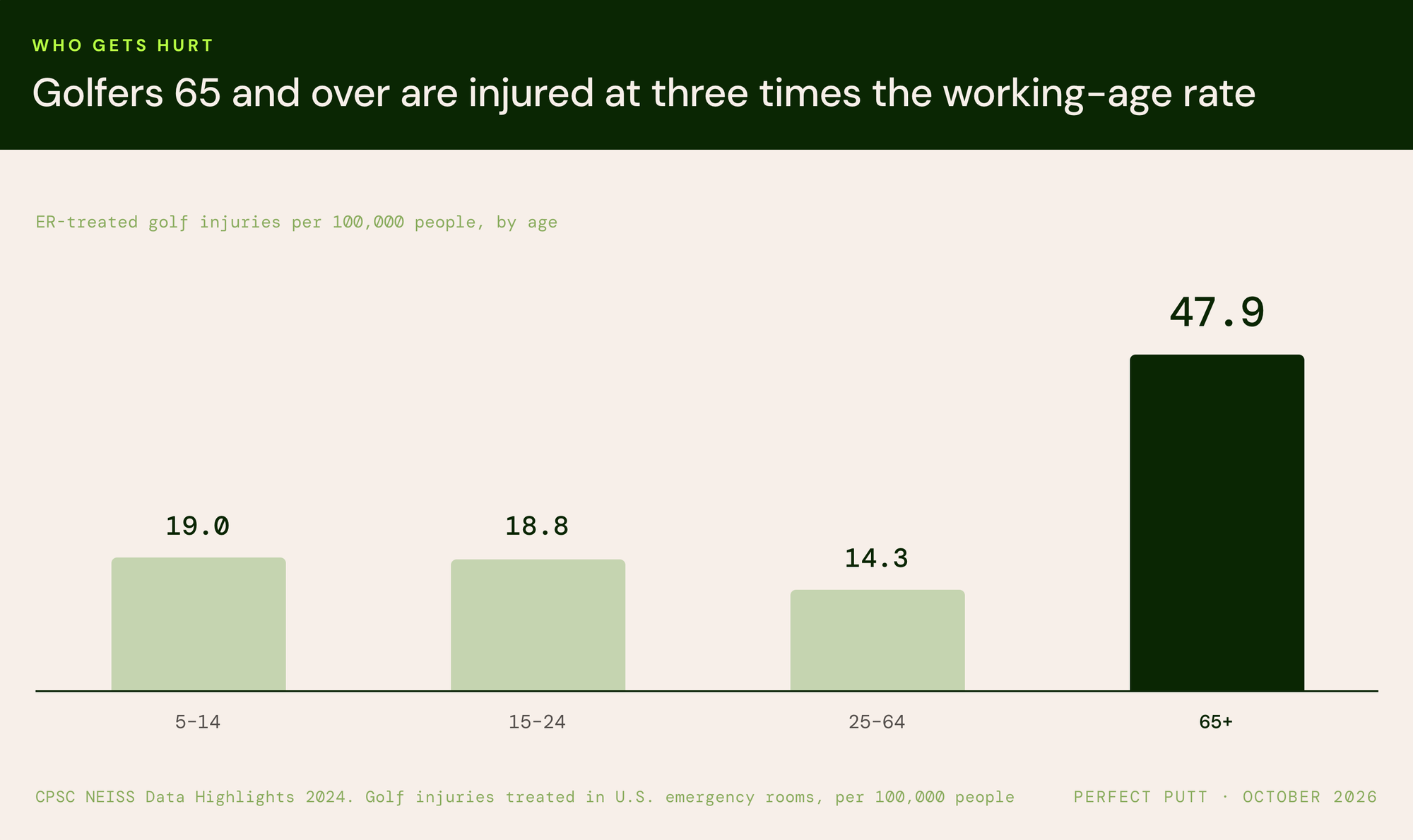
That cohort also carries the injury burden. Consumer Product Safety Commission data show an estimated 72,026 golf injuries treated in US emergency rooms in 2024, and golfers 65 and over accounted for 40.6% of them. Against NGF participation, that works out to roughly 4.6 emergency visits per 1,000 senior golfers, about two and a half times the rate for younger golfers, by Perfect Putt’s calculation.
The same people are moving into gyms. The Health & Fitness Association reported a record 81 million US facility members in 2025, with members 65 and over the fastest-growing cohort at 8.6%. That customer is buying more years of play, not more yards. Each added year is worth more to the clubs, courses and equipment makers collecting the spending than to whoever delivers the training.
Health systems have noticed. Cleveland Clinic, the Tour’s new healthcare provider, plans to open a 210,000 square foot performance center in Cleveland in 2027 that will serve the public. The golf industry has not measured the demand. No NGF, Golf Datatech or PGA of America figure tracks how many recreational golfers train for golf or what they spend on it. Golf counts driver sales to the unit and has no count of the training spend behind them.
Workouts Are Becoming Free
If the demand is real, the next question is who captures it. Recent deals in adjacent sports point in one direction. Larger platforms are absorbing sport-specific training, and what they choose to buy is revealing.
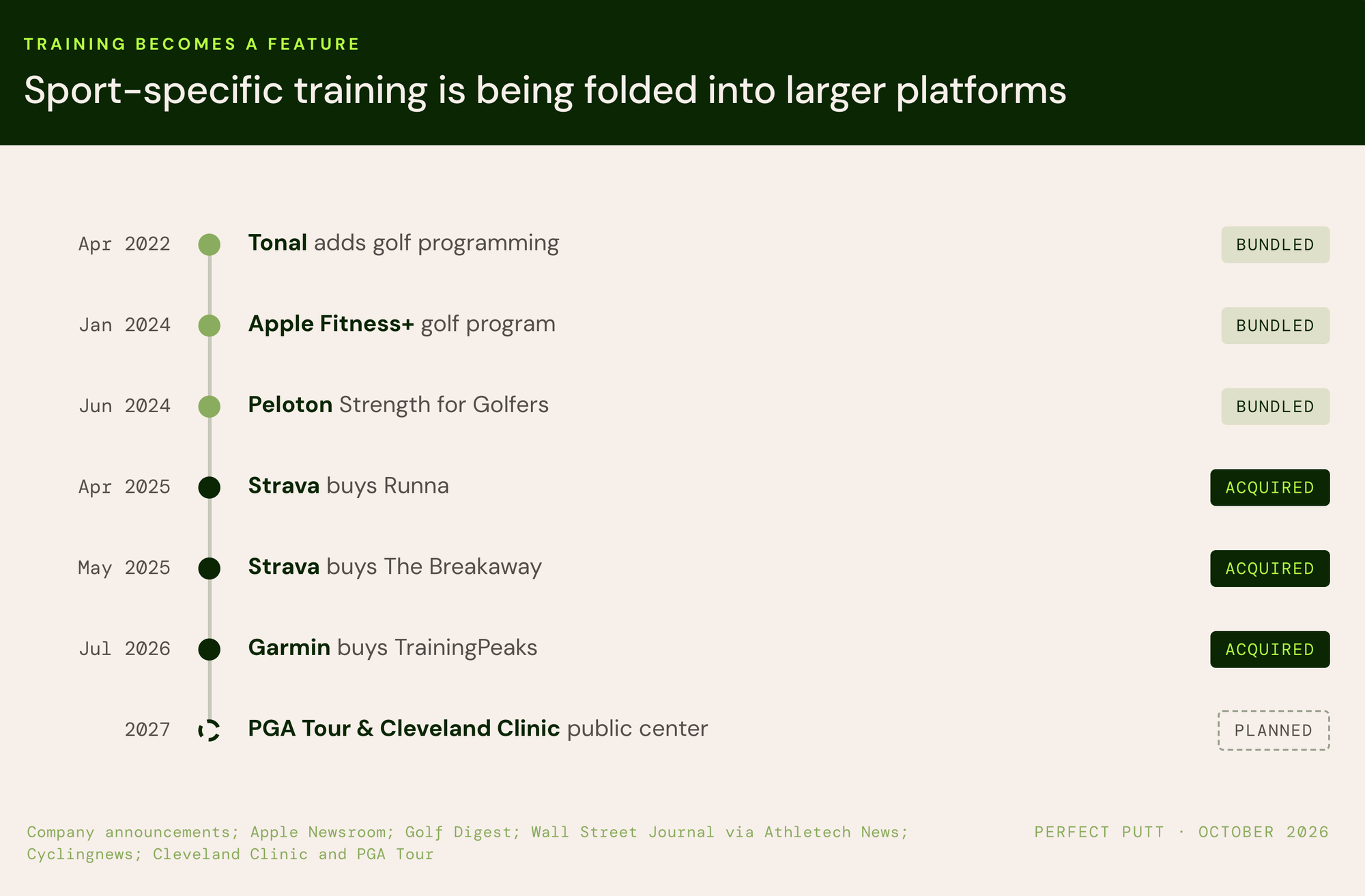
In 2025, Strava acquired Runna, a running training-plan app, and The Breakaway, a cycling training app, alongside a funding round that valued Strava at $2.2 billion, according to the Wall Street Journal. In July 2026, Garmin acquired TrainingPeaks, the coach-athlete platform founded in 1999, together with TrainHeroic, its strength and conditioning counterpart. Strava bought training plans. Garmin bought the software coaches use to manage their clients.
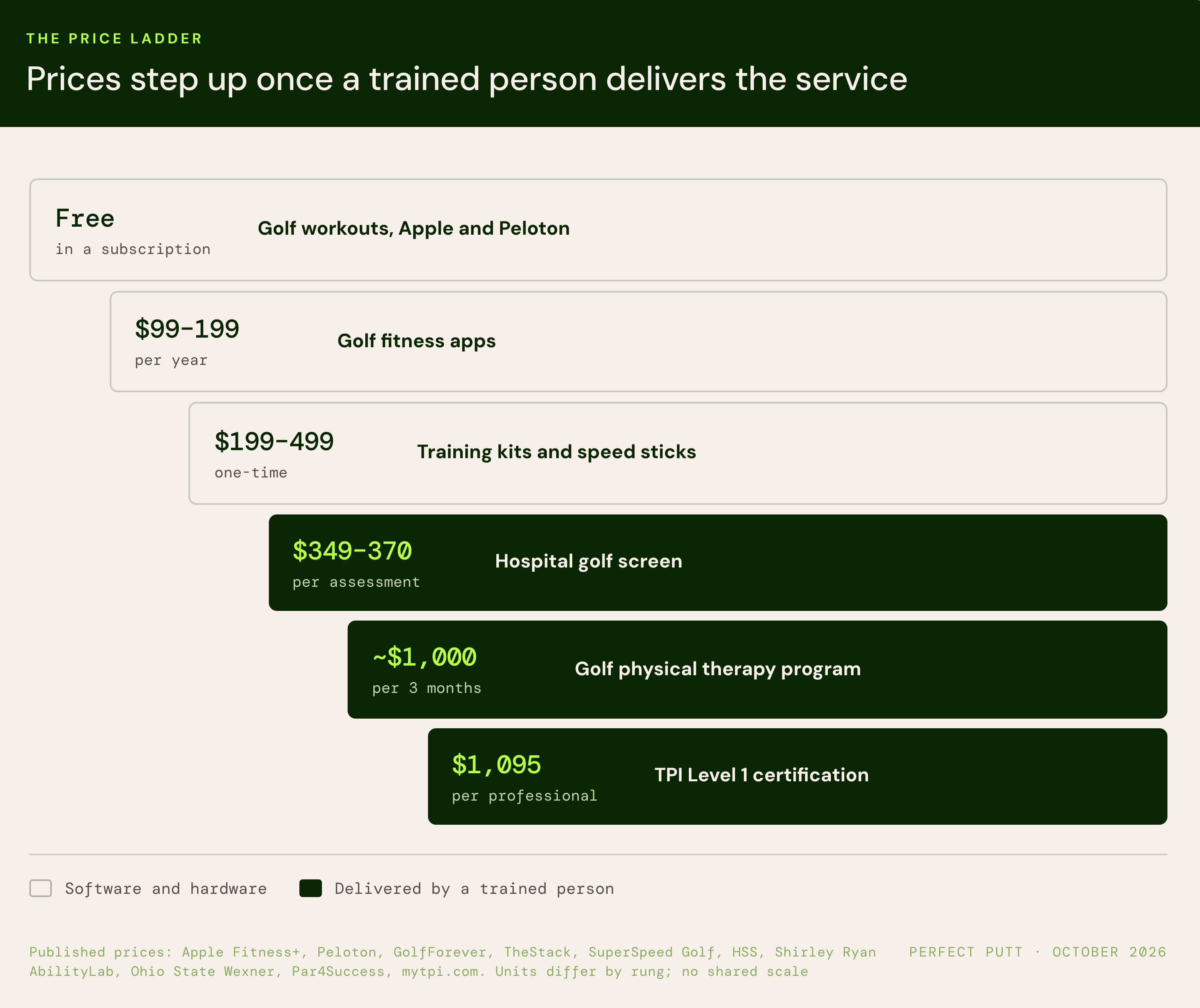
Golf content has gone the same way without an acquisition. Apple Fitness+ added a strength and yoga program for golfers featuring Rose Zhang in January 2024. Peloton launched Strength for Golfers that June, taught by a TPI-certified instructor. Both come inside existing subscriptions at no extra cost.
The valuations sit with sport-agnostic platforms that use golf for marketing. WHOOP, the PGA Tour’s official wearable through 2028, raised $575 million at a $10.1 billion valuation in March 2026 and said it had reached a $1.1 billion annual revenue run rate.
Golf’s own consumer brands have settled on a subscription model. GolfForever sells a $199.99 trainer that leads into a $199 annual app. TheStack bundles memberships of $99 to $129 a year. SuperSpeed Golf added a $99 annual app to its training sticks in 2024. Hardware has become the acquisition channel, and the subscription has to carry the business.
That is a hard business to carry. RevenueCat’s 2026 subscription benchmark puts the median health and fitness app’s realized first-year revenue per paying user at $35.64, and across categories only 28% of annual subscribers are still paying a year later. A golf app that signed up 2% of NGF’s 14.9 million core golfers would collect roughly $10.6 million a year, by Perfect Putt’s calculation, while replacing most of its subscribers every year. On this evidence, golf workout software is likely to end up as a feature inside larger platforms.
Trust Is the Product
What platforms cannot bundle is trusted human delivery, and in golf fitness that runs through one credential. The Titleist Performance Institute, founded in 2003 at Acushnet’s Oceanside test facility, says it has certified more than 27,000 professionals in 63 countries. Its Level 1 course costs $1,095, with $199 a year to keep active status, and its screening and programming app is free to certified pros and their clients.
TPI gives the software away and charges for the credential that makes the software trusted. Acushnet lists TPI only among its trademarks. If a third to half of certified pros renew, fees come to roughly $2 million to $3 million a year by Perfect Putt’s estimate. That is a small fee line on an asset valued for its tour relationships and its place in the fitting channel.
The credential underpins most delivery channels. Programs at Hospital for Special Surgery, Shirley Ryan AbilityLab and Ohio State staff TPI-certified clinicians and charge $349 to $370 for a golf assessment, according to their published prices. Insurance does not pay. Orlando Health and the FYZICAL network both state their golf performance programs are private-pay.
A cash-funded, older market points to private clubs, which have a reason to pay that an app subscriber does not: a member who keeps playing keeps paying dues. Invited, the Apollo-owned club operator, added golf performance training in an August 2026 reinvestment at The Hills Country Club in Austin. Bonita Bay Club in Florida employs 22 TPI-certified golf and fitness professionals.
The service relationship holds customers far longer than software does. At Par4Success, a golf-focused physical therapy practice in North Carolina, an initial three-month program starts around $1,000 and clients stay an average of more than three years, according to Business North Carolina. A client who kept spending at that initial rate would be worth about $12,000 in revenue over three years.
The limit is capacity. Revenue grows with clinician hours, and the trust behind that retention belongs to the clinician. Trust is the product, but it leaves with the trainer. The owners best placed to keep it attach it to something larger: a credential, a hospital brand or a club membership.
Where Capital Belongs
The capital record matches that picture. The largest disclosed venture round in golf-specific fitness is GolfForever’s $10 million Series A in 2024, led by Clerisy. Drake Star’s 2025 sports technology report ranks wearables and performance among the most active segments for $100 million-plus financings, led by Oura’s $900 million raise. It lists no golf biomechanics or fitness transactions, and its golf entries are course and venue deals.
The evidence ranks the opportunities. First is delivery attached to whoever owns the golfer’s lifetime spend: performance programs at private clubs, cash-pay golf and return-to-play service lines inside physical therapy groups, and longevity programs at premium fitness operators. These assets are valued as services, on clinician capacity, retention and price. The underwriting question is whether the trust stays with the institution when a trainer leaves.
Second is assessment data, owned as an acquisition target rather than built as a standalone business. Golf apps today personalize programs through questionnaires, and camera-based golf tools measure the swing rather than the body. Outside golf, AI movement screening already operates at scale: Sword Health raised capital at a $4 billion valuation in 2025 for AI-guided musculoskeletal care. A golf product that does what a TPI screen does in a clinic, at a phone’s cost, would give certified pros better data. It would also give a buyer such as Garmin, WHOOP or an equipment maker the coach-facing layer that TrainingPeaks provided.
Third, and weakest, are content-only workout apps, which compete with programming Apple and Peloton include at no extra cost.
Three signals will show whether the shift is accelerating: whether NGF or Golf Datatech begin measuring golf-fitness participation, how quickly Cleveland Clinic’s public performance center fills after it opens in 2027, and whether a horizontal platform buys a golf training company the way Strava bought Runna. Until then, the business sits with whoever the older golfer trusts to keep them playing. The value sits with whoever collects that golfer’s next ten years of dues, green fees and drivers.
The best way to support Perfect Putt is to share it with a friend.