
Golf Entertainment Goes Mobile
Dryvebox provides an interesting business case in golf entertainment.
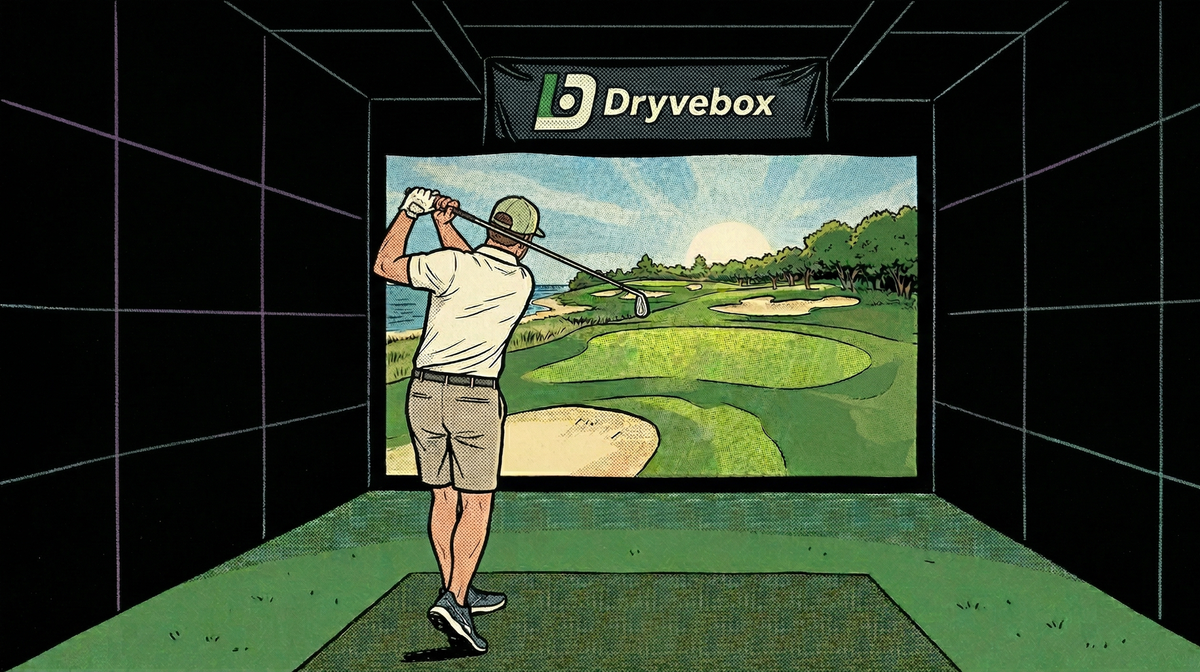
A doctor turned serial entrepreneur wanted a golf simulator in his house. His wife said no. So he bought a trailer, outfitted it with a launch monitor and a hitting screen, and parked it in San Francisco. When he towed it to Stanford's campus, a line formed. Dryvebox — mobile golf simulation, delivered to your location — was born. The origin story is charming. The business model underneath it is more interesting.
Golf is a $140B+ industry. Every week, Perfect Putt breaks down what's actually driving it. Welcome to the new members who've joined since our last send — you're now part of a growing community of 11,000+ golfers who follow the business of the game
Read Time: 6 minutes
The Model
Dryvebox operates mobile golf simulator units — custom-fabricated trailers, patented in design, purpose-built so a golfer can take a full swing inside. The company delivers the unit to the customer rather than requiring the customer to come to a fixed venue. That inversion — golf entertainment as a service rather than a destination — is the core differentiator.
The business runs on two primary revenue channels: events and self-service bookings. Events include corporate outings, birthday parties, holiday activations, and conference engagements — Dryvebox is signing five to six contracts per event in some markets. Self-service bookings allow individual golfers to reserve a unit for practice or recreation.
The company currently operates in 23 cities across the United States. Each unit is reportedly already profitable at the individual level.
The Franchise Pivot
Dryvebox launched as a company-operated model, self-funded by founder Adeel Yang — a two-time founder whose most recent company was acquired by Philips in 2019. The company raised its first institutional round in 2022 and began expanding into new markets.
The inflection came in 2023, when Dryvebox shifted to a franchise model. The catalyst was twofold: consistent inbound demand from potential operators, and a venture capital environment that had tightened significantly. Franchising allowed the company to continue scaling without the capital intensity of company-owned expansion.
The estimated initial investment to launch a Dryvebox franchise ranges from $137,000 to $364,000. That cost structure is the headline. For comparison, a Five Iron Golf location requires an estimated $1.4 to $4.4 million. An X-Golf franchise runs roughly $1 to $2 million. A tech-enabled range conversion is $4 to $6 million. A Topgolf venue at peak buildout was $30 to $50 million.
Dryvebox is entering the off-course golf market at a fraction of the capital intensity of every established format — with no real estate lease, no construction timeline, no F&B buildout, and no brick-and-mortar permitting process. A new location can be operational in weeks rather than months or years.
The Capital Table
Dryvebox recently closed a strategic investment round from a group of golf-focused investors: Old Tom Capital, EP Golf Ventures, TMRW Sports, and Golf Digest. Terms were not disclosed, but the company has raised over $5 million in total across both rounds.
The investor composition is notable. TMRW Sports — the parent company behind TGL — brings immediate distribution and partnership infrastructure. Dryvebox has already built custom-branded trailers for three TGL teams, creating a fan engagement asset that extends the TGL experience beyond the arena. The company has also activated at multiple PGA Tour events this season, positioning mobile simulation as a live-event engagement tool.
The Strategic Position
Dryvebox is building in the highest-growth segment of the golf ecosystem. Off-course golf participation has grown by an estimated 6.3 million participants since 2020. The category has more than doubled since 2018. Every major format in the space — simulators, tech-enabled ranges, entertainment venues — is expanding.
Dryvebox occupies a distinct lane within that category. It does not compete directly with fixed-location operators for the same customer occasion. A Five Iron or X-Golf serves the golfer who wants a recurring membership-based experience. Dryvebox serves the corporate event planner, the tournament activation director, the birthday party host, and the conference organizer who needs a golf experience for up to 100,000 attendees — delivered, set up, and removed without permanent infrastructure.
The company has deliberately avoided the F&B component that adds margin but also adds complexity, labor, and regulatory burden to every other format in the category. Dryvebox is a pure golf product — and that simplicity is a feature of the cost structure, not a limitation.
The Unit Economics Advantage
The capital efficiency of the model compounds at scale. No lease obligations. No construction risk. No multi-year buildout timelines. No food-service licensing. Franchise operators deploy capital at $137,000 to $364,000 per unit, reach profitability quickly at the unit level, and can add incremental units without the step-function cost increases that define brick-and-mortar expansion.
The company has doubled in size since January. The addressable market, by management's estimate, supports hundreds of units domestically — with capacity for thousands. Whether that TAM proves realistic depends on franchise operator execution, market density limits, and whether mobile simulation maintains its novelty and event appeal as it scales. But the capital required to test those limits is orders of magnitude lower than any competing format.
The Takeaway
The off-course golf market has been defined by a spectrum of capital intensity — from Topgolf's $30-to-$50-million venues at one extreme to franchise simulator lounges at $1 to $2 million at the other. Dryvebox enters below the bottom of that range and removes the two inputs that most frequently destroy value in venue-based businesses: real estate risk and construction cost.
The model is early. Twenty-three cities and a franchise network that is still scaling do not yet constitute a proven national platform. But the cost structure, the strategic investor base, the TGL and PGA Tour activations, and the unit-level profitability data all point in the same direction: mobile golf entertainment is a viable and differentiated format within the off-course category, and it is scaling at a pace that fixed-location competitors structurally cannot match.
The question is not whether the concept works. The early data says it does. The question is how large the addressable market is for mobile golf entertainment as a category — and whether Dryvebox can build the operational infrastructure and brand consistency required to own it at scale.
The best way to support Perfect Putt is to subscribe and share with a friend.