
The Business Case for a Shot Clock
Media Rights are 40% of PGA Tour Revenue.
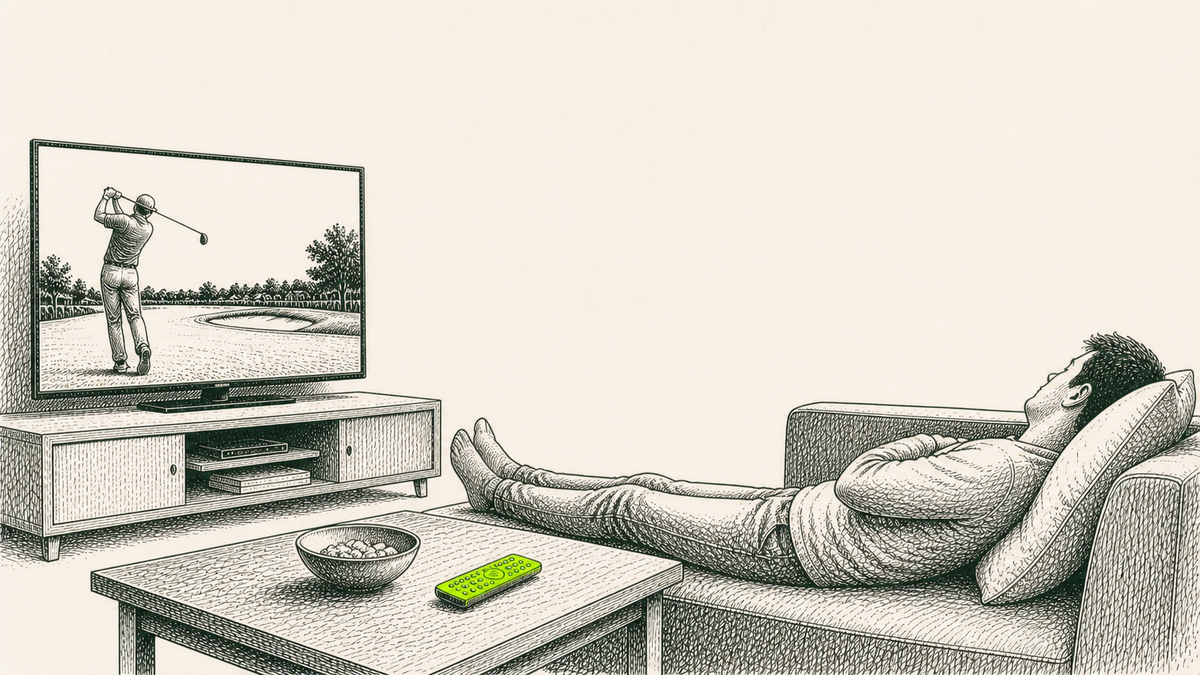
Media rights account for an estimated 40% of the PGA Tour's revenue. In 2023, the Tour recognized approximately $730 million in media rights income out of $1.83 billion in total revenue. That single line item is the economic engine that funds purses, operations, and the Tour's long-term commercial viability.
And the product that drives media rights value — the television broadcast — is losing its audience.
Golf is a $140B+ industry. Every week, we break down what's actually driving it. Welcome to the new members who've joined since our last send — you're now part of a growing community of 11,000+ golfers who follow the business of the game. If someone forwarded this to you, subscribe below.
Read Time: 7 minutes
The Ratings Problem
Sunday viewership for non-major PGA Tour events declined an estimated 19% in 2024. Saturday viewership dropped an estimated 17%. These are not one-off dips. The American Express saw its Sunday audience fall from 534,000 viewers in 2024 to 232,000 in 2025 — a 57% decline in a single year.
This is not unique to the Tour. Major championship ratings have softened. The NBA has seen similar declines. But for an organization that just accepted $1.5 billion from SSG at a $12 billion valuation, with media rights representing the single largest revenue driver, a 19% decline in the primary product's audience is a structural problem — not a cyclical blip.
In business terms, it is the equivalent of watching your core product line's sales drop by a fifth in a single year.
What Viewers Actually See
A breakdown of a recent Farmers Insurance Open first-round broadcast illustrates the challenge. The broadcast ran three hours and forty-seven minutes. In that window, viewers saw 268 golf shots — roughly 1.2 shots per minute. Commercials consumed approximately 40 minutes. Playing Through segments added another 18 minutes. A quarter of the broadcast was some form of advertising.
Only 25 of the 155 golfers in the field appeared on screen.
The commercial load is a known variable, and the Tour and its broadcast partners have presented data suggesting it is within industry norms. The deeper issue is shot density. At 1.2 shots per minute, the broadcast is asking viewers to stay engaged through long stretches of dead air between the moments that actually matter.
The Shot Clock Argument
The DP World Tour tested a shot clock format in a single event several years ago. The rules were simple: 40 seconds to execute a shot, with a one-stroke penalty for exceeding the limit. Pace of play dropped by 34 minutes. Scores also dropped. Player reception was broadly positive.
The PGA Tour's current system relies on monitoring rather than enforcement. Every player is ranked by pace of play in the Tour's member app, updated weekly. The average time per shot on Tour is approximately 38 seconds. Players who exceed 45 seconds per shot are placed on an observation list. After one free warning per year, fines of $50,000 can be assessed. Penalty strokes are rare — the Tour's position is that strokes are not equitable across the leaderboard, since a penalty hurts a contender far more than a player destined to miss the cut.
That logic cuts both ways. A player contending on Sunday may rationally prefer paying a fine over accepting a penalty stroke — which means the current system's deterrent weakens precisely when pace matters most to the broadcast product.
The Tour's primary structural response has been reducing field sizes beginning in 2026. But smaller fields do not automatically produce faster play. At the American Express, the final group played in five hours and forty minutes in perfect weather with only 71 golfers on the course — nearly an hour beyond a reasonable par time.
Why It Matters Now
The connection between pace, broadcast quality, and media rights value is direct. Faster play means more shots per broadcast hour. More shots means a denser, more compelling product. A more compelling product holds and grows audiences. Audiences drive the next media rights negotiation.
If the average Tour shot already takes 38 seconds, a 40-second shot clock imposes virtually no burden on normal play while creating a meaningful enforcement mechanism for the outliers who drag pace — and, by extension, the broadcast product — down.
The Takeaway
The PGA Tour's next media rights cycle will be negotiated against a backdrop of declining linear viewership, a $12 billion enterprise valuation, and a sports media market where the NFL is targeting $24 billion in annual rights revenue. Every other property is fighting for what remains.
A shot clock alone will not reverse the ratings trajectory. But it addresses one of the two factors most commonly cited by disengaged fans — slow play and the distortions created by the money era — and it does so with minimal competitive disruption.
The Tour has an extraordinary demand environment for the recreational game, a broadening demographic base, and a cultural moment that may not last indefinitely. The broadcast product needs to match the energy the sport is generating everywhere else. The window to act is open — but the ratings data suggests it is narrowing.
The best way to support Perfect Putt is to Subscribe and share with a friend.