
Golf's Viewership Paradox
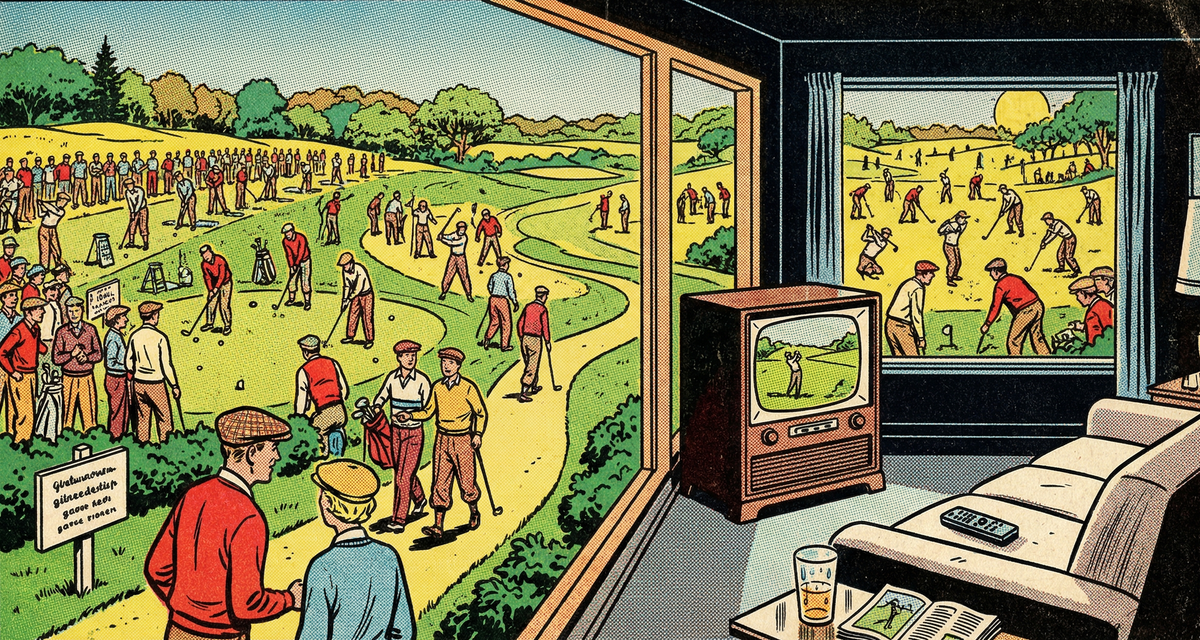
There are 45 million golf participants in the U.S. and roughly three million who watch the PGA Tour on television — about 7%. Participation and viewership have moved in opposite directions for a decade. Netflix's Full Swing generated a measurable short-term bump, but the effect did not sustain. The conversion challenge — turning players into viewers — is the most important commercial problem in professional golf.
Golf is a $140B+ industry. Every week, Perfect Putt breaks down what's actually driving it. Welcome to the new members who've joined since our last send — you're now part of a growing community of 11,000+ golfers who follow the business of the game.
Read Time: 6 minutes
The Inverse Relationship
The golf industry has produced one of the most counterintuitive trends in professional sports: participation and viewership are moving in opposite directions.
In 2012, there were an estimated 29 million golf participants in the United States. An estimated 13.5 million people watched the final round of the Masters. Under 500 million rounds were played.
In 2022, there were over 40 million participants. An estimated 10.2 million watched the Masters final round. Roughly 520 million rounds were played.
More golfers. More rounds. Fewer viewers. The sport added 11 million participants over a decade and lost 3 million Masters final-round viewers in the process.
This is not a PGA Tour-specific issue. The Masters — golf's most-watched event by a significant margin — has seen a steady viewership decline. Final-round viewership exceeded 14 million nine times between 1997 and 2014. It has not reached that threshold since 2015. The 2021 and 2022 editions produced the lowest viewership outside of the pandemic-affected 2020 since 1997. The 2023 final round recovered to 12.1 million — the best since 2018 — but still well below the historical ceiling.
The problem is not that people are losing interest in golf. They are playing more of it than ever. The problem is that playing golf and watching golf are fundamentally different consumer behaviors — and the sport has not built the bridge between them.
The Full Swing Effect
Netflix's Full Swing docuseries, released in February 2023, was the highest-profile attempt to convert golf interest into viewership. Season one was watched for an estimated 53.1 million hours through June 2023. Despite a mid-February release, it ranked 267th out of more than 18,000 titles in Netflix's first-half viewing report.
For context within sports docuseries: Formula 1's Drive to Survive generated 90.5 million hours. Tennis's Point Break produced 30.5 million hours. Full Swing outperformed tennis and delivered meaningful engagement — though it fell short of the F1 property that has become the benchmark for sports-to-streaming conversion.
The early broadcast viewership data following Full Swing's release showed measurable lift. In the first quarter of 2023, NBC viewership was up approximately 3%. CBS was up 4%. Golf Channel was up 15%. The Honda Classic and WGC Match Play posted four-year viewership highs. The Valspar reached a five-year high.
The digital metrics were even stronger. PGA Tour website traffic increased an estimated 8% in the first quarter. Social video views surged approximately 31% year-over-year. ESPN reported that ESPN+ viewership was up significantly in the first three months — though specific numbers were not disclosed.
The sustained impact was more modest. CBS finished the year up only 1% in total viewership — meaning the initial Full Swing bump dissipated over the course of the season. The docuseries generated awareness and trial, but it did not fundamentally alter the viewership baseline.
The YouTube Parallel
While traditional television viewership has stagnated, golf content consumption on YouTube has exploded — and the growth rates dwarf anything happening on broadcast.
In the past year alone, Rick Shiels added roughly 300,000 subscribers — growth exceeding 10%. Good Good added approximately 400,000, growing over 30%. Bob Does Sports added roughly 330,000, nearly doubling its subscriber base. Both Rick Shiels and Good Good now have more YouTube subscribers than the PGA Tour's own channel.
The 31% increase in PGA Tour social video views following Full Swing's release is consistent with this broader pattern: golf consumers — particularly younger ones — are migrating their content consumption from linear television to digital platforms. They are watching more golf content than ever. They are just not watching it on CBS.
The viewership problem may be partially a measurement problem. If the metric is linear television ratings, golf viewership is declining. If the metric is total golf content consumption across all platforms — broadcast, streaming, YouTube, social media — the picture is likely very different.
The Conversion Challenge
Full Swing demonstrated that a well-produced, character-driven docuseries can generate meaningful short-term viewership lift and significant digital engagement. It also demonstrated that the effect is not self-sustaining — viewership reverted toward baseline within months of the initial release.
The Formula 1 comparison is instructive. Drive to Survive did not just generate awareness — it created an ongoing narrative engine that built emotional investment in drivers, teams, and rivalries across multiple seasons. The show fundamentally changed the composition of F1's audience, particularly in the United States, and the viewership gains have sustained over multiple years.
Full Swing faces a structural challenge that Drive to Survive does not: professional golf's weekly format is not designed for the narrative continuity that drives binge-watching and emotional investment. Individual tournaments produce self-contained storylines that reset every seven days. The season-long FedEx Cup narrative has never generated the kind of casual viewer engagement that a championship race in F1 or a playoff race in team sports delivers.
Converting 45 million golf participants into regular tournament viewers requires more than a single content initiative. It requires a broadcast product that rewards the casual viewer's attention — faster pace, more shot density, compelling storytelling within the broadcast itself — combined with a multi-platform distribution strategy that meets the audience where it already consumes content.
The Takeaway
Golf's viewership paradox — more participants, fewer viewers — is one of the most important commercial challenges in the sport. Media rights represent an estimated 40% of PGA Tour revenue. The value of the next rights deal will be determined by the Tour's ability to demonstrate audience growth.
Full Swing proved that the audience is convertible. The initial viewership bump, the digital traffic surge, and the social video growth all confirm that golf participants can be activated as content consumers. The challenge is sustaining that activation beyond a single content moment.
The answer is not one solution. It is a combination: a better broadcast product with faster pace and higher shot density, docuseries content that builds narrative investment across seasons, creator distribution that reaches the demographics linear television is losing, and a measurement framework that captures total engagement across all platforms rather than indexing exclusively on linear ratings.
The 45 million golfers are already engaged with the sport. The infrastructure to convert them into viewers — across broadcast, streaming, and digital — is being built. The question is whether golf can assemble the pieces fast enough to capture that conversion before the next media rights cycle determines the sport's commercial trajectory for the following decade.
The best way to support Perfect Putt is to subscribe and share with a friend.