
Club Car: Golf's Next Sale?
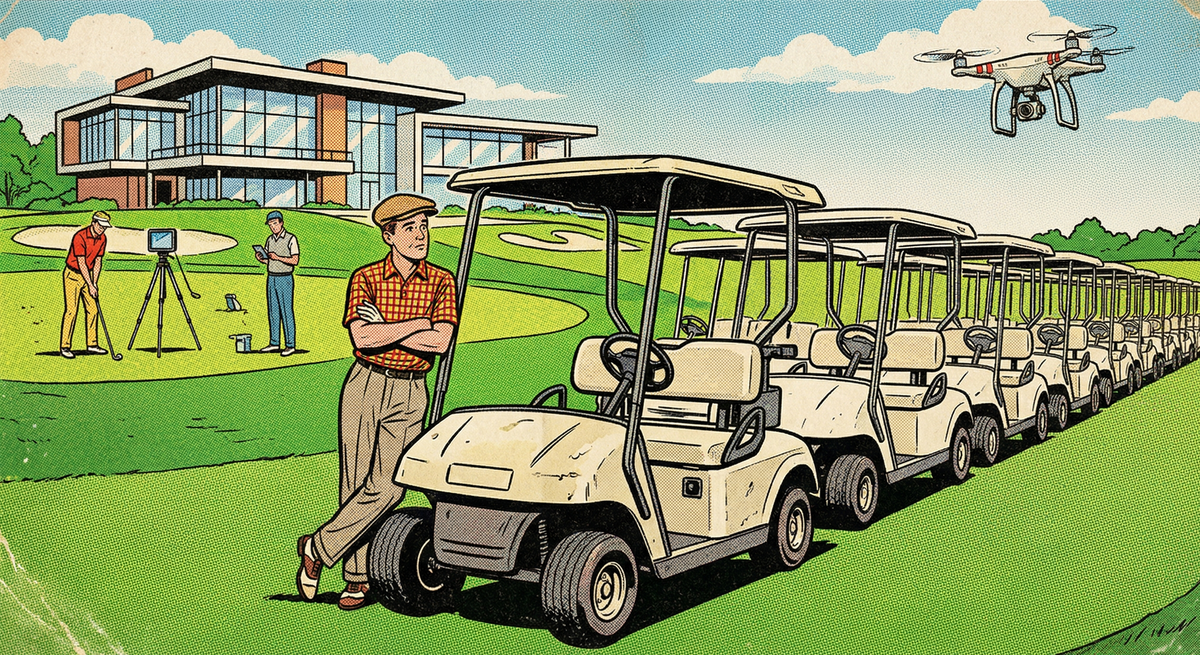
Platinum Equity is reportedly looking to sell Club Car at a $2 billion valuation — three years after buying it for $1.68 billion. The return would trail the S&P 500. But the more interesting story is the market underneath: a multi-billion-dollar golf cart category controlled by conglomerates that treat it as a non-core business, with structural demand tailwinds and virtually no innovation pressure. Here is where the opportunity sits.
Golf is a $140B+ industry. Every week, Perfect Putt breaks down what's actually driving it. Welcome to the new members who've joined since our last send — you're now part of a growing community of 11,000+ golfers who follow the business of the game.
Read Time: 5 minutes
The Market Structure
Three companies dominate the golf course fleet market: Club Car, E-Z-Go, and Yamaha. All three are owned by large industrial conglomerates — and in each case, the golf cart business is a rounding error in the parent company's overall operations.
E-Z-Go is owned by Textron, a manufacturer of aircraft and helicopters. In Textron's 92-page annual report, E-Z-Go is mentioned four times — none with material substance. Yamaha's golf cart operation sits inside Yamaha Motor Company under a category called "other products," alongside engines and generators. The word "golf" appears twelve times in its 96-page annual report.
Club Car under Platinum Equity is the only one of the three operating with a dedicated ownership structure — and even that is a financial sponsor managing a portfolio of dozens of companies, not a golf-focused operator.
The implication: the dominant products in the golf cart category are being managed as non-core business units inside conglomerates that have no strategic thesis around golf. They are maintained, not optimized. They are generating cash, not innovating.
The Unit Economics
The core revenue driver for golf cart manufacturers is the fleet lease. Golf courses typically lease fleets on four-year cycles. At the end of the lease, the carts are recycled through distributors into the consumer market — families, retirement communities, lake towns, and planned neighborhoods where golf carts are increasingly permitted on public roads.
Both demand channels are structurally growing. Golf rounds and participation are at record levels, which drives fleet replacement demand on the course side. On the consumer side, municipalities across the country are expanding street-legal golf cart access — a regulatory trend that has produced measurable sales spikes in communities that adopt it. A lake town that legalized golf cart street use saw local sales accelerate immediately.
The category is not dependent on a single demand driver. It is leveraged across two distinct growth vectors — recreational golf and personal transportation — both of which are expanding.
The Disruption Opportunity
The golf cart has been fundamentally the same product for decades. Recent additions — touchscreens, backup cameras, Bluetooth speakers — are incremental feature upgrades, not structural innovation.
The real disruption opportunity sits at the intersection of golf technology and the cart itself. A golf cart that integrates a launch monitor, on-course shot tracking, real-time scoring and handicap data, entertainment for group play, or even wagering infrastructure would represent a category redefinition — not just a better cart, but a fundamentally different on-course experience.
No incumbent is building this. The conglomerate ownership structures that control E-Z-Go, Yamaha, and Club Car are not organized to invest in golf-specific technology innovation. They are organized to manufacture vehicles and manage lease cycles.
The Startup Angle
The gap between incumbent capability and market opportunity is where startups enter.
Companies like Voyager — a golf cart manufacturer staffed with aerospace engineers, pricing units under $10,000, and actively recruiting distributors — represent the early edge of a challenger wave. The product is sharp, the price point is aggressive, and the team is focused exclusively on golf carts rather than managing them as one line item inside a diversified industrial portfolio.
The challenge for any challenger brand is channel access. Golf courses make fleet purchasing decisions based on reliability, lease terms, service infrastructure, and institutional relationships. Displacing Club Car, E-Z-Go, or Yamaha from a course's fleet contract is a multi-year sales process that requires service network buildout, financing capability, and demonstrated product durability over thousands of rounds.
The consumer side is more accessible. Individual buyers are less brand-loyal, more price-sensitive, and more responsive to design, features, and value. A sub-$10,000 cart with modern design and technology features can compete for the consumer dollar without needing to crack the institutional fleet market first.
The Club Car Valuation
A $2 billion exit on a $1.68 billion entry produces approximately a 1.2x multiple of invested capital over three years. Assuming the roughly 10x EBITDA valuation is accurate, Club Car is generating approximately $200 million in EBITDA — a healthy cash flow business with stable demand characteristics and low cyclicality relative to other consumer discretionary categories.
The buyer profile for Club Car at $2 billion is likely another financial sponsor — the business generates consistent cash flow, operates in a consolidated market with high barriers to entry, and benefits from structural demand tailwinds in both its golf and consumer transportation channels. A strategic acquirer from the golf industry is unlikely at this price point; a conglomerate or infrastructure-focused PE fund is the more probable destination.
The Takeaway
The golf cart market is a multi-billion-dollar category with structural demand growth, consolidated market structure, and virtually no innovation pressure from its incumbent manufacturers. The three dominant brands are managed as non-core units inside conglomerates that do not prioritize golf-specific product development.
That creates an opportunity on two fronts. For financial buyers, Club Car at $2 billion represents a stable, cash-generative asset with pricing power in a growing market. For entrepreneurs and venture-backed challengers, the technology gap between what golf carts currently offer and what the on-course experience could deliver is wide enough to support a meaningful disruption thesis — particularly on the consumer side, where brand loyalty is weaker and price sensitivity creates entry points.
The golf cart is one of the most ubiquitous products in the sport. It is also one of the least innovated. That combination — high installed base, low innovation, growing demand — is the profile of a category waiting for disruption. Whether that comes from a $2 billion acquisition or a sub-$10,000 startup depends on who moves first.
The best way to support Perfect Putt is to subscribe and share with a friend.