
What Golf Owes Its Players
The PGA TOUR is valued at $16 billion. Its players share in roughly 25 cents of every dollar it generates. Here’s how that compares to other major American sports — and what’s being done about it.
Golf is a $140B+ industry. Every week, we break down what's actually driving it. Welcome to the new members who've joined since our last send — you're now part of a growing community of 10,000+ golfers who follow the business of the game. If someone forwarded this to you, subscribe below.
Read Time: 6 minutes
The Math Behind the Money
Pick any major professional sport and ask a simple question: what percentage of the money the league generates actually reaches the players? In the NFL, the NBA, and the NHL, the answer is locked in by collective bargaining — roughly 48 to 50 cents of every revenue dollar goes to player compensation, by contractual obligation.
In professional golf, there is no such agreement. No union. No floor. No formula.
So what does the math actually look like when you run it? The answer is more nuanced than the usual “golfers are underpaid” take — but the structural gap it reveals is real, and the PGA TOUR is finally starting to close it.
Starting With the Raw Comparison
The most straightforward cut: total annual player compensation set against total league or tour value. The numbers are striking — not because the Tour looks stingy, but because of what the ratios reveal.
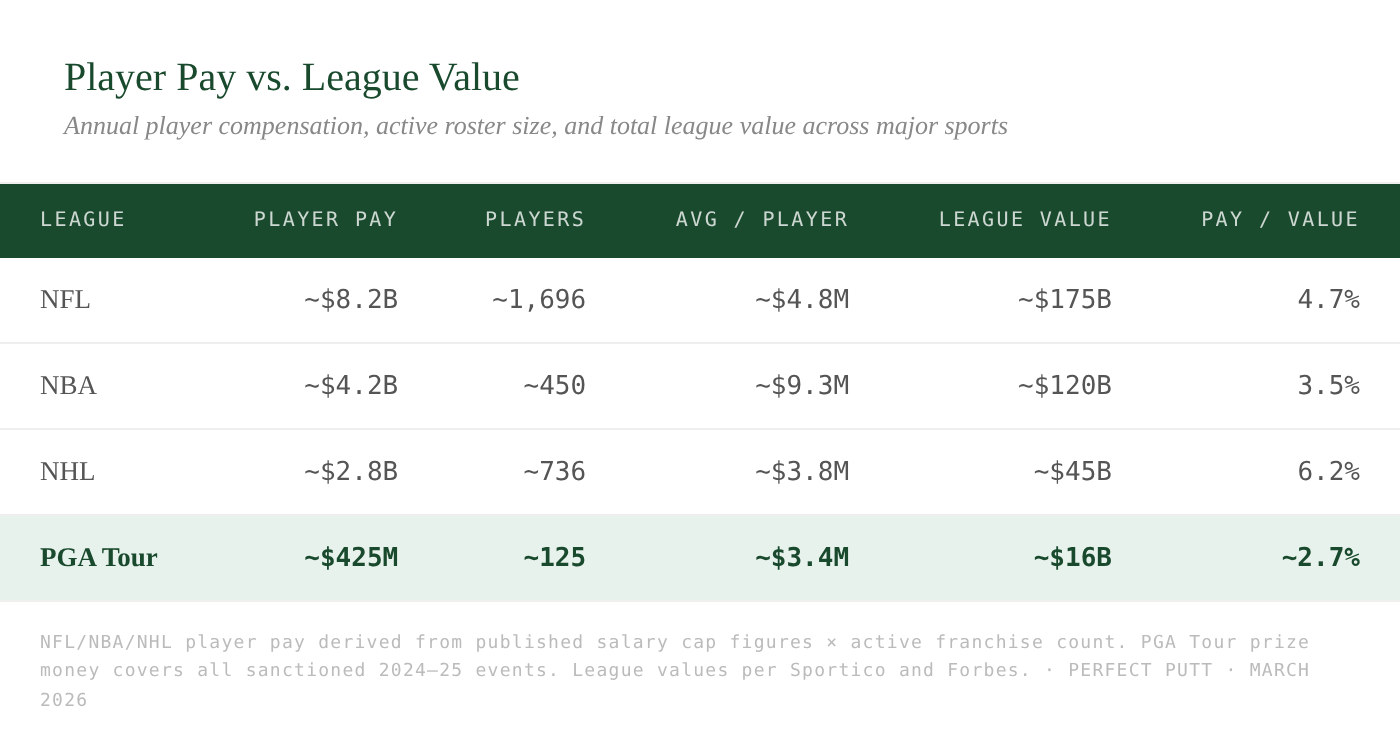
Two things stand out. First, the PGA TOUR’s pay-to-value ratio is the lowest of any major American league — by a meaningful margin. Second, the average per-player number looks competitive on the surface. But that average is doing a lot of heavy lifting. To understand why, you have to look at how each sport actually distributes its money.
The Distribution Problem: Averages Lie
Average player compensation is one of the most misleading numbers in sports. The more honest comparison looks at the floor — the minimum a player can earn — and how concentrated the money is at the top.
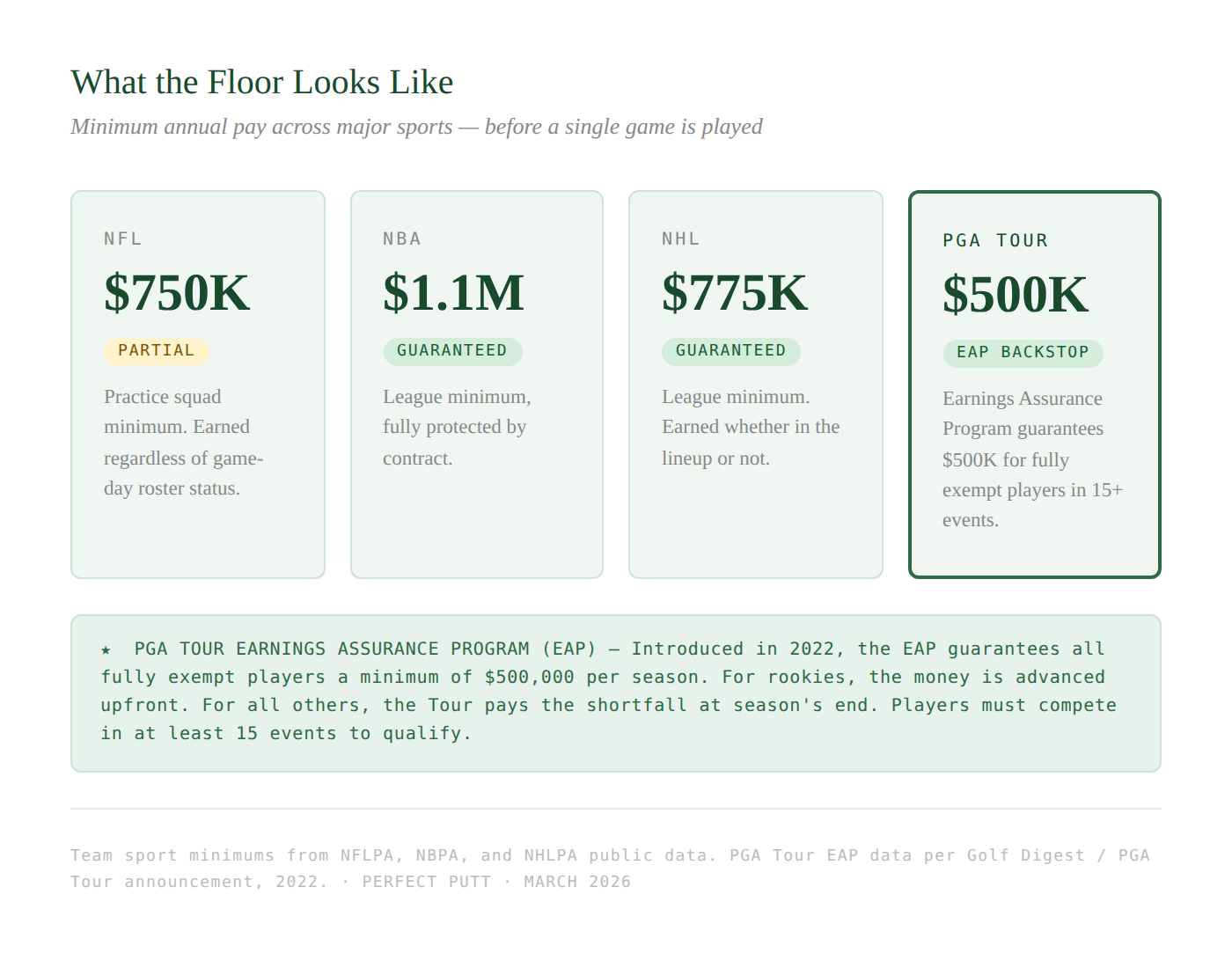
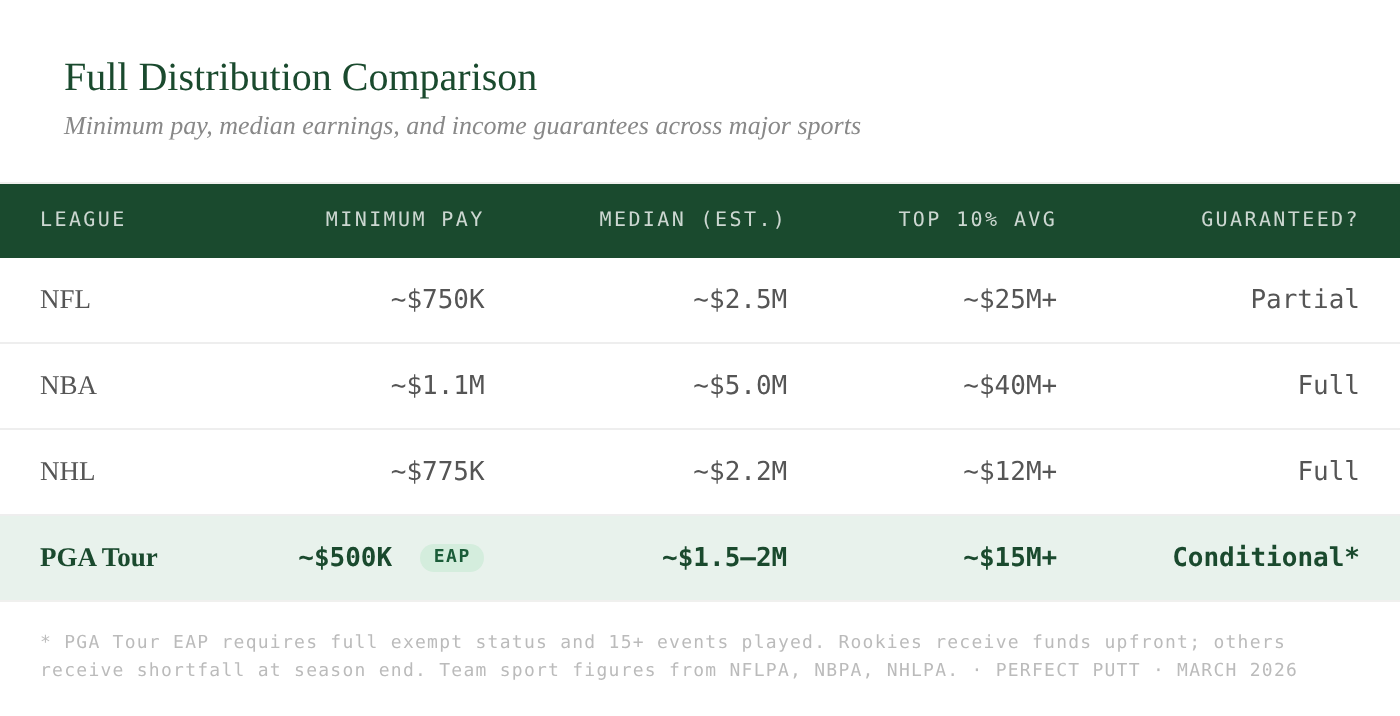
The floor tells the real story — though it's more nuanced than it first appears. In 2022, the PGA Tour introduced the Earnings Assurance Program (EAP), which guarantees all fully exempt players a minimum of $500,000 for any season in which they compete in at least 15 events. For rookies, that money is advanced upfront at the start of the season. For everyone else, the Tour makes up the difference at year end if they fall short. It's a genuine backstop — and a meaningful one.
That said, the structural difference from team sports remains real. A practice squad player in the NFL earns $750,000 guaranteed before a single game is played, with no performance requirement attached. In golf, the $500,000 floor is conditional — it requires full exempt status and a minimum number of starts, and it doesn't apply at all if you lose your card mid-season. The meritocracy that makes golf compelling is the same mechanism that makes its economics uneven below the top tier, even with the EAP in place.
The Revenue Share Gap
The most structurally important comparison isn’t individual salaries — it’s what percentage of total revenues players are entitled to receive. This is the number that defines the long-term economics of any sports league.
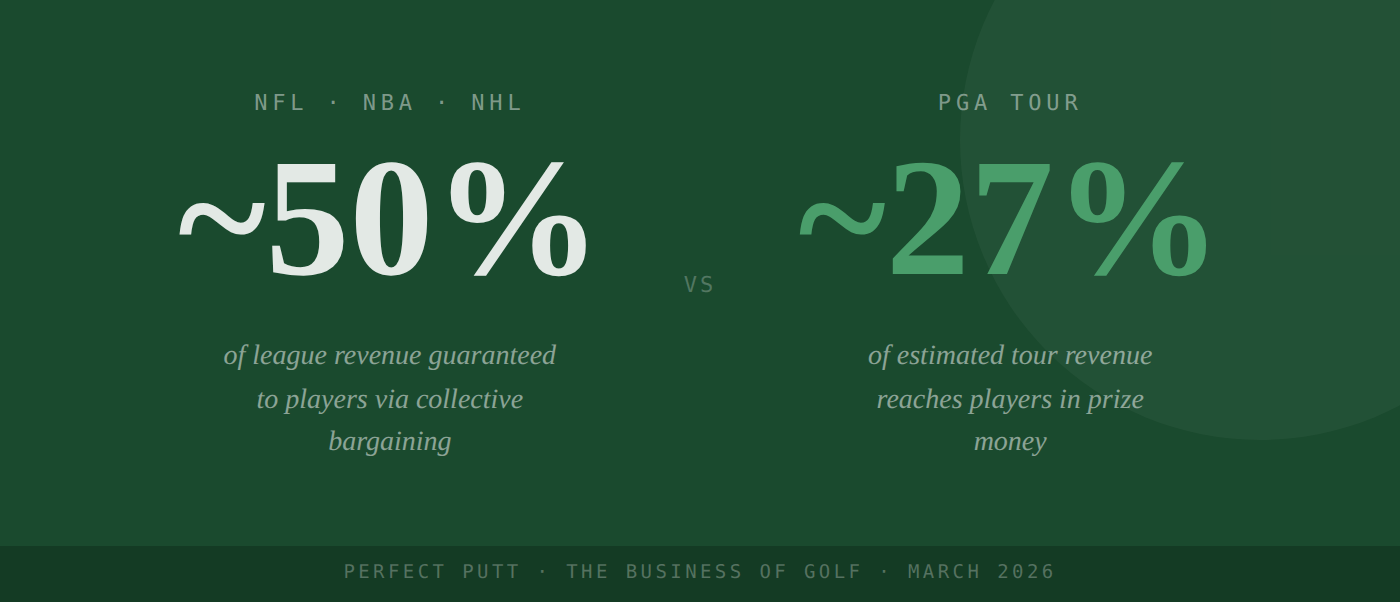
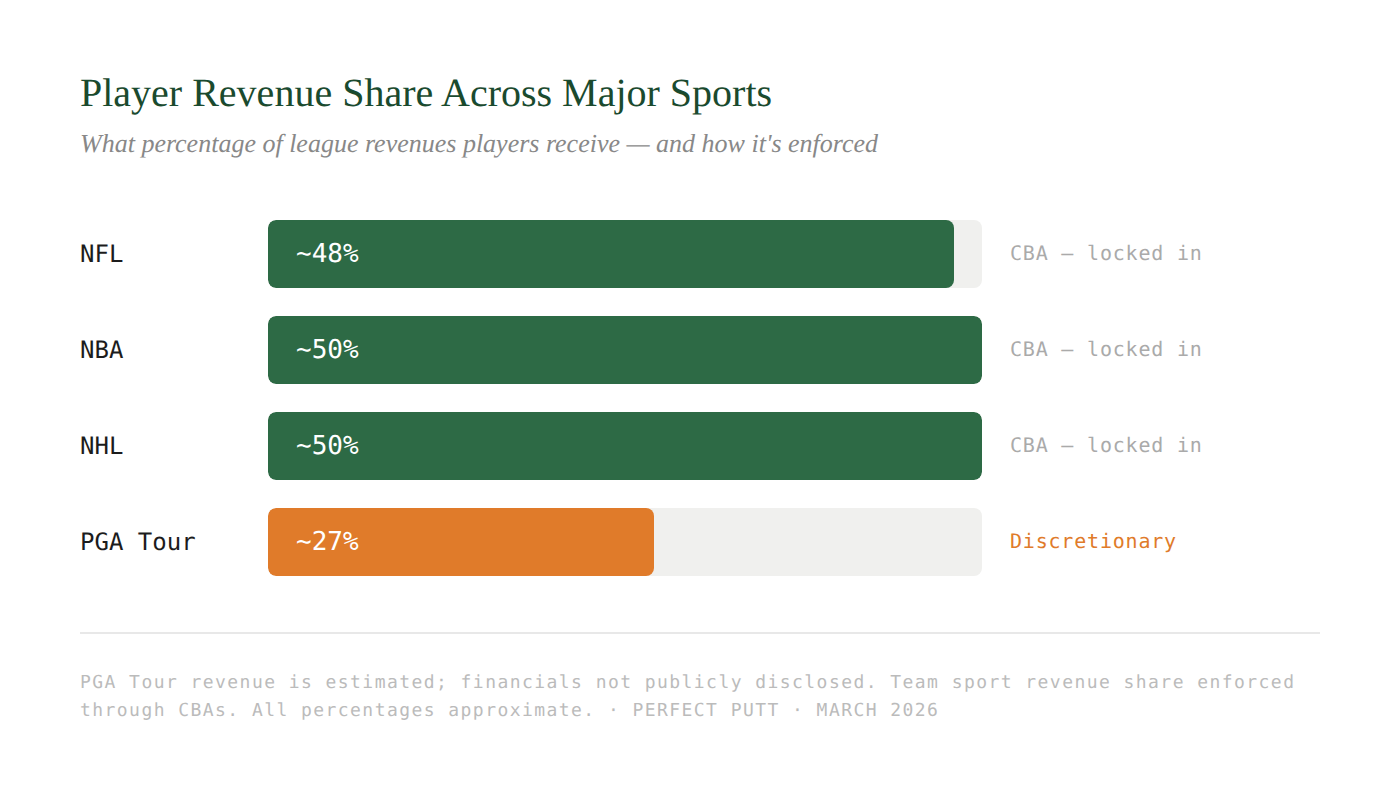
This is the sharpest number in the comparison. NFL, NBA, and NHL players collectively capture roughly half of their league’s revenues — not because leagues are generous, but because players negotiated that right. The share is automatic, formulaic, and grows as the league grows.
PGA TOUR prize money is set at the Tour’s discretion. When revenues grow, prize money doesn’t automatically follow. There is no trigger, no formula, no union to enforce one. The estimated 25–28% revenue share for Tour players is roughly half the rate their counterparts in team sports have locked in through collective bargaining.
The One Number That Changes the Comparison
Here’s where the golf comparison gets genuinely interesting — and where the standard narrative misses something important.
PGA TOUR players own equity in the Tour itself.
No NFL player owns a piece of the NFL. No NBA player owns equity in the league. In those sports, players negotiate their share of revenues and walk away with a paycheck. In golf, Tour members hold an ownership stake in the institution they’re competing for. Speaking at TPC Sawgrass this week, new PGA TOUR CEO Brian Rolapp put it plainly:
“The fact that the players own equity in the Tour is unlike any other sports model, professional sports model that I can think of.”
That equity stake doesn’t show up in any prize money comparison. It’s not in the revenue share calculation. But it’s real — and if the Tour’s commercial ambitions play out, it could represent significant long-term value for the players who hold it. It’s an imperfect substitute for guaranteed pay. But it’s also something no collective bargaining agreement in team sports has ever delivered.
What the Tour Is Doing About It
The revenue share gap isn’t going away on its own. But the Tour’s current restructuring plan — outlined in detail by Rolapp at The Players this week — is, at its core, a mechanism to grow the commercial pie that prize money draws from.
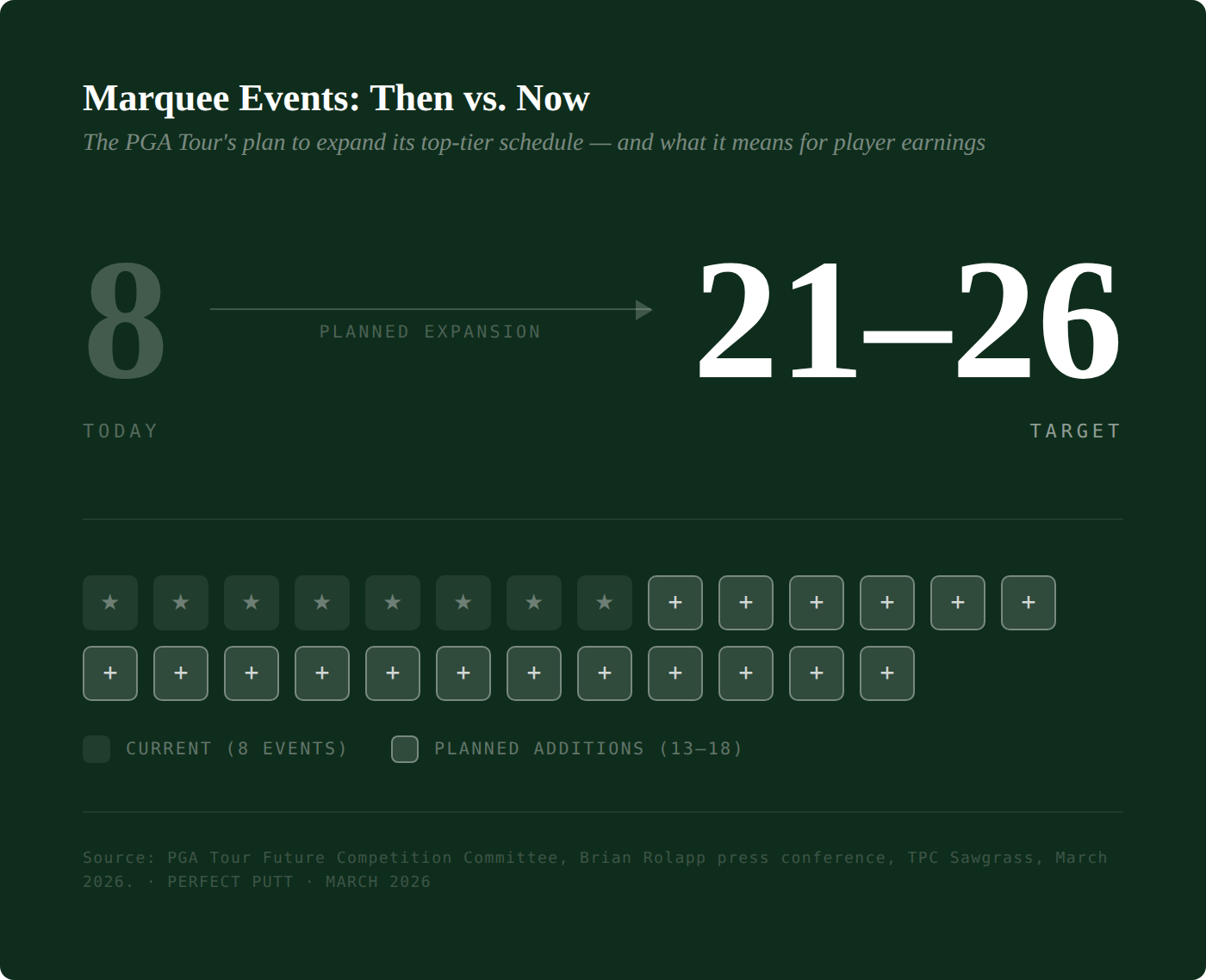
Doubling the number of marquee events isn’t just about more prize money on the table today — it’s about building a more valuable media rights package for the next deal cycle. Rolapp framed the competitive context directly: the U.S. sports media market totals roughly $30 billion annually. The NFL captures $12 billion of that and is publicly targeting $24 billion. For every other property in sports, that math demands urgent attention.
Prize money growth follows media rights growth. The Tour’s structural changes are, at their core, about making the product more commercially valuable. That’s what makes the equity stake meaningful, and that’s what ultimately moves the revenue share number.
The Honest Takeaway
Run the comparison cleanly and the conclusion isn’t that golf exploits its players. It’s that golf operates under a fundamentally different economic model — one that never had the union infrastructure to capture a guaranteed revenue share, but also one that offers something no team sport has figured out how to deliver: actual ownership.
The gap in revenue share is real and measurable. The floor for lower-ranked players is genuinely thin. But the trajectory — more marquee events, larger purses, better media positioning, equity upside — is pointed in the right direction, and the pace of change has accelerated meaningfully under new leadership.
The $25 million sitting at TPC Sawgrass this week is part of the story. The revenue share percentage it represents is the more important number. Closing that gap is the work the Tour is now explicitly trying to do.
The best way to support Perfect Putt is to share it with a friend.