
Golf's Biggest Creators Just Launched a $1 Million Tour
The economics of creator golf, the CPM arbitrage, and why capital is flowing to a third tier of sports media.
Golf is a $140B+ industry. We break down what's actually driving it. Welcome to the new members who've joined since last week — you're now part of a growing community of 10,000+ golfers who follow the business of the game. If someone forwarded this to you, subscribe below.
Read Time: 6 minutes
Where the New Audience Lives
Broadcast television remains the economic backbone of professional golf — CBS, NBC, and ESPN’s nine-year, $6.3 billion media rights deal with the PGA Tour proves it. But a parallel distribution layer has matured alongside it, and the economics are fundamentally different.
Grant Horvat and the Bryan Bros. just announced a four-event creator golf circuit called Your Golf Tour — YGT — with a $1 million finale at Wynn Las Vegas. Sixteen of YouTube golf’s biggest names. Four captains. Multiple seasons planned.
The instinct is to dismiss this as content creators playing dress-up. But look at the economics underneath it — and a mispriced layer of the golf media ecosystem comes into focus.
The Cost of Attention
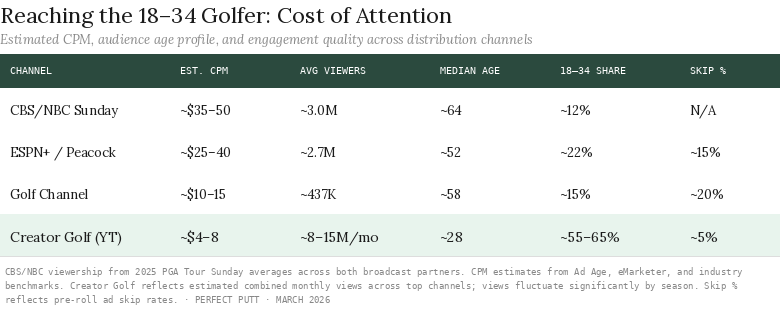
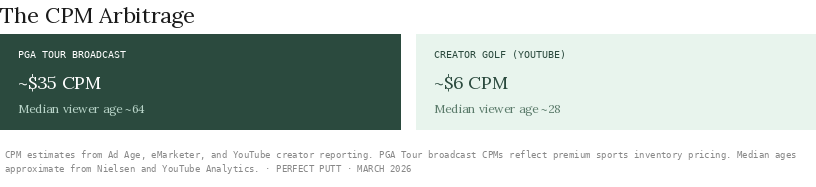
The CPM gap across distribution channels is roughly 6x — an estimated $35–50 on PGA Tour linear television versus $4–8 through creator golf on YouTube. The audiences are structurally different: the median broadcast viewer is 64 with roughly 12% falling in the 18-to-34 range; the median creator golf viewer is 28, with 55–65% under 35.
These are complementary products. CBS and NBC deliver an average of roughly 3 million Sunday viewers — the kind of concentrated live audience that remains irreplaceable for sponsors seeking mass reach. Horvat's channel generates roughly 8–10 million monthly views, though the number fluctuates seasonally with golf's calendar. The Tour's broadcast deal is priced on reach, scale, and live event exclusivity. Creator golf is priced on audience quality and the compounding shelf life of content. Both layers are attracting capital — with early signs of overlap across investor bases.
The Creator Golf Revenue Stack
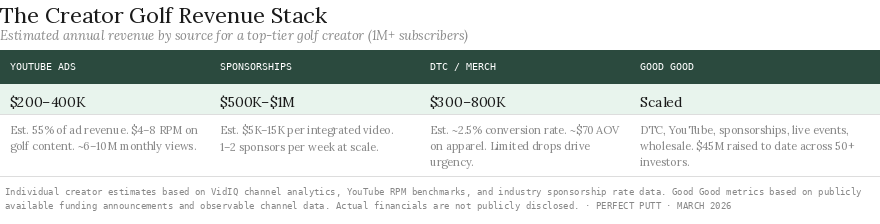
A top-tier golf creator with 1 million-plus subscribers operates across four revenue verticals:
- YouTube ads: $200–400K annually (estimated $4–8 RPM on 6–10M monthly views)
- Sponsorships: $500K–$1M (estimated $5K–15K per integrated video)
- DTC merchandise: $300–800K (estimated ~2.5% conversion on limited drops)
- Equity / affiliate: Variable; top creators increasingly blend OEM sponsorships with equity stakes in DTC brands, shifting monetization from commission-based endorsement toward ownership-aligned income
The Compounding Advantage – Every video is a permanent asset. Good Good can turn one tournament week into 100+ pieces of content. A single Horvat video generates views for years after upload. Traditional sponsorships depreciate on broadcast. Creator content appreciates on algorithm.
Good Good has scaled this model further than anyone else — and their trajectory tells you where the category is headed.
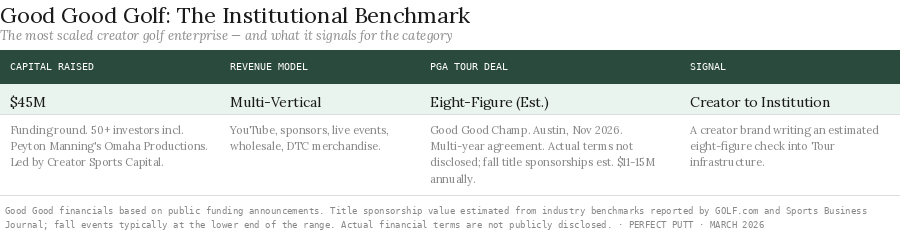
A creator-led brand raising $45 million in institutional capital and deploying it back into the Tour's competitive infrastructure — that's a sign of how deeply the two ecosystems are becoming intertwined.
What YGT Signals
Four events. Sixteen players. Four captain-led teams — Horvat, Wesley Bryan, and George Bryan captain three. The season opens at Pursell Farms in Alabama and ends at Wynn Las Vegas with a $1 million stroke play championship. Multi-year roadmap. Wynn as permanent finale home.
Wesley Bryan is a PGA Tour winner, currently suspended for competing in LIV Golf’s Duels influencer events. Rather than waiting for reinstatement, he’s building his own competitive circuit:
“Competitive golf is where we started. YouTube golf is where we’ve evolved. We believe there’s a place for both.”
YGT’s real significance is the economic model underneath it — and it’s one of four models being tested in creator golf right now.
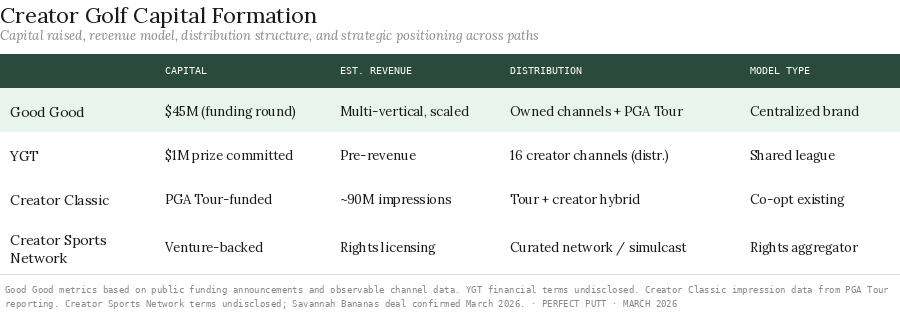
Two of these models extend the existing institutional framework. Two build adjacent to it. All four are being built and, in different ways, capitalized — and the most likely outcome is convergence, not competition.
The Third Tier
The global sports economy runs roughly $2.5 trillion, with media rights at its center. Creator Sports Network's Savannah Bananas deal — four live games distributed through a curated creator network — effectively establishes creator distribution as a third tier in the rights stack, alongside linear and streaming.
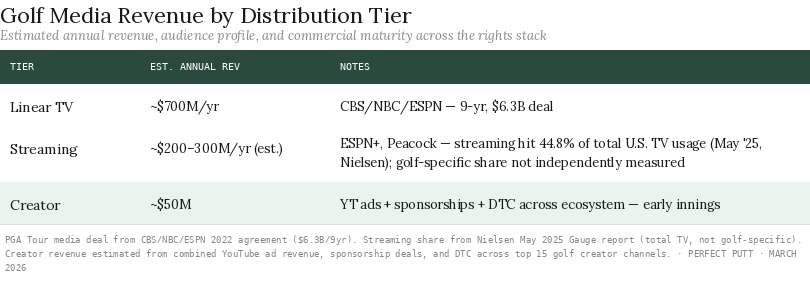
Creator golf captures an estimated ~5% of golf media revenue today — but commands an estimated ~55–65% of the 18–34 audience. That gap is the arbitrage.
The chart tells the story. In May 2025, Nielsen reported that streaming accounted for 44.8% of total U.S. television usage — surpassing broadcast and cable combined. That figure captures all TV, not golf specifically, but the directional shift is clear: viewers, especially younger ones, are migrating to digital platforms, and golf is unlikely to be the exception. The infrastructure shift is real. The business model is catching up.
The Takeaway
The audience acquisition problem is solved — the monetization question is open. Creator golf has captured the 18-to-34 demographic. The Creator Classic generated over 90 million impressions across social platforms, and the Tour expanded from one event to three in a single year. What doesn’t yet exist is a proven model that converts creator reach into durable, recurring revenue at scale.
Creator golf compounds differently. Every video is a permanent asset. Good Good can turn one tournament week into 100+ pieces of content. At $4–8 RPM, a video that accumulates 2 million lifetime views is worth an estimated $8,000–16,000 in ad revenue — before sponsorship and DTC attribution.
The trust premium is becoming quantifiable. Ad rates in verified creator environments can command an estimated 2–3x premium over algorithm-driven content. As creators build deeper, more consistent audience relationships, that trust carries measurable economic value — and advertisers are beginning to price it in.
The Final Shot
Creator golf captures an estimated 5% of golf media revenue today but commands a majority of the sport’s youngest audience. The PGA Tour's $700-million-a-year broadcast deal and the $45 million Good Good raise exist in the same ecosystem, separated by economic logic that is starting to converge. That gap will narrow.
The next generation of golf consumers is building alongside the institutions that have always served the sport — and the smartest operators on both sides recognize the opportunity. The question for brands, sponsors, investors, and the Tour itself isn’t whether this layer matters — it’s where to deploy: sponsor a creator, invest in a league, partner on distribution, or build it internally. The capital decision is now — and the window to act early is narrowing.
The best way to support Perfect Putt is to share it with a friend.