
Frost Delay by Perfect Putt
Cam Young came from four back to steal The Players, Rolapp unveils the Tour's ambitious restructuring plan, and we do the math on whether The Players actually deserves the fifth major conversation
Happy Monday. You’ve got back-to-back calls today — we get it. Tell them your Zoom is running long and give yourself five minutes.
Welcome to the first edition of Frost Delay — Perfect Putt’s new Monday morning read. The name felt right. Mondays at work, you’re looking for any excuse to grab time to yourself, take your eyes off a calendar that already looks like a crime scene, and do something that doesn’t involve a status update. This is that thing.
Every Monday we’ll get you caught up on everything that happened in golf over the past seven days. Tournaments, business news, what’s worth paying attention to this week. In and out.
Starting now, two gears:
- Mondays — Frost Delay. Last week in golf. Five minutes. You’re welcome.
- Thursdays — Perfect Putt. The weekly deep dive on golf’s business and economics.
Zoom’s still “running long.” Let’s go.
Did someone forward you this email? What a legend. Smash that button below.
On the course
USA wins The Ryder Cup The Players
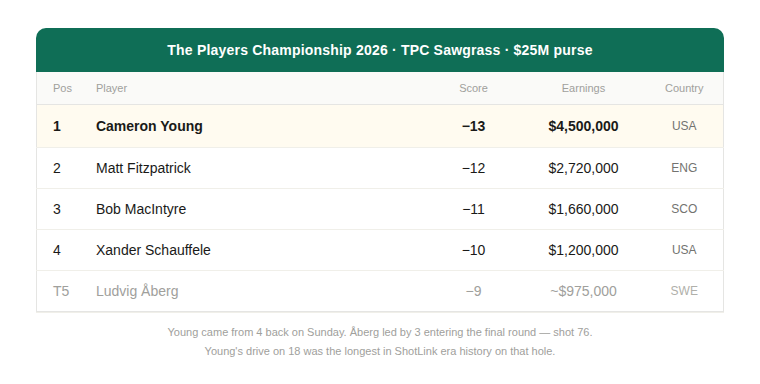
In what played out as a Ryder Cup final match, Cam Young came from four shots back on Sunday and hit what ShotLink measured as the longest drive in the history of the 18th hole to close out a final-round 68 and a winning total of −13.
Matt Fitzpatrick was second at −12. Bob MacIntyre third at −11. Xander Schauffele fourth at −10.
Ludvig Åberg, who led by three entering Sunday, shot 76. Found water on the back nine. Finished T5.
Let’s be clear about something: Åberg did not lose The Players. He had it taken from him by TPC Sawgrass on a Sunday afternoon, which is basically what that golf course does for a living. But the 40 on the back nine will follow him into Augusta in three weeks, and the questions about his mental game under final-round pressure — questions that feel a little unfair for a 26-year-old — are now officially on the table.
As for Cam Young? He’s 28, a Ryder Cup veteran who beat Justin Rose 1UP at Bethpage, and has spent the last two years quietly fixing a putting stroke that used to be a liability. Sunday was the payoff. He deserves every bit of it.
Bryson wins in Singapore. Rahm calls the DP World Tour’s fines “extortion.”
Bryson DeChambeau won LIV Singapore at −14, but only after Richard T. Lee gave it back by missing an 18-inch putt in regulation that would have won it outright. Lee will not be sleeping well this week.
Jon Rahm finished fifth, but his most notable contribution was off the course — publicly calling the DP World Tour’s fines for LIV participation “extortion.” He reportedly still owes roughly £2.5 million in penalties for playing LIV events.
Here’s the thing: Rahm is not wrong that the situation is messy. But calling it extortion while you’re playing in a league backed by sovereign wealth is a bit like complaining about the restaurant service while you’re eating for free. The governance dispute is real and unresolved. The victim framing doesn’t quite land.
Rory said Rahm’s deal sounded generous and pointed out that eight of nine LIV players accepted it. He was diplomatic about it. He was also correct. (The Times)
The business of golf
Everyone wants to call The Players a major. So let’s look at the receipts.
Cam Young took home $4.5 million on Sunday. Nice week. But the more interesting number isn’t what the Tour paid out — it’s what the tournament pumps into the Jacksonville economy just by existing.
The Players generates somewhere between $152M and $234M in economic impact for Northeast Florida.
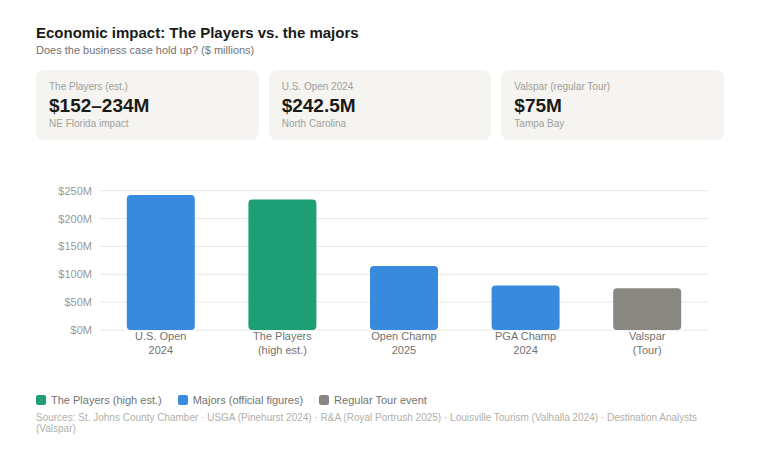
The U.S. Open at Pinehurst in 2024 delivered $242.5M to North Carolina — the USGA published the study. The Open Championship at Royal Portrush in 2025 generated £89.2M in direct impact, per the R&A. The PGA Championship at Valhalla came in at roughly $80M for Louisville.
The Players sits right alongside golf’s actual majors on that chart. Which raises an obvious question: if the economic case is this close, why does the “fifth major” debate keep going in circles?
The answer is disclosure. The USGA and R&A publish detailed, itemized post-event breakdowns — visitor spending, jobs supported, airport traffic, the works. The Tour publishes chamber-sourced estimates and calls it a day. That’s not a knock on the tournament. It’s a note on the homework. If Rolapp wants The Players in the major conversation — and his Wednesday press conference made clear he does — commissioning and publishing the same quality of economic data the governing bodies produce would do more for that argument than any marketing campaign. Show the work. The numbers are already there.
📈 The market
Wait — there are only two golf stocks?
Yes. Two. The entire publicly traded golf universe fits on a Post-it note, which is either a massive opportunity or a sign that the industry has historically been very good at avoiding Wall Street’s gaze. Probably both.
Anyway. Neither of them had a good week.
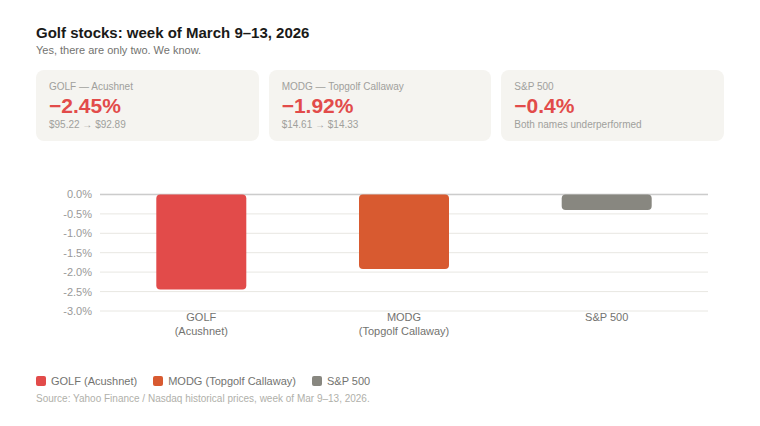
Acushnet (GOLF) dropped 2.45%, from $95.22 to $92.89. Topgolf Callaway (MODG) fell 1.92%, from $14.61 to $14.33. The S&P 500 declined roughly 0.4% — both names underperformed. No company-specific news drove either move. This was macro.
The structural stories behind each stock are pretty different, though.
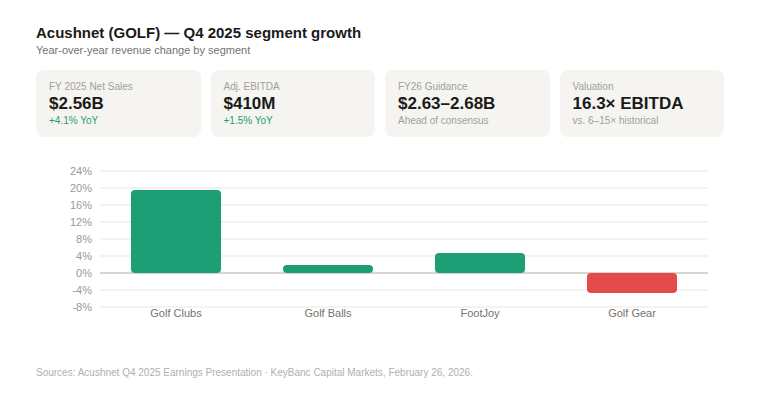
Acushnet is a genuinely strong business. FY2025 net sales: $2.56B, up 4.1%. Q4 Golf Clubs grew 19.5% on new product momentum. FY2026 guidance came in ahead of consensus at $2.63–2.68B. The issue is valuation — KeyBanc notes the stock is trading at 16.3× FY2027E EBITDA, above its historical 6–15× range. There’s also a ~$40M tariff headwind in 2026 that management expects new product launches to offset. Current analyst rating: Sector Weight. Bull case: $120. Bear case: $70.
MODG is a restructuring story. The stock has been recovering from a multi-year drawdown after the Topgolf merger, and the near-term catalyst is the separation: Topgolf Callaway agreed to sell a 60% stake in the Topgolf entertainment business to Leonard Green & Partners at roughly $1.1B. That’s a notable markdown from original acquisition pricing, but the deal is expected to close in 2026 with proceeds going to debt reduction and share buybacks — which is exactly what the balance sheet needs.
⚡ Quick hits
AI answers the phone at your golf course — but make it Faldo. GOLF.AI launched its Concierge Agent this week: a 24/7 AI booking system for pro shops, voiced by Sir Nick Faldo, deployable in five minutes for free. The pitch is that courses can’t afford to miss calls during peak hours, which is true. The celebrity voice choice is interesting — presumably someone ran the numbers and concluded Faldo closes more tee times than Mike Tirico. Debatable! But if your 68-year-old member is going to trust a robot with his Saturday morning tee time, a six-time major champion is probably the right voice on the other end of the line.
GolfPod: all the Toptracer, none of the acreage. The world’s most compact technology-led range opened its first UK facility on March 9 at Cranham Golf Course in Upminster, with a national rollout planned. The pitch is simple: full Toptracer experience, fraction of the footprint. In a country where land costs a fortune and golf demand is real, squeezing a proper range into a corner of an existing facility is either a great access story or a real estate workaround. Probably both.
Are today’s golf courses too samey? Golf Club Atlas — the internet’s spiritual home for architecture nerds — had a spirited debate this week on whether modern course design has become unoriginal. The thread started with a Garrett Morrison post on The Fried Egg and spiraled from there. The short version: a lot of new courses look like they were designed by the same Pinterest board. It’s a fair critique, and the business implication is real — in a market where course differentiation drives membership, destination travel, and media coverage, “it’s really good but also kind of like the last five courses we played” is not a ringing endorsement.
Hannah Green ends a 12-year Australian drought. Green won the Australian Women’s Open, the first home champion at the event in over a decade. Didn’t make many headlines stateside. Should have. The women’s game in Australia and Asia-Pacific is attracting real sponsor and broadcaster attention, and events with local champions tend to generate the kind of engagement that actually moves the commercial needle.
What to watch this week
The Valspar Championship tees off Thursday. The week after The Players is always a bit of a comedown — smaller field, lower stakes, Tampa Bay instead of Ponte Vedra. But Valspar has quietly built one of the best atmospheres on Tour at Innisbrook, and with the Masters three weeks out it’s a useful form guide. Watch who shows up hungry versus who’s already mentally at Augusta.
TGL holds its playoff semifinals Tuesday night. Tiger Woods’ tech league wraps up its debut season this week with semifinal matches at SoFi Center. The regular season pulled surprisingly solid TV numbers for a concept most people weren’t sure would work. Whether the playoff audience holds — and what ESPN does with those numbers heading into renewal conversations — is the real story worth tracking.
The Masters invite list quietly finalizes. The field for Augusta is essentially set at this point. Worth checking who’s in, who’s on the bubble, and whether any of the LIV players who remain eligible — Rahm, DeChambeau, Garcia — show up. The Masters doesn’t care about your tour affiliation. It cares about your world ranking and whether you’ve won the right things. That always makes for an interesting entry list.
Frost Delay drops every Monday. The Perfect Putt deep dive drops every Thursday. If this is useful, share it with a member of your foursome.